
By what kind of death

The lectionary Gospel reading a couple of Sundays ago — for the Sunday I was to lead worship — was John 21, about Jesus’ appearance to his disciples on the beach at the Sea of Tiberias. I’ve always loved this story, with its many sensory details, fascinating dialogue, and even bits of comedy. And, of course, the notion of breakfast with the risen Lord.  So, in preparing for the Sunday ahead, I was enjoying this text, from the fishing scenes through the meal through the three-time “Do you love me” question to Peter and on into 

Truly, truly, I say to you,
when you were younger,
you used to gird yourself,
and walk wherever you wished;
but when you grow old,
you will stretch out your hands,
and somebody else will gird you,
and bring you where you do not wish to go.

And continuing on to

Now this he said, signifying by what kind of death he would glorify God. And when he had spoken this, he said to him, “Follow me.”

Which brought me up short.

First of all, what’s this talk about death, when this is a story of resurrection? Everything here, from a net teeming with fish to the aroma of a charcoal fire, brims with life. Miracles and love are once again in full display, and now this reminder (for them, and us) of dying?

But also: by what kind of death he would glorify God? Tradition says Peter also died by crucifixion, and commentators link Jesus’ proverb-like description to that. (I also see, for the first time, via a commentator’s note, a reason for the detail earlier in the story about Peter pulling on his outer garment and jumping into the water to stride to shore — an indication that he was still a man quite capable of dressing himself, and a man who walked where he wished.)

But whatever it meant for Peter, the description sounds much too much like my father’s death, like his last years, that once strong and independent man now reduced to the most adject helplessness, being taken everyday where he wished not to go. It also sounds like the place a favourite aunt has reached, dependent in a hospital bed and her once gentle personality drastically altered.

This kind of dying doesn’t connect for me — not logically at least — with “glorify God.” Dad’s moment of death had beauty, yes, and relief, but what about the years of dying before it, locked away from us and from his own memories, in some prison we couldn’t penetrate, which seemed to give no glory at all, not to himself or his Creator?

And yet these words jumped out at me, and I knew if a demeaning death and giving glory to God were combined here for Peter, that somehow the combination could be seized, and trusted, for my father’s death, and my unknown one as well. I’ve asked God, I’ll confess, for certain privileges, like a clear mind to the end, and a ripe old age, but not too ripe, though long enough to finish up all my projects, of course, and it would also be nice to have enough notice to get my house in order (six weeks?), and a scene out of one of those pious old novels would be a bonus — you know the one with the family round the bedside, sweet final blessings, and songs… Who wants to be killed by a bus, or transition through the long bleak tunnel of Alzheimer’s?

No one. But we don’t get to choose, and until it’s indicated by what kind of death we will glorify God, we’ve got this, an invitation to whatever it may be: “Follow me.”

In honour of David Ewert

Today I want to say a few words in honour of David Ewert, longtime Bible teacher, preacher, and writer, who died Friday, April 23, in Abbotsford, B.C. (Winnipeg Free Press obituary here.)

I was not a student of Dr. Ewert. My interactions with him were mainly during my years at the MB Herald, in the capacity of editor to writer, and in this capacity I found him not only willing to serve whenever asked, but wonderful to work with as well. His copy was always on time or early, and so precisely written it needed virtually no editing at all. Last year, when we asked to reprint an article, “Does the resurrection make a difference in everyday life?” which had first appeared more than 20 years earlier, and said that we needed to shorten it and also update bits of the language here and there, he readily granted permission, and trusted us to make the changes. To my recollection, he said he didn’t even need to see the revised piece, although we sent it to him for his review anyway. He was polite and somewhat formal in his correspondence, but he never failed to include some affirming or grateful word about the ministry of the magazine, and coming from him, this was valued encouragement indeed. 

But my larger gratitude concerns David Ewert’s place in our denomination, where he was known not so much personally as broadly, by all of us, for his many contributions. He was born in 1922, served the Mennonite Brethren and wider church some 70 years: 25 years at the Mennonite Brethren Bible College in Winnipeg, and also as professor at Eastern Mennonite Seminary in Harrisonburg, Virginia, at Mennonite Brethren Biblical Seminary in Fresno, California, and as visiting teacher in other schools in North America and internationally. He preached in many churches, and wrote more than 20 books.

According to the short biography of him by Bruce Guenther with Kevin O’Coin, carried in the recent Leaders Who Shaped Us, Ewert’s influence and leadership were particularly significant in the transition of Mennonite Brethren in North America out of “their isolated, often rural, ethnically homogenous communities” into a more urbanized and outward-looking ethos. He “defined and embodied the convictions of the Mennonite Brethren church,” write Guenther and O’Coin, but “helped to move [it] away from both a particular, and often exclusive, German-Russian ethnicity, and from aspects of American fundamentalism that some had found attractive.”

Some years ago I read, and enjoyed, David Ewert’s autobiography, A Journey of Faith (Kindred, 1993). I want to mention two things that I’m grateful he impressed upon the MB denomination. One concerns his influence in weaning us away from the dispensational approach to the Bible and into a sounder understanding of the Book of Revelation. No question, he admitted, caused as much controversy in his experience as teacher and preacher.

Having discovered the wonderful continuity of God’s saving plan for humankind in the Bible, I lost interest in the eschatological intricacies of the dispensational school. I had disposed of Larkin’s eschatological charts long ago…. Since I found no evidence from the New Testament for dividing up the return of Christ into two “comings” (the rapture and the Day of the Lord), and that, in fact, the “last days” had begun in the first centurey, I was spared speculating about which current events might be signs of the imminent return of our Lord. As far as I was concerned, the establishment of the state of Israel in 1948 had nothing to do with the blessed hope of the believer. However, for such views I was called interesting names. I still have a folder full of letters denouncing my “heretical” views on eschatology. My book “And Then  Comes the End” allayed some of these criticisms, when it was discovered that I held to every fundamental teaching of the New Testament on eschatology. What was missing was the nonsense that goes under the guise of “prophecy” (such as date-setting, or determining from political, sociological and economic developments how close we are to the end.)

I’d grown up with those charts too but was not sorry either to see their demise. A large one drawn on cloth hung on the wall of the conference archives room for some time, where it recalled for me, whenever I saw it, the intensity of this interest in the past. But its being there also symbolized the move away from the “nonsense” that had beguiled and consumed us for a time.

The other item of gratitude I want to mention concerns Ewert’s attitude about study and the life of the mind, which may currently be suffering some loss of emphasis in our denomination, and of which he wrote: 

I have found that one can bury one’s head in a lexicon and come out with the glory of God…. It didn’t happen over night but I see it more clearly now than in my younger years, that intense academic efforts do not endanger a person’s devotion to God. In fact, I have found the opposite to be true. When one offers one’s academic activities up to God as a daily sacrifice, they become a means of grace. My patience tends to wear thin when I encounter students who in the name of piety shy away from the rigors of study.

May the work and memory of David Ewert continue to be blessed among us.

Claiming a blessing

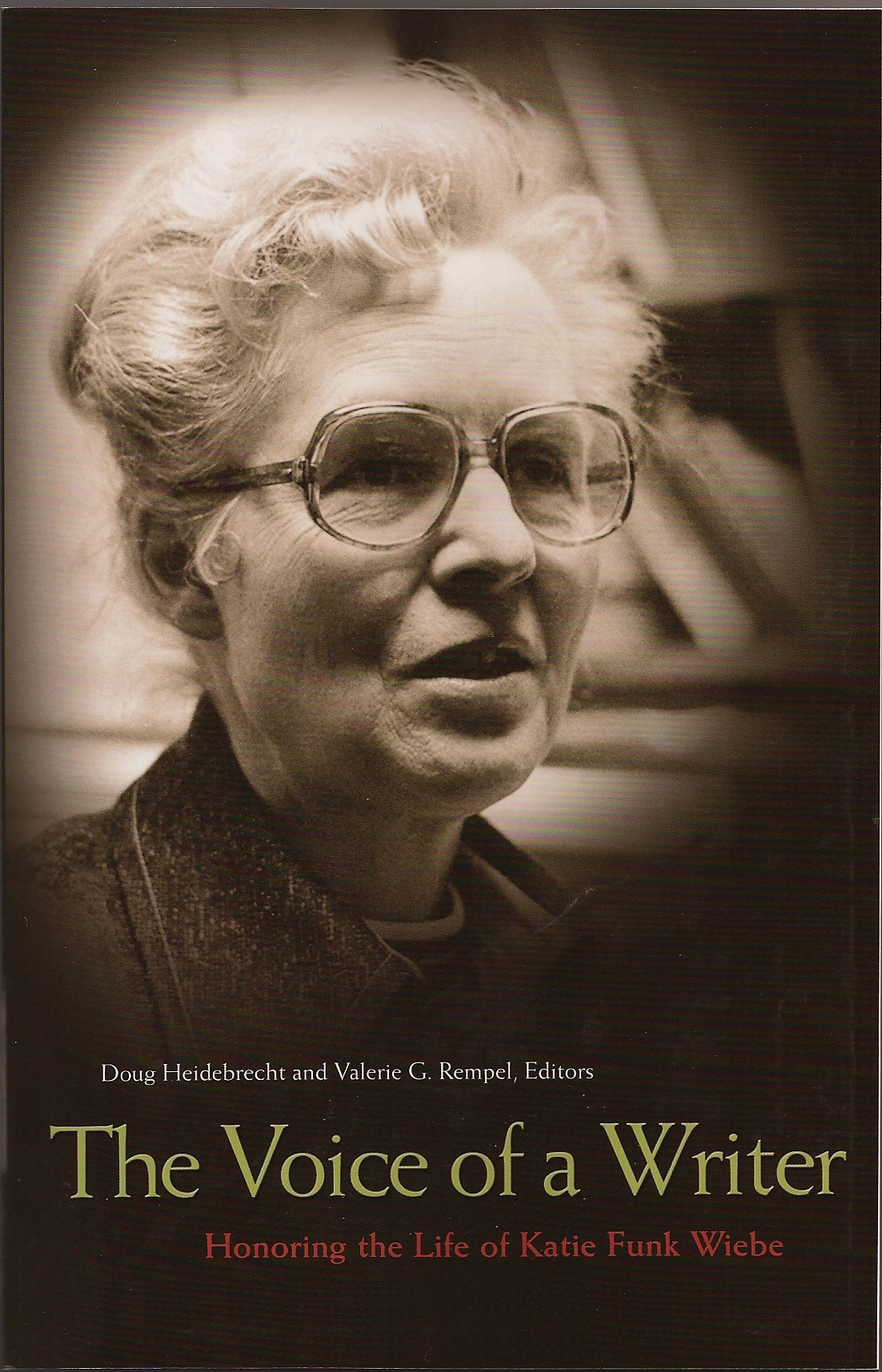
Katie Funk Wiebe longed for a blessing from her church — the Mennonite Brethren — and she’s getting it tomorrow evening (April 24) at Tabor College, Hillsboro, Kansas, with the presentation of a festschrift in her honour: The Voice of a Writer: Honoring the Life of Katie Funk Wiebe, edited by Valerie Rempel and Doug Heidebrecht.

I’ll be reviewing the book for the MB Herald, but I haven’t read it yet. Instead, after finishing the biography of Gloria Steinem mentioned in an earlier post, I re-read Funk Wiebe’s own telling of her story, in You Never Gave Me a Name (Cascadia, 2009). I’d read it in manuscript form in order to contribute a blurb for the cover, but wanted to come back to it in book form.

Which I’ve done….

The title strikes me as unusual, even a little odd. But it’s provocative, and in that provocation leads directly into the arc and accomplishment of Katie Funk Wiebe’s  life.

The plain name she was given by her immigrant parents didn’t seem nearly sophisticated enough for the dreams of the talented young woman; she preferred Kay. When she married, she became Mrs. Walter Wiebe, and when he was ordained, she was Mrs. Rev. Walter Wiebe, both names marking a certain (increasing) status but hiding her own. As a professor at Tabor College she was Mrs. Wiebe at first, and then as formalities disappeared for a new generation, simply Katie.  To her children she was Mom. Then, as a writer and speaker she used Katie Funk Wiebe, and gained name recognition.

Other things were given her: a particular heritage; a church unsure of its identity (evangelical, Anabaptist, fundamentalist?) and limiting of women; and the challenges of widowhood, single parenting, and college teaching. Inside what she was given is implied all that she wasn’t given as well — which she had to discover,  wrestle with, accept, or create.

In the “namelessness” of being a widow, a woman in the Mennonite Brethren church, and an older person, Katie Funk Wiebe named herself. She knew the loneliness of being set aside, hidden, unblessed, but she persevered to assert herself, to speak up for herself and others, and to claim blessing for herself even when it wasn’t granted by people or institutions. Continue reading