
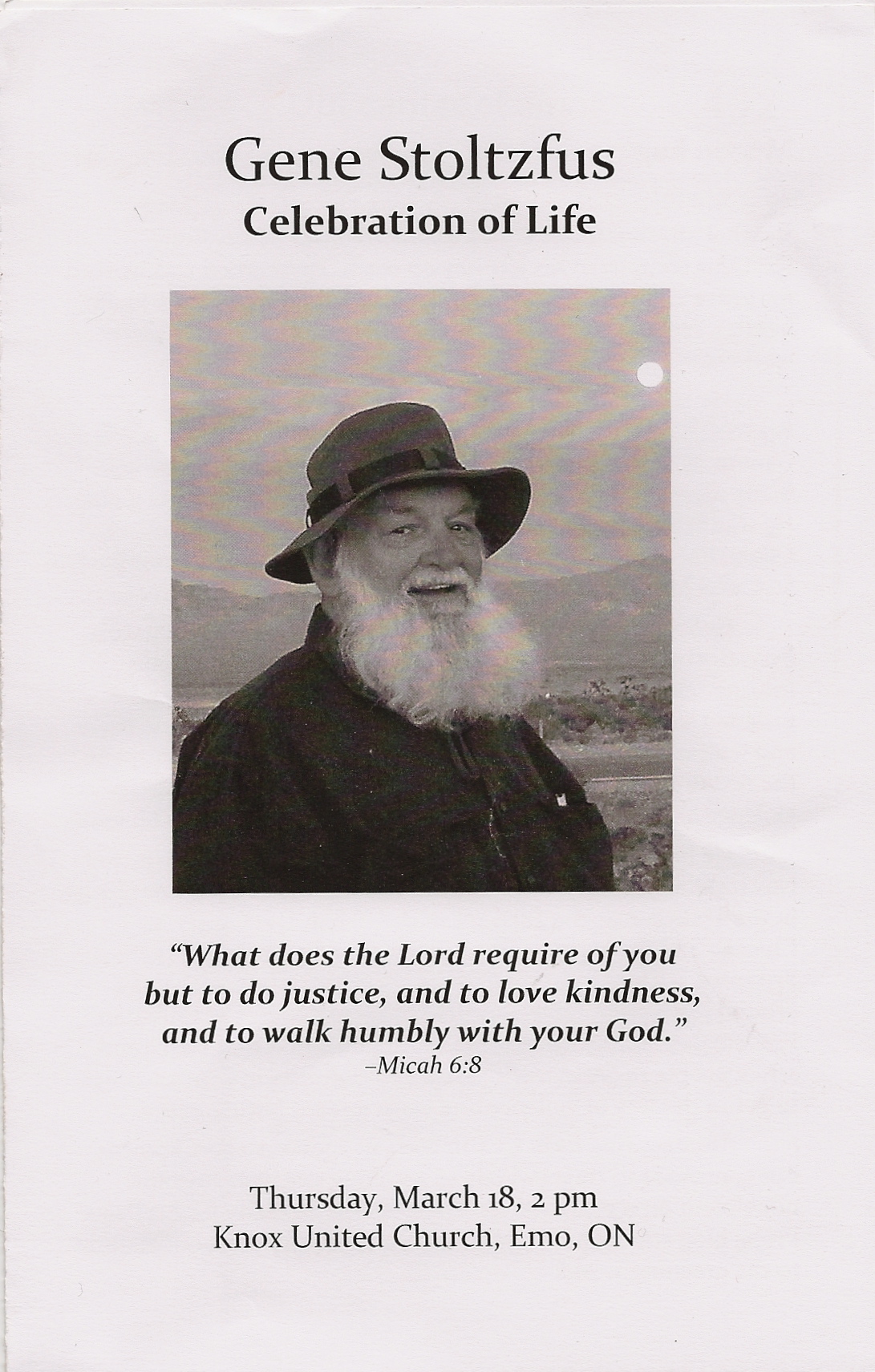
Gene Stoltzfus: celebration of life service

Last Thursday, I attended the celebration of life service for long-time peace activist and founding director of Christian Peacemaking Teams for 16 years, Gene Stoltzfus (1940-2010), which was held in Emo, Ontario.

The service was relatively small, as Stoltzfus and his wife Dorothy Friesen now lived in Fort Frances, Ontario, some distance from family roots and former places of work such as Chicago, where they resided for many years. (Memorials will also be held in Goshen, Indiana, and other places.) So it felt intimate and informal, with some of his favourite songs (including multiple singings of “Ubi caritas et amor” – “where charity and love are found, God is there”), Scriptures upon which his work was based, words from his writings, and many personal remembrances.

We sat in a kind of oval shape around a table with flowers, candles, a twig basket he had fashioned, and the copy of the Martyrs Mirror passed on to him by his father, which was so significant in shaping who be became. He spoke of this in his last article at his blog, Peace Probe, but also a May 4, 2006 column called “Beyond Imagination.” Continue reading
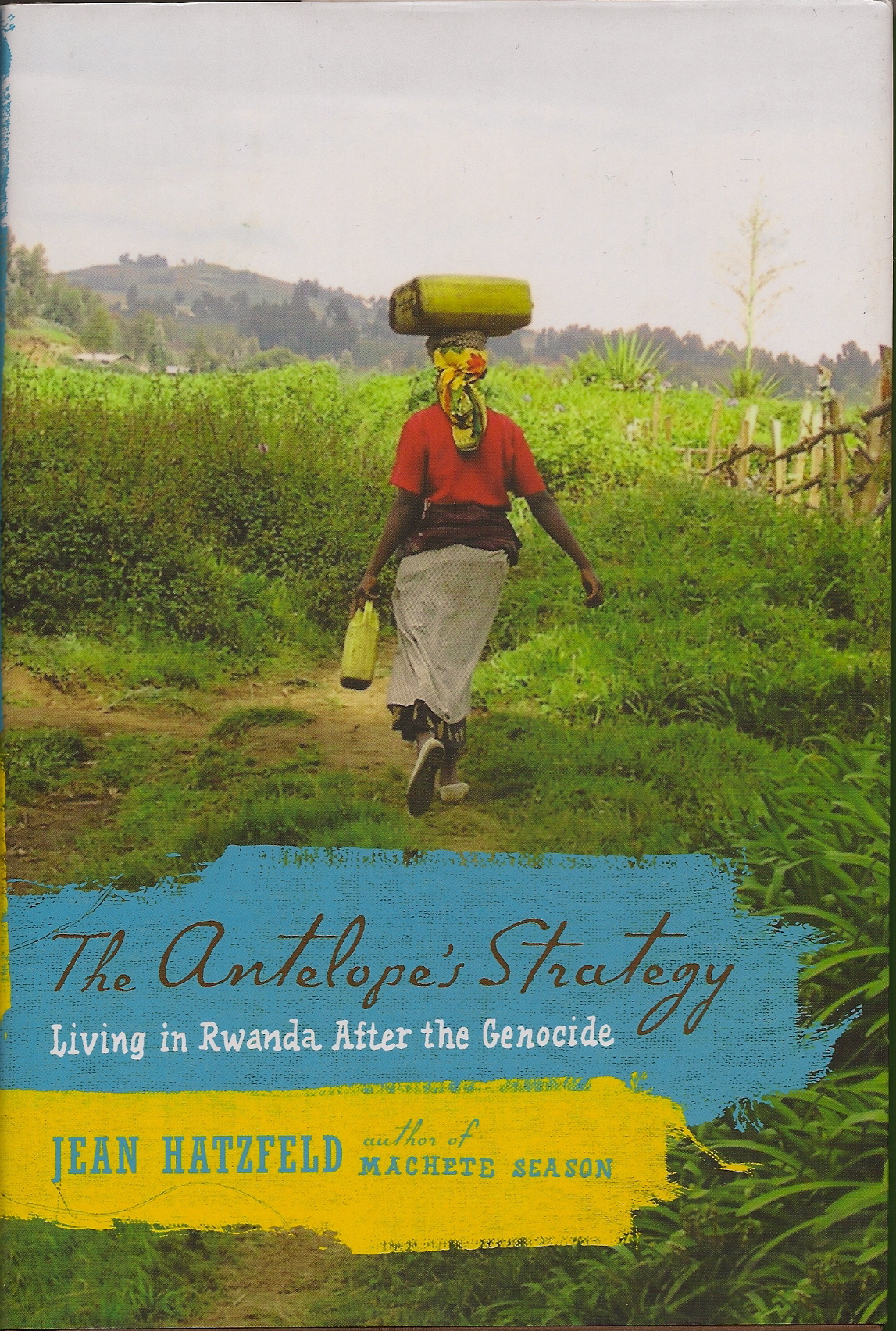
Living, speaking, side by side (Rwanda 4)

(To conclude the series on Jean Hatzfeld’s books on the Rwandan genocide.)

In the Nyamata district of Rwanda, many Tutsis trying to escape Hutu killers during the Rwandan genocide of 1994 hid in the mud and foliage of papyrus swamps. Those who fled to the much less dense Kayumba forest had to rely on running for their lives. Said one,

When the killers seemed to be upon us, we’d scatter in all directions to give everyone a chance: basically, we adopted the antelope’s strategy.

In this his third book on the genocide, French journalist Jean Hatzfeld adopts some of that same “scattering” strategy to give us a sense of what life is like now, some 15 years later, for both survivors and perpetrators, once again occupying the same hills and towns. What I mean is, Hatzfeld tells one story with this perspective, and then another from that, describing one scene after another, until you feel that you’ve not stood in one spot with only one notion of things, but run about to many places and heard many. “Traces and encounters,” Hatzfeld calls them, as he picks up with many of the same people we heard from in his earlier two books, except that killers and survivors will now appear in the same book, side by side. Continue reading

The survivors speak (Rwanda 3)

(To continue the series on Jean Hatzfeld’s books on the Rwandan genocide.)

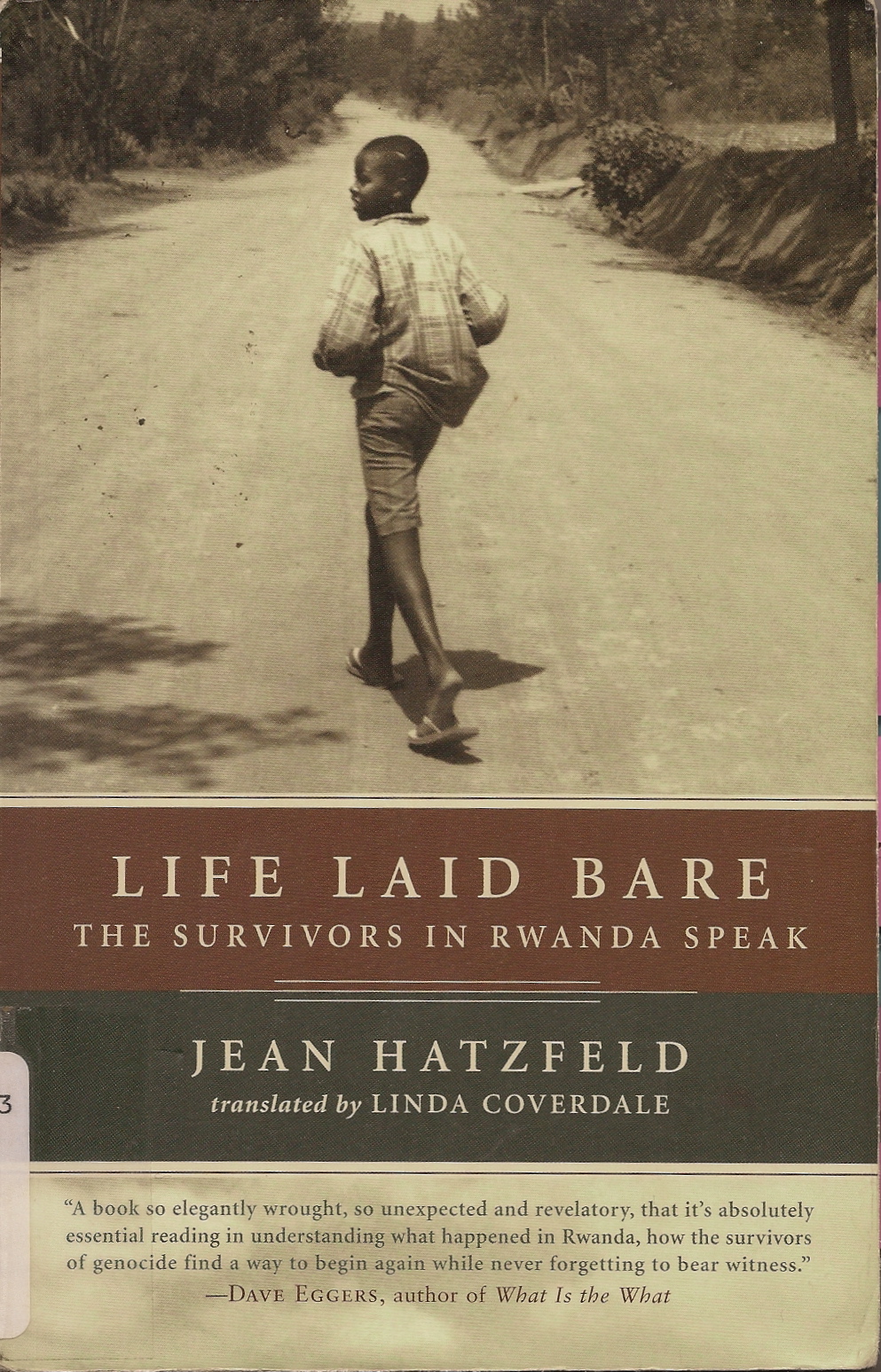
Life Laid Bare: The Survivors in Rwanda Speak has a sadder, more intimate feel about it than Machete Season (see previous post). One reason may be that author Jean Hatzfeld presents each person’s story, of the 14 people he interviewed in the Nyamata district of Rwanda, as a separate whole rather than grouping their various responses topically. He introduces them, places them with lovely description in the setting he found them at the time. A full-page photograph is included with each. (Twelve-year-old school boy Cassius also appears on the cover.)

This is not to say that the book doesn’t occupy the harrowing world of the genocide as do the killers’ accounts. The four men and 10 women speak — with sorrow, bitterness, or confusion — of seeing family members or children hacked to death, of lying in the mud of the Bugesera papyrus swamps while trying to escape notice, of hearing the killers coming for the day’s “hunt”– “announcing themselves with whistles and songs.” Continue reading