Grief and gratitude

On Monday this week, my father died.

That’s the easy sentence to write. Now what do I say?

I can say that in some deaths, grief so out-powers gratitude of any kind, the latter cannot be found until much later. In this one, there’s also grief, but gratitude rises more quickly to the surface — because my dad was a good man, because he lived a long life (88 years and 8 months), and because his last years were ravaged by Alzheimer’s disease (and I use the word “ravage” intentionally with all the meaning it holds: “to work havoc upon, to do ruinous damage”) and so we’d already been grieving slowly and subtly and I trust it won’t be surprising to hear that we’re relieved the suffering of that illness is over.

I’m also grateful I could be at his side when he died. Although Dad had been declining physically as well as mentally, that decline had accelerated in the past weeks. When we left for our Christmas holiday travel, I said good-bye as if I’d not see him alive again. By Christmas Day, he was expected to die before the day was out, but when we returned on the 26th, he was still breathing. He lived a further two days. The staff at the care facility marvelled: such a palpable shutting down, no responsiveness, and yet his heart kept beating. We who knew him were less surprised. Not only had he always been strong and athletic, but this persistence was symptomatic of his temperament. He had a stubborn determination about him; he was not a quitter. Whatever he’d committed to, whether it was his commitment to Jesus Christ at age 14 or his commitment to our mother more than 62 years ago, it lasted by virtue of diligent going-on with it, one hour after the other.
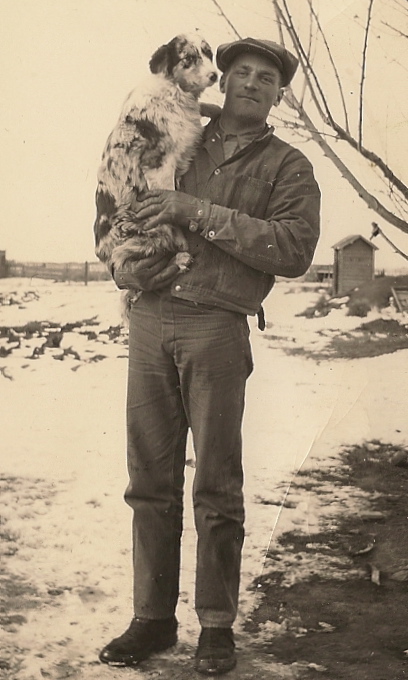
My dad as a young man, with Curly


Our last vigil at my father’s side was as much listening as watching. When life is so reduced, one only notices what’s left. In this case, it was his breathing. The day before his death, Dad would stop breathing for up to 30 or 40 seconds at a time, then resume a further round of it. The day of his death, another pattern ensued, with very few pauses but the breathing faster and shallower and noisier. While we waited and listened, my mother and whoever else was there passed the time talking, singing, reading. We often stroked Dad’s forehead or held a hand. Sometimes I found myself glancing from the black and white photograph on the wall, of my father as a lean young man, holding his dog Curly, to the shrunken body, mouth slack, eyes half open but seeing nothing. In his last hour, his extremities already cool and purplish, the eyes now open completely though still not seeing us (though “seeing” the unseen eternal, as per 2 Corinthians 4:18, perhaps), his breaths became very quiet and scarcely deeper than his throat. Then, each one quieter and shallower, they stopped.

On “The Road” by Cormac McCarthy

It was published in 2006, and I recalled of it only its central image as gleaned from reviews: a man and a boy trudging through a bleak post-apocalyptic world, pushing a shopping cart with all they own inside it. But now The Road has become a movie and it seemed urgent to finally read the book. I needed to let the author create the story in my mind before the filmmaker would.

Having done so this past week, I can only echo the praise lavished on this Pulitzer Prize winner. I did find the style somewhat jarring at first, McCarthy’s way of mixing complete and incomplete sentences inconsistent it seemed to me, but soon he had settled into something that worked better, or maybe I had simply settled into his language and cadence, caught up in the daily and wearisome journey of the two protagonists in that place beyond cataclysm, with its “creedless shells of men tottering down the causeways like migrants in a feverland” and “the banished sun circl[ing] the earth like a grieving mother with a lamp,” the long trudge broken by reprieves of food and warmth, but mostly defined by cold and hunger and suspense — a constant undercurrent of menace, the cannibal “bad guys” near, their evil intimated in horrors like the remains of an infant on a spit.

When I was done it, the story nagged at me as a parable does, with both understanding and confusion. Yes, I see, I do see, but what am I to know from this? What does it really mean? 

For me, as for many readers, the heart of the work is the relationship between the man and the boy — father and son. I loved their exchanges, cryptic but revealing, like outcroppings of love in the pervasive silence of the ashen desolation around them. Each occupies the positions one might expect of their roles as parent and child — the protective, reassuring father and the fearful, dependent child — and yet what makes these unnamed characters so resonant for me is that they don’t stay at stereotype or expectation. Each moves between wisdom and fear the way all humans will, regardless of role. The man is as needy as a child; he is often fearful; he often fails to get beyond an instinctive violence in his encounters with others. The boy can be as protective as a parent; he exhibits a moral conscience that judges his father’s actions; he grasps responsibility. When he is heartbroken over his father’s leaving a thief naked and robbed of everything, essentially to die, the man says, “You’re not the one who has to worry about everything,” and the boy says, “Yes I am. I am the one.”

The story seems a parable to me of being human — as parent or child — but engaged in the reciprocity and mutuality each generation in their humanness must experience with the other.  

“Don’t read [this book] now if you are feeling particularly fragile, especially if you are a parent,” said British writer Victoria Glendinning in this past Saturday’s Globe and Mail, choosing The Road as her pick for “book of the decade.” I’d advise quite the opposite, however. I think The Road is a book well suited for parental fragility and fears. Children know so much more than we realize, and we as parents often so much less. We must help each other through the ashes of what happens. We can’t ever really protect each other in a world so utterly unsafe (be it future, or the one we occupy now), except for the enduring safety of love. But we can love, can’t we?


Merry Christmas

It’s been almost two months since I jumped in to begin something I’d been thinking about for quite some time: this blog. It’s one of the ways I’m pursuing my writing vocation now and so far I’m enjoying it thoroughly. And I appreciate everyone who stops by.

I’ve been trying to get into something of a consistent routine in posting but there are exceptions for almost everything; hence this note. I’ll be enjoying the next week with my 10 favourite people (H., children, grandchildren) — all of us together for the first time in some years. So I won’t be writing — but I will be back again (Deo Volente) after Boxing Day.

A blessed and merry Christmas to all!