The travel I spoke of in my previous post is done and I’m safely back and getting over the jet lag and happily into the final layer of my adventure. The first layer is the anticipation, preparation, occasional worry, and perhaps (at least in this case) some research. The second and thickest layer is the experience itself. And then, home again, comes the opportunity to think back, to reflect, to remember, to realize how rich it was and at the same time, in terms of the limits of two weeks, how inevitably partial. Nevertheless, although I wasn’t entirely sure what to expect, I felt by tour’s end that it had more than fulfilled my hopes.
My son asked me for a highlight. I floundered a bit, because the best answer at that moment seemed “Everything!” but I pulled a sample by telling him about the free afternoon in Tbilisi when M. and S. joined me in my quest to find the particular view on Rustaveli Avenue featured in one of my grandfather’s postcards.  The card is labelled “La place de Golowine avec le temple de la gloire.” I had learned that the street was named Golovin Avenue after Russian commander Yevgeny Golovin in 1841, but re-named Rustaveli Avenue, after the poet Shota Rustaveli, in 1918, when Georgia declared independence from Tsarist Russia. As for the Temple of Glory, whose pillars and steps one sees, that used to be the Russian military history museum but is now the National Gallery. Thanks to M’s infallible sense of direction, we found our way out of the warren of small streets in Old Town where our group had lunched to Rustaveli, Tbilisi’s most prominent avenue, and we got this comparison shot. In the postcard, the avenue’s slight curve is obvious, but it’s there in the photo too, visible between the trees.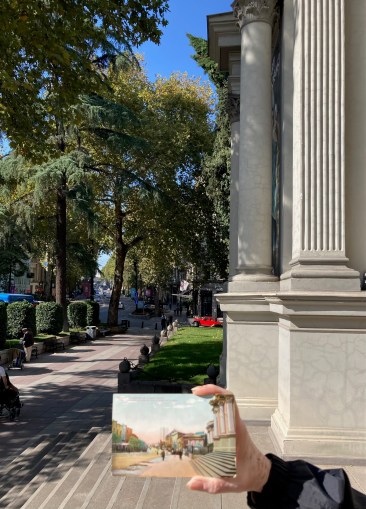
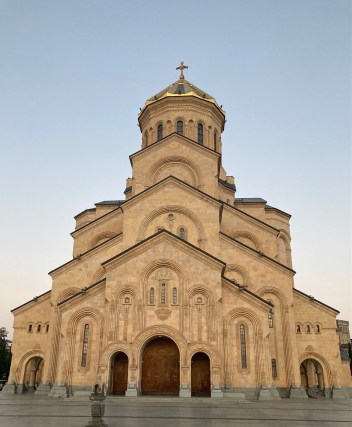
My quest done, M’s desire was for a sit-down with hot chocolate, which we accomplished by walking back into Old Town.That was lovely, and might have been enough — our legs and feet were tired and urging us back to our hotel — but S. longed to see Holy Trinity Cathedral, which hadn’t been on our Tbilisi itinerary. M. and I said we’d join her. Google Maps made it sound easier than it was, but we managed the walk, altogether driving my IPhone step-count up to nearly 24,000 that day. But it was all definitely worth it.

 One afternoon during my writing retreat at St. Peter’s Abbey this summer, our small band of writers needed a break so we drove into nearby Humboldt to check out the thrift store. There was nothing I needed and the book section, except for dozens of Danielle Steele novels, was sparse. As I wandered around, waiting for the others, a chalice in white and blue (perhaps my favourite colour) caught my eye. It’s clearly mass-manufactured, certainly nothing uniquely handcrafted, but just the day before I had mentioned the “chalice of our existence” quote to one of my new friends, and here was a chalice, humble and ordinary, for the grand and entirely affordable price of $2. I knew it was for me!
 Borrowing Bones