
“Atheist Delusions”: what I learned

I joined a book club this year — 4 books, 4 evenings with great desserts — led by Paul Doerksen, teacher at Mennonite Brethren Collegiate Institute, here in Winnipeg. On the menu tonight is Atheist Delusions: The Christian Revolution and Its Fashionable Enemies by David Bentley Hart.

It’s been a slog, frankly, reading this book, but that’s why one joins activities like this, I suppose — to persist in what’s good for one, not just the dessert! Hart takes on the current atheist apologists, none of whom I’ve read, and also considers in some detail the first four or five centuries of Christian history, with which I’m also not as familiar as I probably should be.

But here’s what I learned:

1. The current crop of church antagonists (Hitchens, Harris, Dawkins, Dennett, Pullman) are hardly worthy of the name. Theirs are “vacuous arguments afloat on oceans of historical ignorance.” The church used to have opponents of stature, of whom Nietzsche was the greatest, having at least had “the good manners to despise Christianity…for what it actually was — above all, for its devotion to an ethics of compassion…” 

2. The view of the past that modernity (whose “primal ideology” is nihilism) has given us — and one we’ve probably all absorbed — is just plain wrong. This false narrative, based on distorted history, tells us that the dark, confused Middle Ages gave way to “a new and revolutionary age of enlightenment and reason.” 

3. In fact, Christianity brought something entirely new and profoundly remarkable into the world (along with its single historical claim: Christ’s resurrection).  It was a “cosmic sedition” that gave “a vision…of humanity in its widest and deepest scope, one that finds the full nobility and mystery and beauty of the human countenance — the human person — in each unique instance of the common nature.” 

“For what it is to be human has been, in some real way, irrevocably altered.” 

This good news, he notes, evolving within a pagan culture of spiritual and moral decline, was “uncommonly attractive to women.” It imparted to the world “a deep and imperturbable joy.” And it started hospitals. (On the grounds of Christian charity, Hart gives not an inch — the range of Christians’ exertions on behalf of others was “astonishing.”)

Hart’s style is as vigorous and compelling as it is complex, and he has a magnificent capacity for what seems to me a kind of (usually) holy sarcasm. I’m tempted to quote him endlessly here, but first I want to hear how Paul Doerksen will pull Hart’s thesis together — he’s read the book at least twice — and what the rest of the participants of the group will have to say.
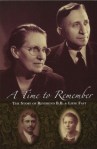
The biography of B.B. and Liese Fast

admin-ajax.php
Last night, another book launch, another biography: A Time to Remember: The Story of Reverend B.B. and Liese Fast, privately published, 2009). B.B. Fast (1896-1964) was a teacher (in Russia and in Springstein, Manitoba) and also a businessman (with the company of C.A.DeFehr, his father-in-law), and a  longtime church leader in NorthEnd/Elmwood Mennonite Brethren Church of Winnipeg.

He was someone whose “strong contribution was not that of a dynamic pulpiteer,” according to MB leader and family friend, J.B. Toews, “but as a person who provided the model of life which in itself became an exposition of biblical truth…the model in which character reflected the truth of his expositions.”

The book was written primarily for the children and grandchildren of B.B. and Liese Fast, and so the launch was at the home of B.B. Fast’s youngest — Bill and Margaret Fast. And the reason I was there? Well, I wrote the book. But I must hasten to say that this was one of those projects with many layers of participation from many people, dreamt of and begun a long time ago, while all five children (Bernie, Bettie, Neil, Nellie, Bill) were still alive. They gathered and organized various materials, and they and the older grandchildren shared their memories. Helen Isaak, Herta Voth, Margaret Harder researched different aspects of the story; I pulled it into a narrative.

When I saw the finished book last night, for the first time, I have to say I was amazed. It was a bigger book than I’d imagined, and so beautifully put together. To the story of their parents, the family added a 6-page introductory essay by Waldemar Janzen (“How Menonites Came to Live, Prosper, and Suffer in Russia”) and lots of photos, maps, and scans of family artifacts, including a gallery of colour photos of B.B. and Liese Fast’s current descendants. It feels both warm and elegant.

Only two of the children are still living — Neil and Bill — and they seemed especially happy last evening that this dream of theirs had been completed at last. It’s a great thing to honour one’s parents — and an honour to participate in a small way in their doing so.

“A Generation of Vigilance”

The other evening, I attended the book launch of A Generation of Vigilance (CMU Press, 2009), the biography of Johannes and Tina Harder by Ted Regehr. Harder was leader of the Yarrow MB Church, a congregation that grew from some 200 to well over 900 members, the largest Mennonite Brethren church in Canada at that point. For several decades, he was the most influential MB leader in B.C.

The launch was rather sparsely attended, but it was a fine evening in spite of the few of us. Regehr strikes me as both gentle and suave, and I enjoyed hearing him read and talk about the project. I’d skimmed the book when it came into the MB Herald office for review and enjoyed that too. (Said review, by Abe Dueck, will appear in the November issue).

Regehr explained how he got involved in the project. Missionary/anthropologist Jacob Loewen “felt he’d contributed to Harder’s death and wanted to make amends,” so began collecting material for a biography but was unable to finish because of ill health. Regehr had “high regard for Jake,” he said, and curiosity too, “to examine some of the same forces, in a place where I knew no one, that had troubled me in Coaldale [Alberta, where I grew up].” Regehr accepted the invitation of the Yarrow Research Committee to do the biography and enlarged it to include Tina.

At the launch, Regehr read, and talked about, 3 sections of the book: the couple’s courtship, their first (Canadian) years in Winnipeg, and the “Rules” he and prominent MB leader B.B. Janz of Coaldale wrote for the Mennonite Brethren. When Janz got Harder’s draft he responded by saying he’d forgotten the most important thing: love. The Regeln (rules) became Richtlinien (guidelines) and the English version referred to “principles.”

In the discussion that followed, someone asked about parallels between Janz and Harder. Regehr explained that Janz was older and not in church office when “the wineskins burst.” (That focussed on his successor at Coaldale, J.J. Siemens.) But for Harder, it happened during his lifetime; “many things to which he’d devoted his life collapsed.” He felt he’d failed.

Harder had become increasingly insistent on immersion for membership, and when the MB conference agreed to widen the category, he went out of the meeting with a terrible headache and told J.B. Toews, “If I was younger, I would start another church.” It puzzles, that he was so adamant on this, for his wife Tina was only re-baptized after they came to Canada, and in his family of origin, some had joined the MBs and others not. His brother became a General Conference (now called Mennonite Church Canada) minister. A puzzle. Or are these explanations?