
Our book club conversation

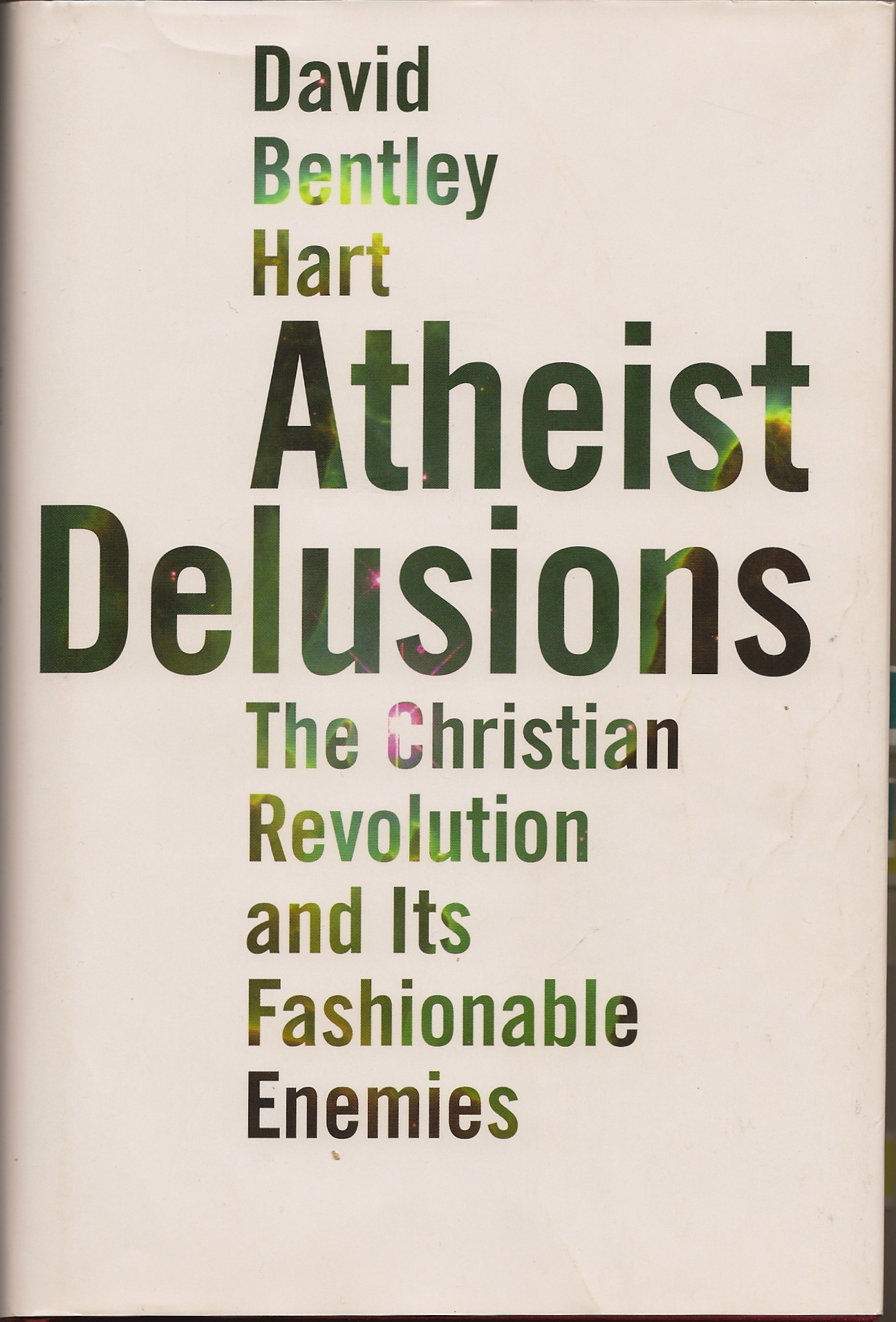
In my last post, I hinted that I might want to say a little more about Atheist Delusions: The Christian Revolution and Its Fashionable Enemies, and something too about the book club conversation last night.

Although there was a bit of grumbling about Hart’s page-long paragraphs and 50-word sentences, there was a recognition by most of us, I think, that this is a significant and mind-changing book. One participant called it “profound,” and another said, in its praise, that it “vigorously undoes alternative narratives I’ve carried with me.” Another, who knew Hart’s earlier book, The Beauty of the Infinite, and had found it somewhat show-offish, liked this latest tome very much.

Paul Doerksen, our host and leader, is a fan as well. (He also offered critique, especially some of the points raised by Paul Griffiths’ review of the book in First Things). He told us that Hart is considered one of the most brilliant scholars in the theological world today. “Period.” And this book, he said, is going to “linger” long after people have stopped reading the “Ditchkins crowd.” Not that the new atheists are anywhere close to the central concern of this book. They’re really more the occasion for it — and for Hart’s insistence that there’s another story and that it has to be told. It was good to hear Paul go through Hart’s thesis, chapter by chapter, as he identifies the false narrative of the Enlightenment we’ve been suckered into and then unfolds the one he’s convinced is true.

One point I’d not picked up in my reading was how strongly Hart’s Eastern Orthodox affiliation comes through when he talks about salvation in his chapter (15) on “Divine Humanity.” I guess by then my Anabaptist/Protestant antennae were tingling so much over his stirring account of Christian humanism (which surely all the Christian traditions share) — this “immense dignity–this infinite capacity…the transcendent possibility and strange grandeur present within each person” — that I missed the fine points of soteriological difference. (Then again, maybe I don’t know the fine points of soteriological difference!)

The enormity of that transformation of thought, of dignity, of caring is the heart of the story, and Hart hones in on it by drawing attention to a small biblical detail in a way that both surprised and moved me, a way that Paul Doerksen pronounced “achingly beautiful” and worth the price of the book. [SPOILER ALERT: if you haven’t read the book but intend to, you may want to come to this on your own and stop reading here.] 

That detail? Peter’s bitter weeping after hearing the cock crow the morning after he’d betrayed his Lord. Let me quote a little and leave it at that.

To us today, this hardly seems an extraordinary detail of the narrative, however moving we may or may not find it; we would expect Peter to weep, and we certainly would expect any narrator to think the event worth recording. But, in some ways, taken in the context of the age in which the Gospels were written, there may well be no stranger or more remarkable moment in the whole of scripture. What is obvious to us — Peter’s wounded soul, the profundity of his devotion to his teacher, the torment of his guilt, the crushing knowledge that Christ’s imminent death forever foreclosed the possibility of seeking forgiveness for his betrayal — is obvious in very large part because we are the heirs of a culture that, in a sense, sprang from Peter’s tears… To the literate classes of late antiquity, however, this tale of Peter weeping would more likely have seemed an aesthetic mistake; for Peter, as a rustic, could not possibly have been a worthy object of a well-bred man’s sympathy, nor could his grief possibly have possessed the sort of tragic dignity necessary to make it worthy of anyone’s notice… But…it is only in Peter that one sees [as literary critic Erich Auerbach noted] “the image of man in the highest and deepest and most tragic sense.” Yet Peter remains, for all that, a Galilean peasant. This is not merely a violation of good taste; it is an act of rebellion. [166-7]

“Atheist Delusions”: what I learned

I joined a book club this year — 4 books, 4 evenings with great desserts — led by Paul Doerksen, teacher at Mennonite Brethren Collegiate Institute, here in Winnipeg. On the menu tonight is Atheist Delusions: The Christian Revolution and Its Fashionable Enemies by David Bentley Hart.

It’s been a slog, frankly, reading this book, but that’s why one joins activities like this, I suppose — to persist in what’s good for one, not just the dessert! Hart takes on the current atheist apologists, none of whom I’ve read, and also considers in some detail the first four or five centuries of Christian history, with which I’m also not as familiar as I probably should be.

But here’s what I learned:

1. The current crop of church antagonists (Hitchens, Harris, Dawkins, Dennett, Pullman) are hardly worthy of the name. Theirs are “vacuous arguments afloat on oceans of historical ignorance.” The church used to have opponents of stature, of whom Nietzsche was the greatest, having at least had “the good manners to despise Christianity…for what it actually was — above all, for its devotion to an ethics of compassion…” 

2. The view of the past that modernity (whose “primal ideology” is nihilism) has given us — and one we’ve probably all absorbed — is just plain wrong. This false narrative, based on distorted history, tells us that the dark, confused Middle Ages gave way to “a new and revolutionary age of enlightenment and reason.” 

3. In fact, Christianity brought something entirely new and profoundly remarkable into the world (along with its single historical claim: Christ’s resurrection).  It was a “cosmic sedition” that gave “a vision…of humanity in its widest and deepest scope, one that finds the full nobility and mystery and beauty of the human countenance — the human person — in each unique instance of the common nature.” 

“For what it is to be human has been, in some real way, irrevocably altered.” 

This good news, he notes, evolving within a pagan culture of spiritual and moral decline, was “uncommonly attractive to women.” It imparted to the world “a deep and imperturbable joy.” And it started hospitals. (On the grounds of Christian charity, Hart gives not an inch — the range of Christians’ exertions on behalf of others was “astonishing.”)

Hart’s style is as vigorous and compelling as it is complex, and he has a magnificent capacity for what seems to me a kind of (usually) holy sarcasm. I’m tempted to quote him endlessly here, but first I want to hear how Paul Doerksen will pull Hart’s thesis together — he’s read the book at least twice — and what the rest of the participants of the group will have to say.

The biography of B.B. and Liese Fast

admin-ajax.php
Last night, another book launch, another biography: A Time to Remember: The Story of Reverend B.B. and Liese Fast, privately published, 2009). B.B. Fast (1896-1964) was a teacher (in Russia and in Springstein, Manitoba) and also a businessman (with the company of C.A.DeFehr, his father-in-law), and a  longtime church leader in NorthEnd/Elmwood Mennonite Brethren Church of Winnipeg.

He was someone whose “strong contribution was not that of a dynamic pulpiteer,” according to MB leader and family friend, J.B. Toews, “but as a person who provided the model of life which in itself became an exposition of biblical truth…the model in which character reflected the truth of his expositions.”

The book was written primarily for the children and grandchildren of B.B. and Liese Fast, and so the launch was at the home of B.B. Fast’s youngest — Bill and Margaret Fast. And the reason I was there? Well, I wrote the book. But I must hasten to say that this was one of those projects with many layers of participation from many people, dreamt of and begun a long time ago, while all five children (Bernie, Bettie, Neil, Nellie, Bill) were still alive. They gathered and organized various materials, and they and the older grandchildren shared their memories. Helen Isaak, Herta Voth, Margaret Harder researched different aspects of the story; I pulled it into a narrative.

When I saw the finished book last night, for the first time, I have to say I was amazed. It was a bigger book than I’d imagined, and so beautifully put together. To the story of their parents, the family added a 6-page introductory essay by Waldemar Janzen (“How Menonites Came to Live, Prosper, and Suffer in Russia”) and lots of photos, maps, and scans of family artifacts, including a gallery of colour photos of B.B. and Liese Fast’s current descendants. It feels both warm and elegant.

Only two of the children are still living — Neil and Bill — and they seemed especially happy last evening that this dream of theirs had been completed at last. It’s a great thing to honour one’s parents — and an honour to participate in a small way in their doing so.