Rich vocabulary for the beautiful game

Normally I’m not much of a sports fan, but for the big events like the World Cup, I also get involved, enjoying the televised dramas of athletes and nations, and the remarkable skillfulness and intricacies of what’s been called “the beautiful game.”

A bonus in this particular series is listening to the play by play commentary of the announcers (British they seem to be). I’m not the first person to mention this. Early in the series I recall a newspaper writer saying he’d taped an otherwise unremarkable game just to listen to the way it was called. The announcers have at their disposal a rich and fascinating vocabulary, drawn sometimes from the world of epic battle, sometimes from the earthy informality of schoolboys playing on a neighbourhood vacant lot, and it streams from them quite unstudied, it seems, as if they always talk in such vivid and varied ways.

I jotted down a few examples from today’s Ghana-Uruguay game. It was a “potentially crackling game,” though as the game progressed to its end with a tie, no prediction could be “forthcoming.” When one team did something well after a sluggish stretch, they were “rejuvenated.” A good opportunity stopped by the defense? They’d made “a total hash of that.” The Ghanians, it was declared, have “an insatiable appetite for work.” Something happened “in the winking of an eye” and a saved ball landed in the keeper’s “welcoming arms.”

It’s the game’s pace, perhaps, that leaves a little more room for adjectives than (our game) hockey’s “he gets the pass, he shoots, he scores.” One play was “a valiant job,” another “a heart-stopping moment.” On one play, the defenders not only defended but “bravely” defended.

Verbs of all sorts too, of course — strong and varied ones. Players “instigated” plays, the crowd was “roaring in anticipation” (and later, “had another blow on the vuvuzuela.”)

When Gyan missed the penalty kick in the last moments of overtime, he had his “glory snatched away, but he served his country well enough.” And when he stepped up for his turn at the deciding penalty kicks, “the whole of Africa [was] praying lightning doesn’t strike twice.”

Once, after a number of attempts on goal during regular play, the announcer said that no shots had been “particularly cogent.”

Did he just say cogent?

Beautiful game indeed.
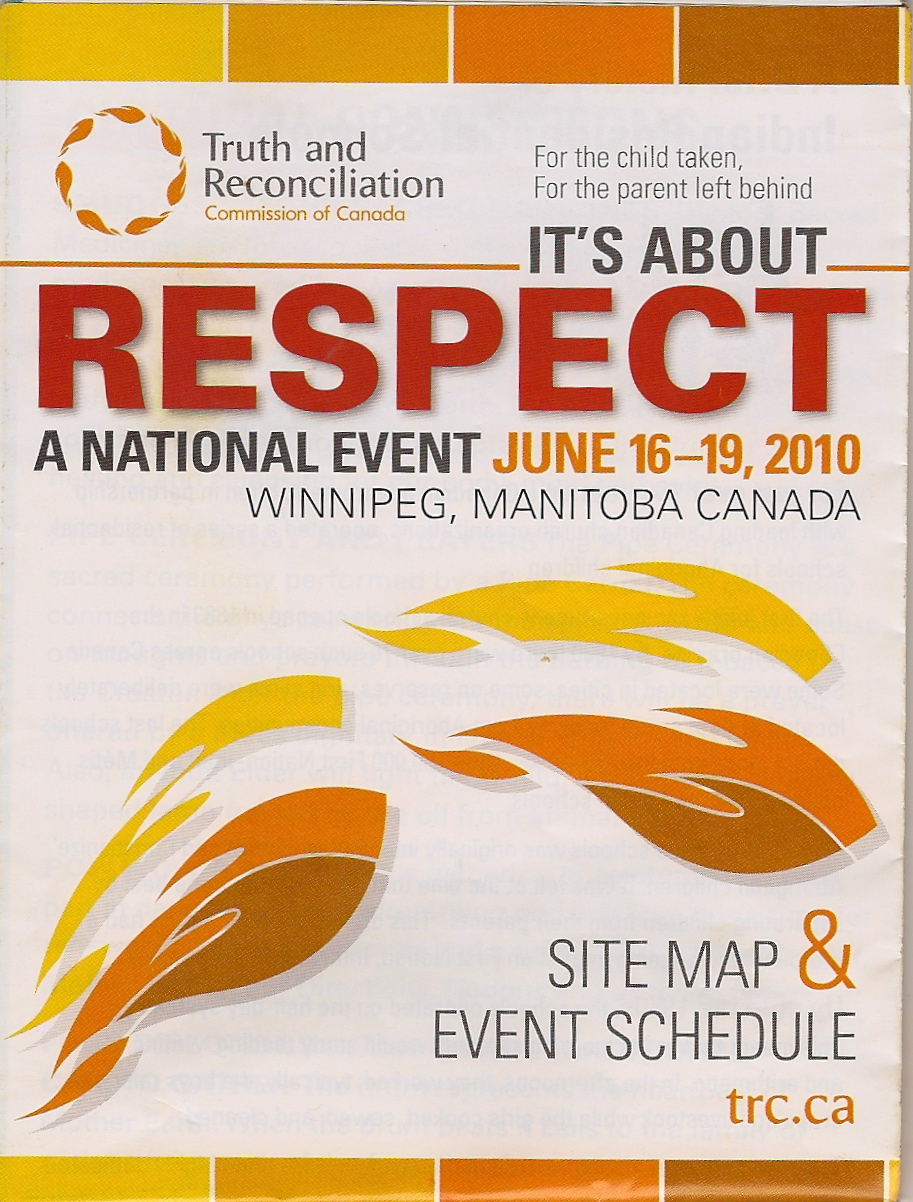
Truth and Reconciliation Commission: Days Three and Four

Day Three, rain and more rain, all day, and the large commissioner’s tent deserted because of the sogginess and the sharing circle moved into a room at the theatre building at the Forks.

The miserable weather affected attendance and some pieces of the event had to be cancelled. I don’t know whether it’s a cultural thing or just the underlying sombre nature of the event itself lending perspective, but I didn’t hear a single complaint about it, however. I was struck by this, it seemed so unusual. The only one who mentioned the rain, in fact, was a woman in the sharing circle, and she said she was thankful because it was adding tears to the sorrow of memories. And, said another, “we have many tears to shed.”

I was happy that H. could take some time from work and come with me. I would describe to him when I came home what I was seeing and hearing these days, but it’s different actually experiencing it together. We spent several hours witnessing the sharing circle, and also watched a new play by Ian Ross called “Fabric of the Sky.” The play was about a man who had not been a good father to his son because of his residential school experiences. Then as he finally opened up about it,  the gap between him and his son began to close.

The point of the play could hardly be missed and so it felt a little didactic, but still, it was well done, and the point does need emphasizing. We’d heard so much of that in the stories: as children finally learn and began to understand what their parents have gone through, they begin to understand and even forgive the ways in which they have also been damaged by their parents’ lack of love and other behaviours.

Day Four — today — and a lovely day, clear and sunny. I returned to the Forks for a few more hours of listening, this time to some conversation in the interfaith tent: “signs of reconciliation and reflecting on our experiences.” There were more than a few interesting moments here. Continue reading

Truth and Reconciliation Commission: Day Two

Day Two at the TRC event in Winnipeg (Thursday) was grey and rainy, a tempestuous contrast from the first day’s heat. It made no difference, it seemed, except that the women’s sharing circle was paused earlier than expected in the afternoon because of tornado warnings. (Fortunately, a tornado did not materialize.)

It was another full day. I began at the interfaith tent, which hosted a panel discussion on “Native traditional spiritualities in conversation with Christianity” and ended the day at “Writing Truth, Imagining Reconciliation” featuring a strong line-up of writers, including Basil Johnston, Beatrice Mosionier (In Search of April Raintree), and Giller Prize winner Joseph Boyden, speaking or reading from their work.

But the heart of the event is the sharing/healing circle, so once again I sat witness as best I could, first in the tent where there was a men’s circle, and then in the tent where there was a women’s.

What I was witnessing, I realized, was not only the impact of Indian residential schools, via the sharing of survivors, but a constant ministry of community support. A painted stone (painted by children) waiting on the chair of each person in the sharing circle itself, to hold while speaking. Traditional spiritual supports like opening prayers, “blessed” water to drink for participants, the smudge, eagle feathers. And more contemporary supports, like kleenex and the blue-vested “counsellor” people constantly in attendance. (Tear-soaked tissues are not garbaged but gathered to be offered on the sacred fire later in the day.) When the telling gets especially difficult, a family member (though everyone is addressed as “relatives” in the circles) might be standing behind the speaker, hand on their shoulder. Continue reading