
Grief and gratitude

On Monday this week, my father died.

That’s the easy sentence to write. Now what do I say?

I can say that in some deaths, grief so out-powers gratitude of any kind, the latter cannot be found until much later. In this one, there’s also grief, but gratitude rises more quickly to the surface — because my dad was a good man, because he lived a long life (88 years and 8 months), and because his last years were ravaged by Alzheimer’s disease (and I use the word “ravage” intentionally with all the meaning it holds: “to work havoc upon, to do ruinous damage”) and so we’d already been grieving slowly and subtly and I trust it won’t be surprising to hear that we’re relieved the suffering of that illness is over.

I’m also grateful I could be at his side when he died. Although Dad had been declining physically as well as mentally, that decline had accelerated in the past weeks. When we left for our Christmas holiday travel, I said good-bye as if I’d not see him alive again. By Christmas Day, he was expected to die before the day was out, but when we returned on the 26th, he was still breathing. He lived a further two days. The staff at the care facility marvelled: such a palpable shutting down, no responsiveness, and yet his heart kept beating. We who knew him were less surprised. Not only had he always been strong and athletic, but this persistence was symptomatic of his temperament. He had a stubborn determination about him; he was not a quitter. Whatever he’d committed to, whether it was his commitment to Jesus Christ at age 14 or his commitment to our mother more than 62 years ago, it lasted by virtue of diligent going-on with it, one hour after the other.
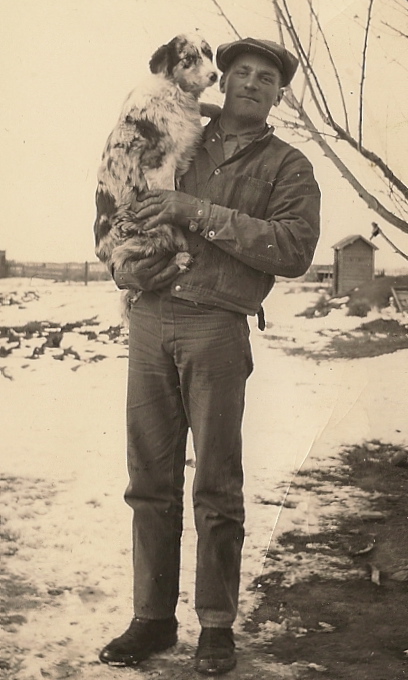
My dad as a young man, with Curly


Our last vigil at my father’s side was as much listening as watching. When life is so reduced, one only notices what’s left. In this case, it was his breathing. The day before his death, Dad would stop breathing for up to 30 or 40 seconds at a time, then resume a further round of it. The day of his death, another pattern ensued, with very few pauses but the breathing faster and shallower and noisier. While we waited and listened, my mother and whoever else was there passed the time talking, singing, reading. We often stroked Dad’s forehead or held a hand. Sometimes I found myself glancing from the black and white photograph on the wall, of my father as a lean young man, holding his dog Curly, to the shrunken body, mouth slack, eyes half open but seeing nothing. In his last hour, his extremities already cool and purplish, the eyes now open completely though still not seeing us (though “seeing” the unseen eternal, as per 2 Corinthians 4:18, perhaps), his breaths became very quiet and scarcely deeper than his throat. Then, each one quieter and shallower, they stopped.

Photos of the dead

Speaking of funeral customs — just this one more post on the subject, I promise, before I move on to something else!

I grew up taking for granted the family photograph around the body of the deceased. I saw such photos, and was in at least one of them (see below).

Since then, I’ve discovered through random conversations that this custom is by no means universal and actually rather shocking to some. And I’m not the only one. Googling, I see that Colleen Friesen in a recent column on her blog (Traveling Light) under “Mennonite Musings” remembers “the first time I found out that most people didn’t have photo albums full of dead people.” She was in Grade 8 and she and a friend were looking through albums, and her friend noticed and said it was “weird.”

I don’t necessarily find it weird — I’m used to it after all. But can anyone enlighten me on this? Is this something only Mennonites did? And if so, why they and not others?

sc005939ab

My siblings and me at our maternal grandfather's funeral, 1971


sc0058f51b

A family photograph taken with the body of my paternal great-grandfather, Peter D. Doerksen of Kleefeld, Ukraine, who died Dec. 5, 1912 at age 59. My grandfather, Johann, age 25, is standing third from the right.

Does the body need to be there?

The recent death in our family has me thinking, again, about funerals. Not so much the “plain” version as still practiced in smaller and more cohesive settings like the Mennonite settlements of Paraguay, as the ways in which we’re doing it here, in North America. 

Poet and undertaker Thomas Lynch, quoted in the previous post, notes “the disappearance of corpses in the funeral ceremony” and he’s not pleased. “These celebrations are notable for the fact that everybody’s welcome but the dead guy,” he says. “This, to me, is offensive and I think perilous for our species.”

Thomas G. Long, in a recent Christian Century article, “The good funeral,” here, complains about it too, this “entirely new pattern of memorializing the dead,” marked by: memorial services instead of funerals (remains not present), customized rather than clergy-centred rituals, focus on the deceased person’s life, emphasis on joy/celebration rather than sadness, private disposition of the body.

I don’t mean to go all Jessica Mitford-ish here but isn’t it a little disingenuous on the undertaker’s part? Didn’t the bodies disappear already, a long time ago, taken away from us into the North American funeral parlour, to be embalmed and suitably suited-up for their carefully controlled reappearance? 

Long’s article, which I found helpful for its tracing of customs in history, acknowledges as much. The problems to which today’s trends react also concern shifts that happened in the latter part of the 19th century. He says it wasn’t so much “the guild of embalming technicians” taking the funeral away, however, as “church and culture…more than ready to hand it over.” 

But I find myself “yes-but-ing” Long as well.

Cemeteries are separated from us now, he writes, not near the church to help us remember that “the living and the dead are part of one ‘holy communion’.” Yes, but those cemeteries next door could also be brutal displays of who was “in” and who was “out,” judgments we surely had no business making.

Yes, the public gathering is different when the order is reversed — a private burial followed by a memorial, or a service with the body there. But does that preclude accompanying the loved one on “the journey of Christian dead toward the life everlasting”? Can it not be done through the rituals of “the viewing” and the burial that we do?  

It seems to me that’s what’s important in the funeral as far as being Christian is concerned, is the content, the assertions of what we believe, whatever the order, body there or not. Saying, counter-culturally, that we believe there’s life after life on earth. I weighed in on aspects of this in an MB Herald editorial once, here, and want to think that with deliberation, we can do our funerals well, in spite of our inevitable shifts along with the wider culture. Or am I being too accommodating, too optimistic?