
Claiming a blessing

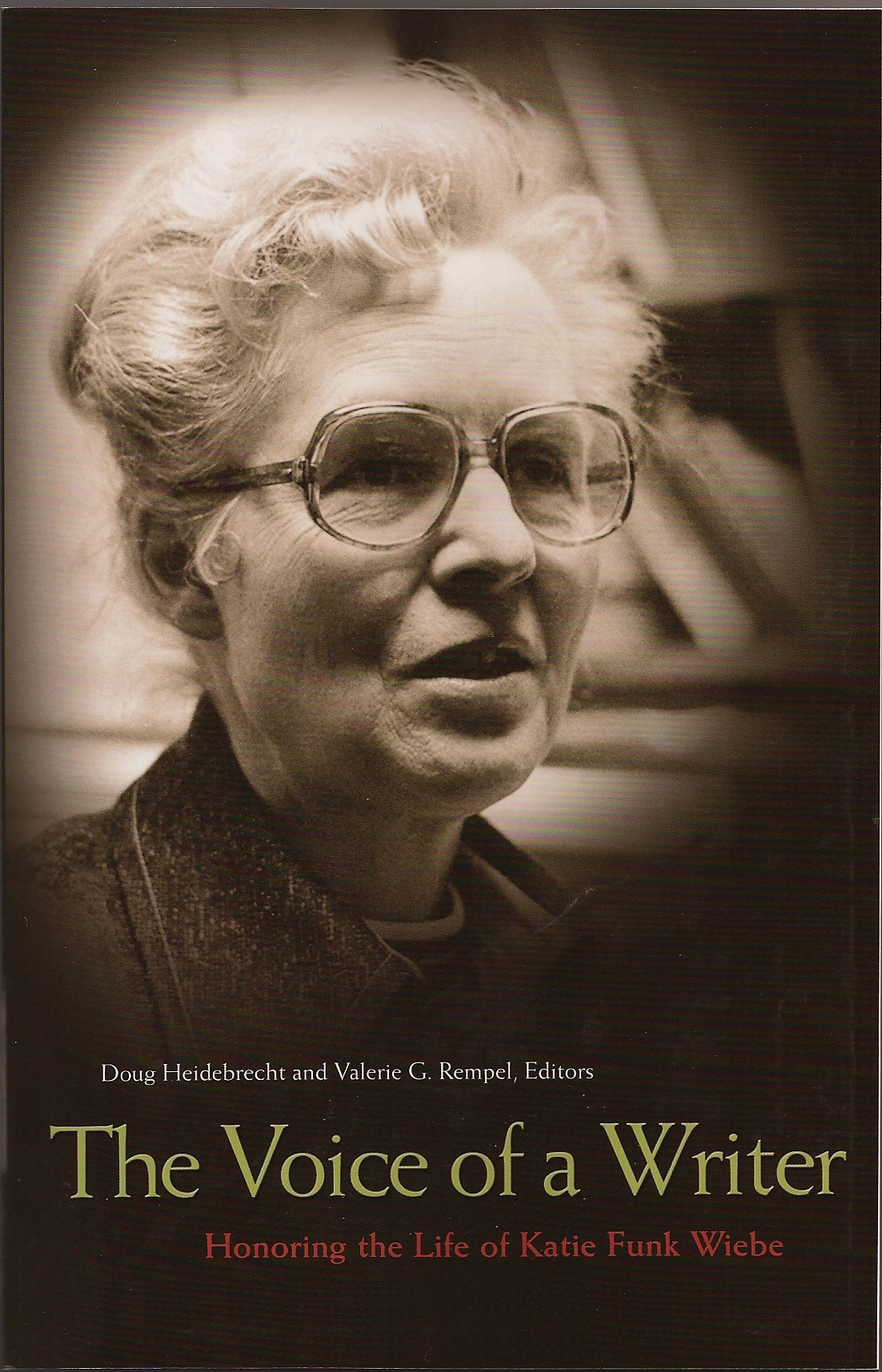
Katie Funk Wiebe longed for a blessing from her church — the Mennonite Brethren — and she’s getting it tomorrow evening (April 24) at Tabor College, Hillsboro, Kansas, with the presentation of a festschrift in her honour: The Voice of a Writer: Honoring the Life of Katie Funk Wiebe, edited by Valerie Rempel and Doug Heidebrecht.

I’ll be reviewing the book for the MB Herald, but I haven’t read it yet. Instead, after finishing the biography of Gloria Steinem mentioned in an earlier post, I re-read Funk Wiebe’s own telling of her story, in You Never Gave Me a Name (Cascadia, 2009). I’d read it in manuscript form in order to contribute a blurb for the cover, but wanted to come back to it in book form.

Which I’ve done….

The title strikes me as unusual, even a little odd. But it’s provocative, and in that provocation leads directly into the arc and accomplishment of Katie Funk Wiebe’s  life.

The plain name she was given by her immigrant parents didn’t seem nearly sophisticated enough for the dreams of the talented young woman; she preferred Kay. When she married, she became Mrs. Walter Wiebe, and when he was ordained, she was Mrs. Rev. Walter Wiebe, both names marking a certain (increasing) status but hiding her own. As a professor at Tabor College she was Mrs. Wiebe at first, and then as formalities disappeared for a new generation, simply Katie.  To her children she was Mom. Then, as a writer and speaker she used Katie Funk Wiebe, and gained name recognition.

Other things were given her: a particular heritage; a church unsure of its identity (evangelical, Anabaptist, fundamentalist?) and limiting of women; and the challenges of widowhood, single parenting, and college teaching. Inside what she was given is implied all that she wasn’t given as well — which she had to discover,  wrestle with, accept, or create.

In the “namelessness” of being a widow, a woman in the Mennonite Brethren church, and an older person, Katie Funk Wiebe named herself. She knew the loneliness of being set aside, hidden, unblessed, but she persevered to assert herself, to speak up for herself and others, and to claim blessing for herself even when it wasn’t granted by people or institutions. Continue reading
“Leaders Who Shaped Us”

I will, as promised in the last post, write about Katie Funk Wiebe and her book You Never Gave Me a Name, within the week I hope, but first this….

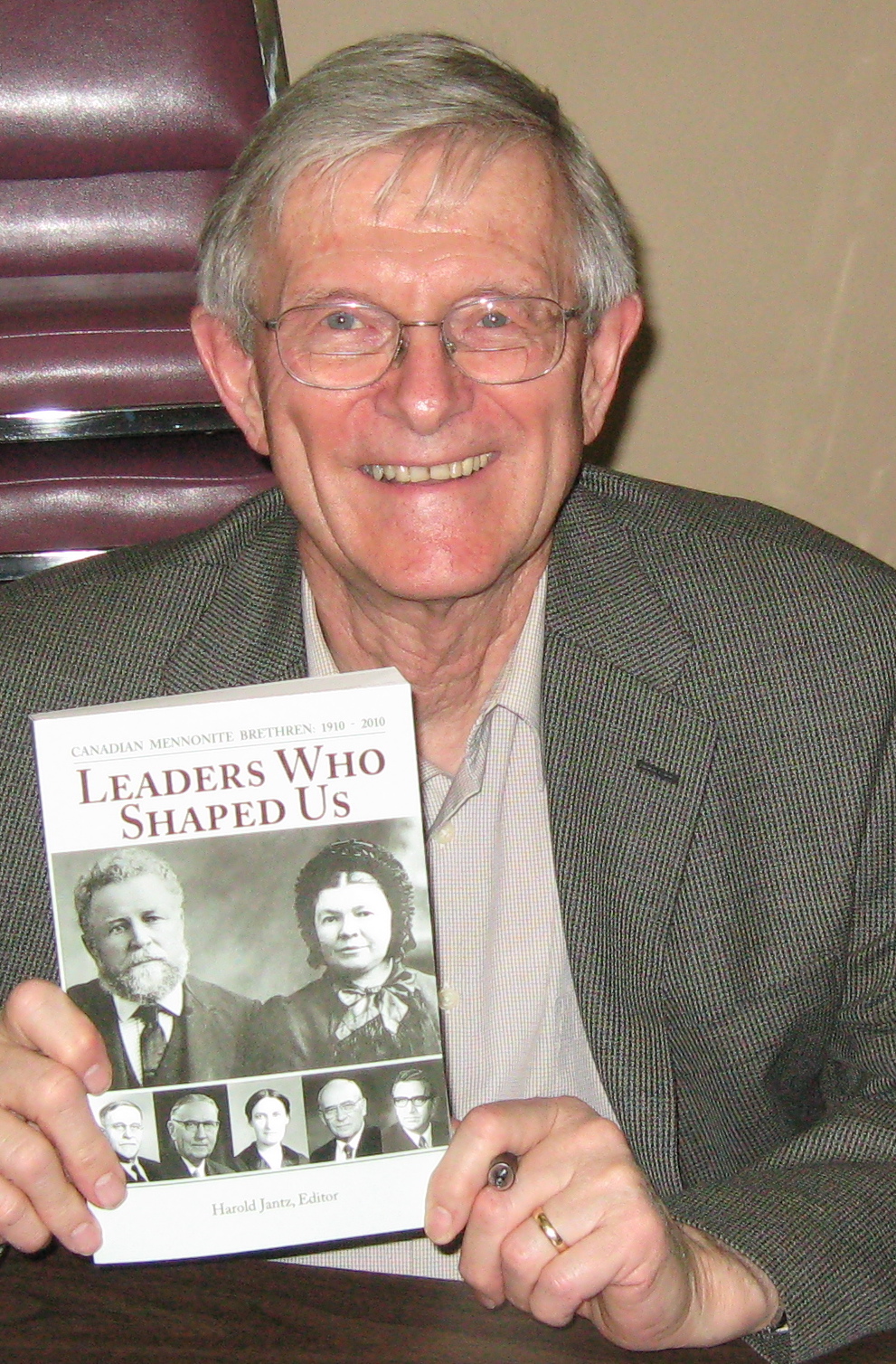
I’m just back from the launch of Leaders Who Shaped Us, a book of 25 biographies of Canadian Mennonite Brethren. (This year marks the 150th anniversary of the Mennonite Brethren denomination, and the centennial of the Canadian part of it.) Harold Jantz (left) planned the book, served as its editor, and also wrote six of the biographies. This evening, in his usual passionate and persuasive way, he highlighted the significance of some of them. Abram Kroeker, for example, not only a key early player in the potato growing industry of Manitoba, but a tireless promoter of Sunday school in churches, so much so that he became known as Mr. Sunday School. And entrepeneur C.A. DeFehr who was always on the scene, it seemed, when it came to building up the institutions of the church. 

It was while he was on holidays, Jantz said, and thus energized, that the idea for the book came to him. He realized that he knows a great deal of early Canadian MB history, and he also knows how quickly memory can disappear. He put together a list of 25 names out of a great many he could have chosen — 25 people who demonstrate influence and “shaping” of the Canadian church in various ways over the century. A number of the biographical subjects, including Herb Neufeld, John Redekop, Nick Dyck, and others,  are still alive. David Ewert, who is also written of in the book, is unfortunately very seriously ill following a stroke several days ago.*

Nineteen writers contributed to the volume in all, and those of us from Winnipeg who were around — Ingrid Koss, Dorothy Siebert, Sarah Klassen, Doug Heidebrecht, and myself — participated by reading a portion of our piece or talking about the experience of researching and writing our particular subject. I had written the article on B.B. Janz, “Moses” to some 20,000 Mennonites who managed to leave the Soviet Union in the 1920s and subsequently a leader in many aspects of Mennonite life here in Canada. I found him quite compelling. He was intelligent, sensitive, and persistent to the point of stubbornness. I liked his position on how conscientious objectors might have participated during World War II (as non-combatants, but providing service in the interests of life even on the battle front), though he annoyed conservative Mennonites by it and had no success with the government in developing such a program either. There was even a small personal connection, as my mother whispered to remind me after my little spiel tonight; B.B. Janz had ordained my father for church ministry.

I saw the completed book for the first time this evening. It looks great and I can hardly wait to read it.

Dorothy Siebert contributed 2 biographies: on Marie Wiebe and H.S. Rempel


Ingrid Koss wrote about Anna Thiessen


Doug Heidebrecht wrote about Katie Funk Wiebe


Sarah Klassen authored the story of missionary Katy Penner

 *David Ewert died April 23, 2010. See post in his honour.

The pieces we’re missing

A news article in the latest MB Herald, with the headline “MB seminary professor apologizes for remarks,” reveals that B.C. conference minister Steve Berg sent an email to the MB seminary (MBBS) board in November expressing “his concerns” that “Mark Baker states that penal substitutionary atonement is unbiblical.” The email also said, “In what is already a very challenging time for MBBS, we are concerned that there is a disconnect underway between BCMB churches and MBBS, and the atonement debate is accelerating the process.” 

The article describes and quotes Baker’s response to the B.C. executive and pastors. Baker sounds gracious and thorough in explaining what he believes and what he wishes he’d communicated more clearly, what he wishes he had not written. The content of it sounds very much like what he stated at the MB study conference in Saskatoon in October — the same affirmations, clarifications, attempts at nuance — though he goes further to address a number of his responses at the conference itself. At that event, he stated his first book will be revised. He also clearly affirmed the MB Confession of Faith, Article 5 on Salvation, and does so again in his letter. I attended and reported — here — on the Saskatoon conference. I don’t recall “‘unbiblical’ rhetoric.” I do know that Baker felt himself rather on the block, so to speak, which is never an easy place to be, and I do recollect that he responded carefully and with integrity to the challenges raised to him. 

My opinion on whether an apology is necessary is beside the point, however. He made it, and it needs to be received.

But, will it be received? Has it been? Maybe that’s what’s bothering me about this article. It’s not what’s here, but the pieces we’re missing. The back story. And what happened next.

Re. the back story, I’m wondering why Berg sent this email to the seminary board after the October conference, when Baker’s views had been clearly indicated there. Berg himself led the session in which Baker presented. Is there other pressure coming to the B.C. executive? From the two people Baker says he wishes he had responded to more affirmingly? From those who did not attend? What’s going on?  Berg notes an accelerating debate, but it’s hard to believe that Baker is responsible. And, to be honest, I’m queasy, fearing he’s being made the fall person. 

MBBS president Lynn Jost is also quoted in the article. He thanks the B.C. executive  for communicating their concerns directly with the seminary, and reminds of the seminary’s commitment “to biblical authority and to interpreting the Bible in a way consistent with the MB Confession of Faith.” This commitment, truly said and truly meant, is also not new. Has it been heard and truly received? I can’t help recalling Jost’s words at the MB Forum recently, about “the difficult position that a culture of suspicion raises for the Seminary.” 

Yesterday, I happened to be sorting through a pile of papers and came upon the candid words of a young B.C. pastor to the recommendation on women in ministry at Calgary some years ago. He intended to support the motion, he said, even though it hadn’t gone as far for full and equal participation as he wished. Because of that, it would require his own “self-control and respect of people who believe very differently.” He went on to say, “It will also require some of you to stop labeling me and others who believe similarly, as heretics or on a slippery slope to liberalism, or as being soft on ethics, or whatever other label you might use to write off people who hold a reasoned opinion that disagrees with your own.”

His words felt oddly familiar within this new context. There’s been labelling, baiting, mollifying of behaviors that foster a culture of suspicion, withdrawing of financial support. (The latter has always struck me as the most pernicious, and I’d even say ungodly, strategy individuals or churches can use to exert pressure, because it’s so powerful and puts others into danger not just economically but spiritually.) 

The letter has now been reported. But is there more we should know? And will there be other, good, responses to come?