For the Bolivian Mennonite women: a lament

Abe Warkentin of Steinbach recently sent a letter to editors of some Mennonite periodicals, expressing his concern about the raped Mennonite women of Bolivia (see more in this post ), which he also copied to me and to Leona Dueck Penner. Leona, a writer friend of mine, has been reading the Magnificat in Luke 1 in preparation to lead worship in her church on December 20 and that text and Abe’s letter, got her going, she said, “mourning the plight of those oh so humble abused women and girls suffering for years from post-traumatic stress after being raped, suffering silently for the most part as such women do, for decades, while we continue to sing harmoniously at MWC.”

The suffering of the women and the sparseness of Abe’s words just wouldn’t leave her mind. It “sort of seemed like a poem to me,” Leona said, “and struck home quite forcefully.” She sat down and lined the words of the letter into a poem.

His words — a letter which is a poem, a poem which is a letter — sing a moving lament no matter which way you read them. Both Abe and Leona have given me permission to share them here.

“The least” among us

Regarding the brief media accounts of the rapes,
hanging and vigilante-style justice in Manitoba Colony,
Bolivia in the last few months:

The silence
from our Mennonite constituency
is deafening

but this ‘thing’ isn’t going to go away.

Those horrific reports out of the Manitoba
and neighboring Las Cruces colonies
can only be interpreted as urgent cries for help.

And in the long run
we will be judged
not on how wonderfully we sang
at Mennonite World Conference
(and I applaud that!)
but on how we treated “the least” among us.

In this decade for certain,
and perhaps far longer than that,
“the least” among us are
the raped women
and girls
of Manitoba Colony.


Left with a void: the new Mennonite memorial in Ukraine

Monuments often bear witness to those who are missing, but the design of the granite monument unveiled to “Soviet Mennonite Victims of Tribulation, Stalinist Terror and Religious Oppression” in Zaporizhia, Ukraine on October 10, 2009 is particularly poignant about absence. Designed by Paul Epp, it consists of three life-size silhouettes: a woman, a man, and two children. The base is meant to represent a mantel upon which we keep pictures of those who we want to remember, says Epp, except that here “we are left with a void, with all of what that can represent.”

The International Mennonite Memorial Committee for the Former Soviet Union, has erected a number of memorials in the former Soviet Union, but according to a report of the event by Anne Konrad, this is the first one within the former USSR to memorialize all Soviet Mennonites.

Mennonite memorial (photo credit: T. Dyck)


Committee co-chair Peter Klassen (left) said, “This monument bears enduring witness to the suffering of many thousands who cannot speak for themselves,” and co-chair Harvey Dyck (at mic) said, “The story of 30,000 Soviet Mennonites… chronicles a tragic past and opens us more fully to the suffering and heroism of Ukrainians, Russians, Jews, peoples of Siberia and Central Asia and people around the world.” 

My grandparents were among those fortunate to escape what World War I and then the Russian Revolution unleashed, not to mention World War II and the long terrors of the Stalinist regime in the Soviet Union. But as was the case in so many families, others in their family were not. The difference in the fates of those who left and those who stayed were often literally the difference between life and death.

I can’t get my head around how arbitrary it all sometimes seems, except to engage in the linked theological practices of thanksgiving and lament, but let me raise to the void of the new memorial just a few faces and names that belong there.

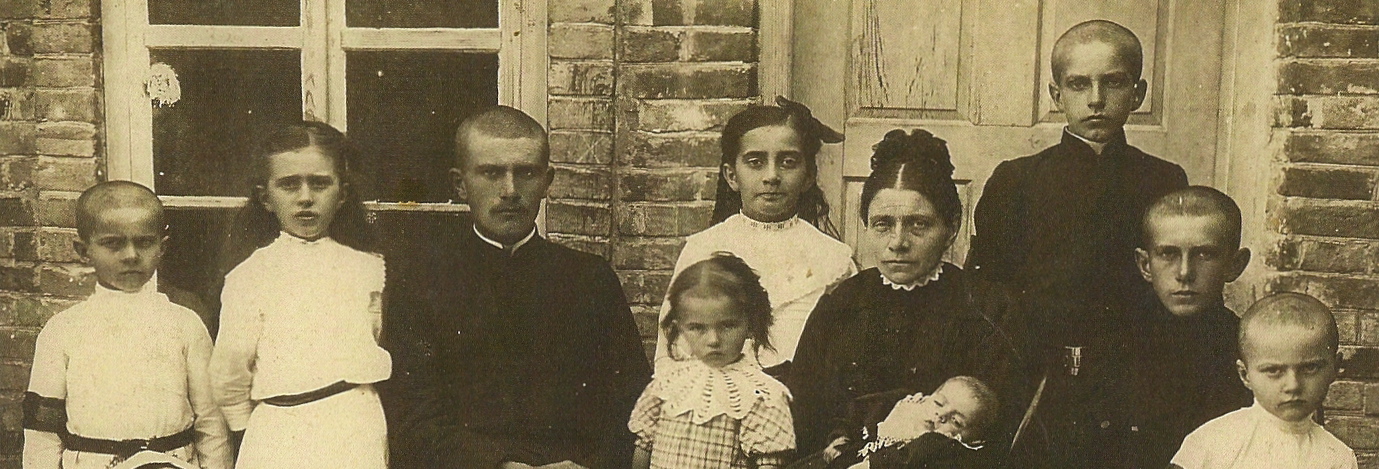
Tina Woelk and children, 1917


My grandmother Helena (Harder) and her family came to Canada. Her older sister Tina (Woelk) did not. Here is Tina with her 9 children, photographed at the burial of her husband in 1917. The oldest son, David, third from the left, was murdered in the political turmoil of 1919. As for the three boys on the right: Jakob reached Germany during the Second World War and did not return to Russia; Gerhard disappeared in that same war; Kornelius simply disappeared. Helena, second from the left, died of cancer in Siberia in 1956, Siberia being shorthand for the family’s exile to the work settlements of the north. Peter, on the left, died in Karaganda, that name shorthand for exile to the coal-mining southeastern region.

This is about all I know about these relatives of mine, told by the daughter of Katharina (standing at her mother’s shoulder), who grew up in the Soviet system and eventually, after the Cold War ended, moved to Germany with her husband.

So many empty spaces, children and youth without descendants. Just faces on a photo and names on a scrap of paper.

Bolivian Mennonite rape victims

One of the articles I’d hoped to pull together before leaving the MB Herald was that of the horrifying and bizarre situation in some of the Mennonite colonies of Bolivia. The news flashed around the world this summer (one example here, from The Guardian), about the eight men jailed arrested after being charged with drugging (via spray) entire households at night, then breaking in to rape the women while they slept.

We carried a short MCC release about it in the MB Herald, here. And that was all we did with it.

I’d been pushed into opening a file on it, at least, by some rounds of email correspondence with a man who worked with Low German/conservative Mennonite concerns in various ways for many years, who was greatly burdened following the news (which has continued to build, with some 12 or 13 men now in jail, reports of bribes and death threats, and many rumors as well), and who is finding the silence of the Mennonite press “deafening.”

“I expected an outpouring of concern from Mennonites everywhere,” he wrote, “but it didn’t happen.” He has been trying to rally interest, and hoping Mennonite Central Committee (which already has connections with Bolivian Mennonites) might be pressed to do more as our point agency there.

I won’t have time to do the piece and am turning the file of materials over to assistant editor K., who is willing to sort through what we’ve gathered and also make calls to some people who visited Bolivia recently. Today I finished going through 9 pages of excerpts from the Kurze Nachrichten, a German paper published in Mexico, which my “prod” above says is one of the better sources of information, and translating the salient points for K.

I feel I need more information, understanding, perspective. How far away these women seem, how foreign somehow, even though we share the name Mennonite. I agree that we need to be speaking up. But what do we say? And to whom do we say it?

[March 27, 2010: see update on this story, here.]