To Christopher Hitchens: Let it snow

Just when I was feeling downright cheerful over the hours I’d devoted to television this weekend — watching the 2010 Olympics opening ceremonies (wasn’t that W.O. Mitchell piece, with the kid running and flying over the prairies, terrific?) and the ski moguls and the figure skating, along comes Christopher Hitchens with “Fool’s Gold,” a rant hot enough to melt the remaining snow of Whistler, B.C.

Well, the man can certainly write and I enjoy seeing his skills in action as much as the manuevering of an Apolo Anton Ohno in speed skating. There’s a lot of truth to what he says as well. But I don’t think he’s the winner this round.

Patriotisms and loyalties of any kind can easily become excessive, even dangerous, and we all know that, and I have to say too that I’ve often wished broadcasters of the Olympics wouldn’t focus so much on the athletes of their particular country — just highlight whoever is great at what they do, no matter where they’re from. Certainly the chatter about the somewhat quixotic quest for Canadian gold might be tamped down here. But still, I think there’s so much more and so much better to the stories unfolding in Vancouver than the criticisms Hitchens lobs at them. To watch the Olympics is to watch one small and fascinating drama after the next, and to find in each some pleasure, or sympathy, or even inspiration.

Last night NBC, the American station covering the winter games, was running some minutes behind CTV, the Canadian station. After we’d watched the Alexandre Bilodeau win in the moguls competition on CTV, we turned to watch it at NBC, to see how they would “call” it. Would they focus on, and commiserate over, the American skier, now bumped to bronze?

No, they were equally excited with all the elements of the story, including the motivation Alexandre gets from his 28-year-old brother Frederic, who has cerebral palsy and, Alexandre says, never complains, as well as the fact that this was Canada’s first gold on home turf. And, it was the most perfectly executed run of the evening! It’s a kind of performance art and it’s hard not to be thrilled about that.

I probably couldn’t ski my way down a bunny hill without falling, but I like to watch the Olympic games. I’m amazed at the dedication and training and keen spirits of so many athletes. I find the human dramas that unfold compelling, the skills on display simply remarkable. From me on my couch to Hitchens and his “Fool’s Gold” I say: let it snow, let it snow, let it snow.

The experience of reading “Gilead”

I may very well be the last on the block to have read Marilynne Robinson’s hugely popular Gilead (HarperCollins, 2004). But I’ve done so now — and I enjoyed it too.

Gilead is a novel told in the voice of John Ames, an old man, a minister, who sets down in diary form what he wants his young son to know about him. It’s a story about fathers and sons — several sets of them. Since so much fine commentary has already been expended on this book, I’m going to simply recommend James Wood’s review in the New York Times, which calls it “a beautiful work — demanding, grave and lucid.”

Although I found myself sometimes impatient with the narrator’s style, which mirrors what we perceive as the faults of the elderly — a slow and meandering speech, and something of a preoccupation with the past and one’s own wisdom — Woods says, “Gradually Robinson’s novel teaches us how to read it, suggests how we might slow down to walk at its own processional pace, and how we might learn to coddle its many fine details.” He’s right.  

I will also recommend Debra Dean Murphy’s reflections on re-reading Gilead, which reminds of its theme of blessing, and will pass along a friend’s assessment: “This is a great book for pastors.” (She’s pastoral care coordinator in a local church.)

Gilead being what it is, however, so attentive to life itself, I thought I might also share two “extras” that the experience of reading it gave to me.

1. I read a library copy, so others had been there first. I began to notice that occasionally a word was circled. I went back to find them all. Insouciant, effulgence, susurrus, bodacious, probity, caviling. And then lines in the margin beside this sentence: “…age has a tendency to make one’s sense of oneself harder to maintain, less robust in some ways.” Since these markings were in pencil, I didn’t mind finding them. (Erasure is possible — it’s the folded-over corners that always hurt a little on behalf of the page, because their scars cannot be healed!)

Who was this other reader? Someone sad at their own loss of the self? But still keen of mind, determined to look up the hard words in the dictionary? It was good to contemplate another person with this text, to know that reading is not just about a book but about people at the practice of it.     

2. At one point, the Rev. John Ames talks about Hagar and Ishamel. There was something about what he said that sent me off to that story — in Genesis 21. I simply plunged myself and my concerns into it, and was startled, and — to use Gilead vocabulary — blessed. The Genesis storyteller refuses to favour one character more than another. The clash between Sarah and Hagar is dramatic and difficult, Abraham’s dilemma heartbreaking, and the wilderness for Hagar too, but everyone in the story gets their loving due before God. What a good lesson for a fiction writer, or anyone for that matter. It reminded me of something Mary Anne Isaak said in a recent piece about the woman who wept at Jesus’ feet, that “meaning is created by the way others narrate the story…”

Then, back at Gilead later — second last page, in fact — the old man remarks, “Augustine says the Lord loves each of us as an only child.” I think that’s what Genesis 21 is saying too. (I also notice I seem to be bumping into Augustine everywhere lately, which is probably my just desserts for becoming tired of his Confessions when I read them!)

No, reading is not just about a book, but about the places we go because of it. 


On cards and other gestures

For more than 25 years, H. and I have been observing an almost daily ritual. We get up at six and drink maté, a Paraguayan tea.* During the half hour we’re imbibing our caffeine, I wake up (as a morning person, H. is already wide awake), we usually read Rejoice!and we cross-check our schedules for the day. Then we get on with it.

Weekends, it may all take a little longer, and may include reading the paper and listening to music.

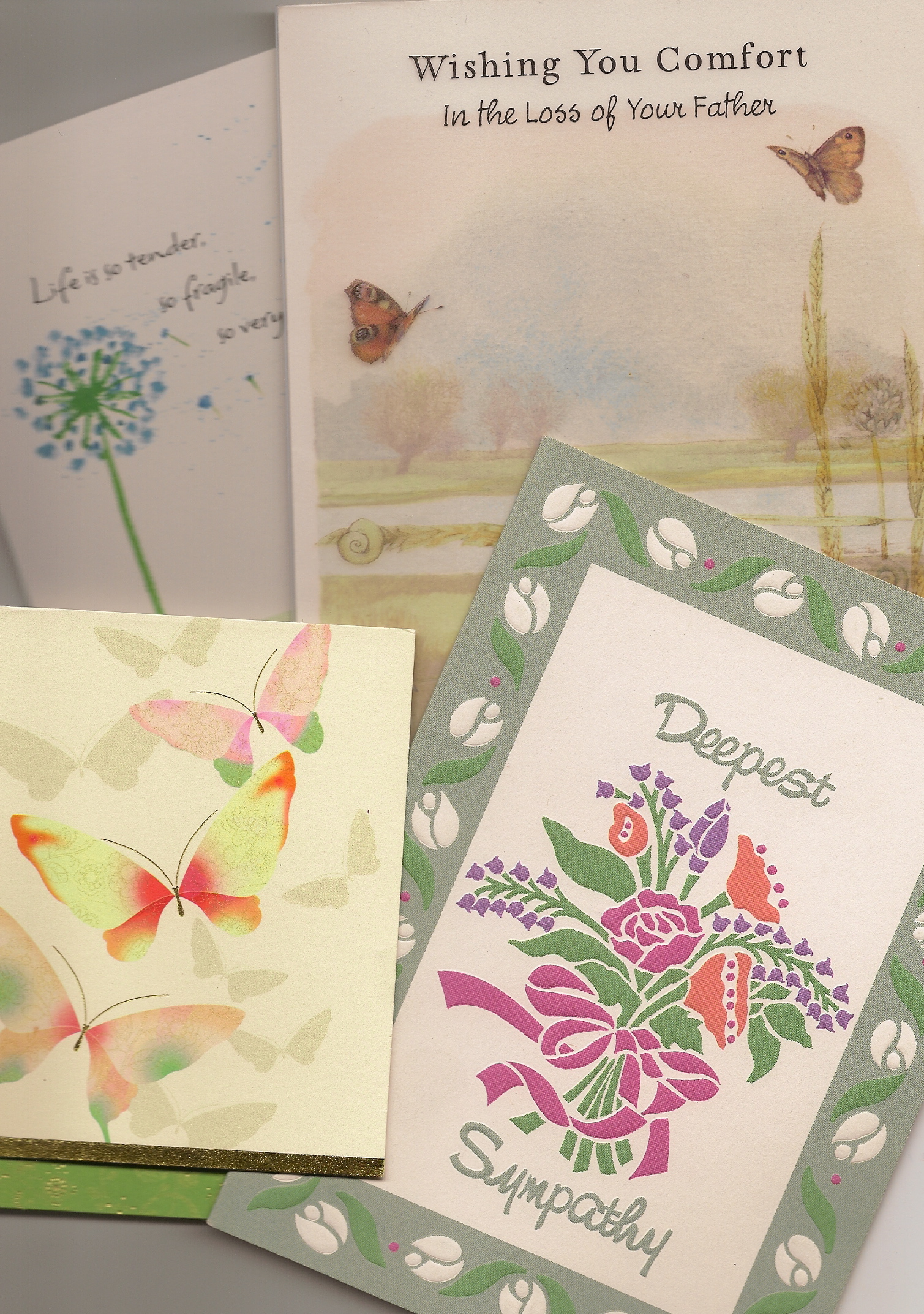
The past weeks we’ve added something else to our maté routine. We’ve been re-reading — three or four of them a day — the sympathy cards we received after my father’s death in December. We think about the senders and what they and the cards have said, and we include them with gratitude in our morning prayers.

I hope it won’t hurt anyone’s feelings to say that most of these cards then land in the recycling bin. The point I want to make is how much the cards have meant to us. Sometimes a person forgets the power of the small gesture — and how large small can be — until one is on the receiving end of one after another after another.

Some cards came from people we would not have expected to send one, and the surprise of that touched us. Some people who knew Dad took the time to share their memories – memories that enlarged our own memories of him. Some added a poem or reflected on similar experiences. Each card was unique, each one was appreciated.

We were the recipients of many other gestures-for-times-of-loss as well, such as emails and phone calls of condolence. Last week, we got the list of people who had donated money in honour of our father to the charity we’d chosen. Again, it was a humbling and touching experience, to see the names and think of what these gifts meant about Dad and us and these givers, and for the recipient mission agency.

Some gestures took the givers significant time. One friend spent the day baking cookies for us because she knew we were having a lot of out-of-town company. Several friends and a neighbour brought meals, including some of the most spectacular soups I’ve tasted in a long time. The church deacons came to visit, bearing  a fruit basket.

These are traditional ways of caring; they’re gestures and rituals we bring out for certain times. But like any ritual, whether it’s a daily one like our morning tea, or something practiced for specific circumstances, they build and maintain community. And what a wonderful thing it is to be part of community.

———-

*Drunk alternately as an infusion of hot water over yerba tea leaves in a container called a guampa and sipped through a metal sieve-straw called a bombilla. (Yerba leaves and paraphernalia pictured left.) Let’s just say it grows on you.