
Now for something lighter

It’s a slow news day, as they say, here at Borrowing Bones (though in truth the ongoing distress of Haiti remains very relevant news for us all). So I thought this might be a good time for something lighter. A good time to make something clear.

I am Al Doerksen’s sister. 

Although we lived in the same city for many years, I still meet people now and then, as does he, who know us separately but don’t realize we’re siblings. If I had kept my maiden name along with my married one back in 1974 when a certain Mr. Dueck and I tied the knot, our common paternity would have been much more easily discerned by all practitioners of the deliciously satisfying Mennonite game, whereby people ferret out one’s biological connections in order to form their opinion of you quickly, thereby saving considerable time and energy in getting to know you. But I suppose “Dora Doerksen Dueck” felt like just too many D’s in a row at the time, and so it is that I’m now routinely queried about any number of Duecks to whom I could be related (but am not) and never asked if I’m Al Doerksen’s sister (not to mention John’s, Norm’s, or Vic’s).

Well, I’m proud of the fact, and though we had our squirmishes as first and second born, and though my attempts to oust him as ruler of what would eventually be a sizable kingdom of siblings were completely unsuccessful, even when I enlisted the help of the brothers who came after me, I appreciate and enjoy him immensely. I’m proud too of the work he’s done over the years, especially in development, and currently as CEO of International Development Enterprises. (Their development entry point is water.) Since he’s spent time with Bill Gates, whose foundation gave IDE a hefty grant, I can also bask in a two-degrees-away brush with celebrity.
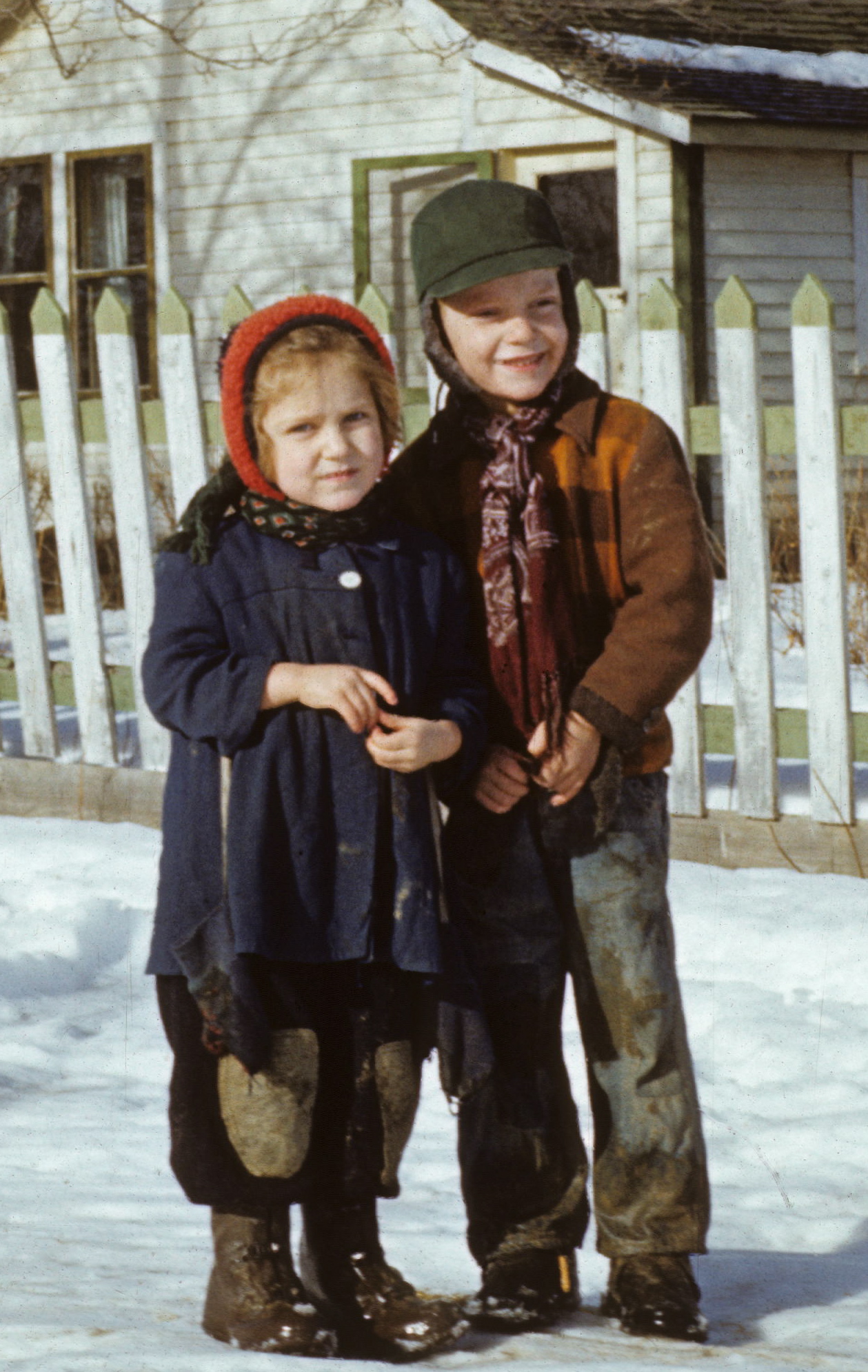
As proof of our long sibling bond, I offer the following photo from our childhood. Cast into the hard world we were, poor little things, so tattered and wretched, knowing we had to be there for the other or all might be lost. Should I ever run for president I will also use this photo as proof of hardscrabble beginnings, of how I pulled myself up by dint of no lies and lots of work — you know the drill — and of course with the precious encouragements of all my Beloveds, who would say inspiring things like, it doesn’t matter the rags, my dear, you shall have something that resembles a sailor suit someday. Yes, there are also photos of us lovely in such outfits, prairie children far from the sea, but clearly arrived in one good port or another, taking turns at the oars no doubt, still as sweet and solicitous as we could be.

But the sailor suits shall be saved for another slow day. 🙂

A movie that did the work of a sermon

It’s not often that a movie does the work of a sermon for me — the work a sermon may do, that is, of linking text/truth to some situation in my life and touching it with compassion, perhaps, or conviction.In this case it was conviction, and the movie was “Up in the Air.” 

Natalie Keener (Anna Kendrick) and Ryan Bingham (George Clooney) in Up in the Air

“Up in the Air” is a charming, thoughtful film about Ryan Bingham (George Clooney), who is constantly flying around the country doing his job as a employment termination specialist — he fires people — and whose personal goal it is to accumulate ten million frequent flyer miles. His lifestyle doesn’t allow time for settling down, not to mention long-term relationships, but he doesn’t really mind. In fact, Ryan also does gigs as a motivational speaker, helping people become freer, more unfettered, as he is. The metaphor he uses is that of a backpack, too stuffed with material possessions, too full of people. A backpack that needs to be burned, or emptied at least.

As the story unfolds, Bingham’s philosophy is challenged by people who demand his reluctant attention, and by an affair premised on his own ideas which reveals its true emptiness when he finds himself falling in love. 

The day H. and I went to the movie had been a busy one, a day in which I’d felt the backpack of obligations pulling heavily on my shoulders. I’ve gotten better over the years at discerning what to say Yes to, and better at saying No, but it’s not always the planned involvements and thought-through lists of our lives that get us down. It’s the things we haven’t planned that derail us. When I was a young mom, for example, it was the unexpected exigencies of children’s lives that could upset a nicely considered schedule again and again.

Now I’m in that swelling demographic of women who find themselves looking after elderly parents. Not looking after in a live-in situation, perhaps, but very much on call for driving, shopping, cleaning, decision-making, and so on. As anyone in this situation knows, there’s nothing predicatable about the lives of the elderly either. 

Whenever our obligations overwhelm us, the easiest reaction is frustration with the people who adhere to them. It is they, rather than the tasks, who seem to be hurting our shoulders. And the easiest solution, at least Bingham’s in “Up in the Air,” appears to involve taking distance from those people. But, as he discovers, that’s a pretty lonely place to land. And driving home from the movie, it hit me squarely. The people in my backpack aren’t the problem. As I trace the web of my relationships, in fact, I see that they’re the source of so much of my life’s value and joy. 

The challenge of how to balance the competing demands of my life probably won’t go away. When the kids were small, it involved constant negotiation, inner and outer, between the obligations imposed by their existence and my (then tiny and seed-like) sense of a call to write. And the negotiation never seemed to end, at any stage, and is still going on, now, in figuring out how to best to fulfill my vocation and take care of these other responsibilities too. 

“Up in the Air” clarified my thinking, re-oriented my heart. I realized anew what’s non-negotiable. It really was as good as a sermon. So maybe this week I can skip church. (Just kidding, Pastor Dan.)

The significance of siblings

Events such as the death of an elderly parent, which my siblings and I experienced this week, bring the original configuration of a family into sharper focus. We were eight children, a relatively large family even for its time. We were also the children of a minister who served various churches, none of them in communities where our grandparents, uncles, aunts, and cousins lived. It has always seemed to me that for all the disadvantages created both by the size of our family and its isolation from our relatives, there were advantages as well, including a strong enjoyment of one another — squabbles notwithstanding — and reliance upon each other for memories around the year’s special days, when families are the key unit of celebration.

It’s been a long time since the last child left home to form her own household, and even longer since the first left to form his. Over the decades we’ve become our own extended families, with five of the eight of us now grandparents. Shaped by divergent career paths, the people we married, and our scattering to reside in four Canadian provinces and one U.S. state, we’ve become much more diverse than we were in our family of origin. We’ve remained relatively close, certainly very cordial, but we’re together occasionally rather than frequently, and certainly much less than siblings who remain in the same place geographically. We have our own “space”; we have our own lives. 

The past week, though, in planning and participating in our father’s funeral, it was the “originals” who met via telephone conference call to make decisions about the arrangements. In the storytelling and slide-viewing that happened once we’d gathered here in Winnipeg, it was, inevitably, the original bunch of us that again came to the fore. Without intending to (and here our spouses are the best witness), we probably slipped back into earlier roles, banter, “insider” references. This deceased man was most particularly ours and, for a while, we went back to this knowledge with whatever joys and wariness it might entail, as children of the household he had formed. 

Truly, the sibling bond is an interesting one. It’s complex, but somehow simple too. Virginia Adams, in “The Sibling Bond: A Lifelong Love/Hate Dialectic,” an article I saved in my files from the June 1981 Psychology Today, says the link between brothers and sisters “is in some ways the most unusual of family relationships…the longest lasting…and the most egalitarian.” 

In the church
In the same file, I found a 2004 Sojourners article by S. Scott Bartchy called “Secret siblings.” Bartchy describes Jesus’ “radical new vision” of believers as family and goes on to say that popular English translations of Paul’s letters have in many cases mistranslated the Greek word for brothers and sisters by using non-family terms. This has diminished the impact of what is proposed as a way of being in the church.

Sibling relationships, as Adams reminds, are indeed unusual, long-lasting, and egalitarian. Implied in them is fairness, equality, the honor of the family, love and support in spite of diversity. When my church — the Mennonite Brethren — was debating women in ministry leadership, it seemed to me that the arguments against it sometimes inserted notions about marriage into the discussion, as if every woman in the congregation was the “wife” of every man. Yes, Paul also compares marriage and the church in Ephesians 5:22 ff, but the church entire is meant vis a vis Christ, with both the marriage relationship and the relationship between church and Christ illuminating the other. But to be siblings of Jesus in the church, well, that’s another perspective all together.

The past week has reminded me how formative, powerful, and life-giving the sibling bond is, and can continue to be. Freshly appreciative of its significance, I want to also probe its meaning for the church. Our identity there as “sisters and brothers” is familiar enough. But, I’m wondering, have we really grasped its many implications?