Winter Stillness: two gifts


St. Benedict's chapel and monastery, behind trees


I spent the weekend at St. Benedict’s, a monastery just minutes north out of the city, at their annual Advent retreat, “Winter Stillness.” It wasn’t my first time at St. Ben’s, but it was my first time doing a retreat of this kind, all of us silent, and essentially on our own but for three meetings with a spiritual director to whom each of us was assigned.

A blog is too public, and the time too soon, to share the specifics of what I experienced during my hours of rest and prayer at Winter Stillness. Too much talk about the movements of one’s own soul can have the effect of “letting the fire out of the bones,” a good friend once observed, and I think she was right — so we wait on wisdom for the “when,” and the “how much.” (Incidentally, my last time at the monastery was with this same friend, on a retreat together while she was fighting cancer. She died 13 years ago this December. A long time ago, really, so I was unprepared for my initial emotions back in the place the first evening: that wrenching sense of the loss of her, once again.)

But there’s a few observations about the broader gifts of such a weekend — gifts we can open in other settings as well — that I want to share with gratitude after my days away.

The gift of hospitality: Hospitality is part of the Benedictine Rule, so they have a long habit of it, but my, how very well they do it! It’s the hospitality of warm welcome, as the “Christa” at the retreat entrance so aptly depicts. But it’s also a hospitality that, while attentive, strikes me as somehow inattentive too, unintrusive, never  hovering. Completely unapologetic, trusting, accepting.

"Christa," 62 in. clay sculpture, Helen E. Norman


I think this fine balance of attentiveness and inattentiveness must truly come from committed practice of it, and I suppose the Benedictines have learned that eventually a hovering hospitality will exhaust its giver, if not the receiver. But perhaps it’s also a Spirit-gift. I’ve experienced it from various people at various times in my life, and would like to grow in giving it in that particular way. I’m not sure I’ve even found the right words to describe it, though. Perhaps some of you know the kind of hospitality I’m talking about and may have insights to share.

 The gift of silence: Silence between people can be so many other things than a gift. It can be confusing, cruel, selfish. But when silence is shared and intentional, when it’s insisted upon for the purposes of personal soul care, it can be a wonderful thing to experience, even as a group of strangers. We came to be quiet; we were given permission to keep quiet. We might nod or murmur a greeting when passing, but we knew what the withholding of further niceties was all about and how respectful it was of ourselves and the others.

The group was small enough — about 15 or so — that we each sat at a table alone for meals. The only sounds were the occasional ping of cutlery against dishes, like the ring of a tiny bell, the scraping of a chair, sometimes the sound of footsteps (oh, and the crunch of taco chips at Saturday’s lunch!). But our last meal together was a “talking lunch.” How fine it seemed to get to know one another then, and share bits of our weekend. Once silence has been opened as a gift, speaking seems an extraordinary blessing as well.

What book could I be?

Over at the blog “Considerations,” David Warkentin tells how he recently spent a couple hours in the library of Douglas College, being a book. It was part of  the Living Library, a movement designed to “promote dialogue, reduce prejudices and encourage understanding” amidst the diversity of our pluralistic world. It’s all about “engaging people,” he explains, “instead of just borrowing books.” David chose the title “Engaging Our Stories – Living Amidst Spiritual and Religious Diversity” for his book-self, and people could “borrow” him for up to a half-hour to discuss anything related to his topic. 

This sounded like a wonderful idea, and it got me thinking. What book could I be?

Most days I’m not an expert at anything, but I imagined for a moment that I might land in the “how-to” section of the library. Next I had some fun at my bookshelves, perusing them for what title(s) I might choose for myself. Here’s what I came up with — borrowing only the title, please realize, and not the contents! 

1. On the writing life.

Let’s see… How about Great Expectations (Dickens), or, continuing the metaphor more realistically, All Things Are Labor (Arnoldi). No, that just sounds pretentious. I think Wilderness Tips (Atwood) should do it here.

2. On marriage.

Well, besides 35 years of experience, what do I know? Two Solitudes (MacLennan) for starters. Marriage is good and definitely worth the perseverance, though, so let’s call me-on-marriage The Progress of Love (Munro).

3. On parenting.

Oh my, the possibilities are endless here! Expensive People (Oates), or Here Be Dragons (Newman). A Multitude of Sins (Ford) — mine, I mean — and then they’re Gone with the Wind (Mitchell). On balance, though, A Good House (Burnard). But it all comes down to two pieces of advice:  See the Child (Bergen) and Mercy Among the Children (Richards).

4. On the life of faith.

Well, that’s The Heart of the Matter (Greene) and some days, Such a Long Journey (Mistry). But perhaps what I’d like to get at is mystery and very life itself. How about Breathing Lessons (Tyler)?

5. On becoming an “elder” (chronologically, that is, not a position in the church).

Just at the very beginning here, so what I know so far is Independence Day (Ford), and The Reprieve (Sartre). Also a chance for Final Payments (Gordon) in a metaphorical sense, though when the recession eats at our RSPs, literally too. One faces ahead The Remains of the Day (Ishiguro), finds oneself in The Summer before the Dark (Lessing). The dark of death, yes, but only as transition. On, on, on, then, to The Radiant Way (Drabble).

(Thanks, D.W., for the idea!)

Left with a void: the new Mennonite memorial in Ukraine

Monuments often bear witness to those who are missing, but the design of the granite monument unveiled to “Soviet Mennonite Victims of Tribulation, Stalinist Terror and Religious Oppression” in Zaporizhia, Ukraine on October 10, 2009 is particularly poignant about absence. Designed by Paul Epp, it consists of three life-size silhouettes: a woman, a man, and two children. The base is meant to represent a mantel upon which we keep pictures of those who we want to remember, says Epp, except that here “we are left with a void, with all of what that can represent.”

The International Mennonite Memorial Committee for the Former Soviet Union, has erected a number of memorials in the former Soviet Union, but according to a report of the event by Anne Konrad, this is the first one within the former USSR to memorialize all Soviet Mennonites.

Mennonite memorial (photo credit: T. Dyck)


Committee co-chair Peter Klassen (left) said, “This monument bears enduring witness to the suffering of many thousands who cannot speak for themselves,” and co-chair Harvey Dyck (at mic) said, “The story of 30,000 Soviet Mennonites… chronicles a tragic past and opens us more fully to the suffering and heroism of Ukrainians, Russians, Jews, peoples of Siberia and Central Asia and people around the world.” 

My grandparents were among those fortunate to escape what World War I and then the Russian Revolution unleashed, not to mention World War II and the long terrors of the Stalinist regime in the Soviet Union. But as was the case in so many families, others in their family were not. The difference in the fates of those who left and those who stayed were often literally the difference between life and death.

I can’t get my head around how arbitrary it all sometimes seems, except to engage in the linked theological practices of thanksgiving and lament, but let me raise to the void of the new memorial just a few faces and names that belong there.

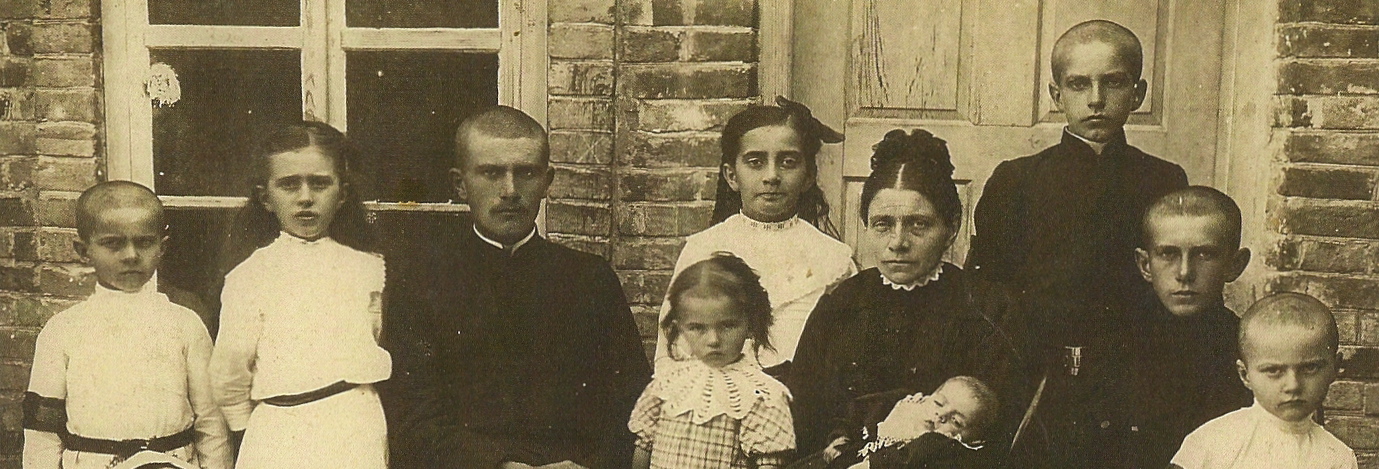
Tina Woelk and children, 1917


My grandmother Helena (Harder) and her family came to Canada. Her older sister Tina (Woelk) did not. Here is Tina with her 9 children, photographed at the burial of her husband in 1917. The oldest son, David, third from the left, was murdered in the political turmoil of 1919. As for the three boys on the right: Jakob reached Germany during the Second World War and did not return to Russia; Gerhard disappeared in that same war; Kornelius simply disappeared. Helena, second from the left, died of cancer in Siberia in 1956, Siberia being shorthand for the family’s exile to the work settlements of the north. Peter, on the left, died in Karaganda, that name shorthand for exile to the coal-mining southeastern region.

This is about all I know about these relatives of mine, told by the daughter of Katharina (standing at her mother’s shoulder), who grew up in the Soviet system and eventually, after the Cold War ended, moved to Germany with her husband.

So many empty spaces, children and youth without descendants. Just faces on a photo and names on a scrap of paper.