
A designation true and warm

Further to John Terpstra and his Skin Boat (see previous post)…

The book is about faith and church, about Christian things, so it might be assumed that the word Jesus would appear. But it doesn’t. Not so far, at least.

What Terpstra uses instead, where the name is required, is “the one who won us over.” Each time I read this, it’s a tiny surprise, to know who is meant and to recognize how this is true. And warm.

It fits the author’s story. The church of his growing-up was a solemn affair, hearing the Ten Commandments every Sunday, knowing guilt and the sentence of death, and yet, every Sunday too, “the congregation is… granted clemency.”

In reality, however, their sentence is only commuted until next week, when the same drama is repeated.

He had to attend, but he could not imagine, as a child, that he would ever “want to be here.”

But he heard the one who won him over replying to the religious leaders of his time about which law was most important.

He answered, Love G—d with all your heart, all your mind and all your strength, and your neighbour as yourself.

I thought: simple, straightforward; I can live with that.

It was the beginning of being won over.

It fits my story too, of a particular day, yesterday, May 6, in the year of our Lord etc. etc.  I’ve been busy this week, and the things I’ve been busy with, including writing and deadlines and a denominational committee assignment about which I can’t say any more except that it involves assessing a complicated conflict, have intensity about them, and the progress through that intensity has for various reasons needed some extra journalling and prayer. Which is good — the religious drama unfolding as it does between need and mercy. But the sense of my day reamined busy and intense. And then, in the evening, as if all of that slipped away or was clarified all at once – simplified really – came the reminder (though I mean this more as assurance than thought) of the Person at the heart of things. The name by which I knew him was a little different than the one Terpstra uses above, but just as true and warm: the one who drew me. 

And I was drawn close.

——-

P.S. Further reading: a review of Skin Boat at ChristianWeek and an interview with John Terpstra at Image.
By what kind of death

The lectionary Gospel reading a couple of Sundays ago — for the Sunday I was to lead worship — was John 21, about Jesus’ appearance to his disciples on the beach at the Sea of Tiberias. I’ve always loved this story, with its many sensory details, fascinating dialogue, and even bits of comedy. And, of course, the notion of breakfast with the risen Lord.  So, in preparing for the Sunday ahead, I was enjoying this text, from the fishing scenes through the meal through the three-time “Do you love me” question to Peter and on into 

Truly, truly, I say to you,
when you were younger,
you used to gird yourself,
and walk wherever you wished;
but when you grow old,
you will stretch out your hands,
and somebody else will gird you,
and bring you where you do not wish to go.

And continuing on to

Now this he said, signifying by what kind of death he would glorify God. And when he had spoken this, he said to him, “Follow me.”

Which brought me up short.

First of all, what’s this talk about death, when this is a story of resurrection? Everything here, from a net teeming with fish to the aroma of a charcoal fire, brims with life. Miracles and love are once again in full display, and now this reminder (for them, and us) of dying?

But also: by what kind of death he would glorify God? Tradition says Peter also died by crucifixion, and commentators link Jesus’ proverb-like description to that. (I also see, for the first time, via a commentator’s note, a reason for the detail earlier in the story about Peter pulling on his outer garment and jumping into the water to stride to shore — an indication that he was still a man quite capable of dressing himself, and a man who walked where he wished.)

But whatever it meant for Peter, the description sounds much too much like my father’s death, like his last years, that once strong and independent man now reduced to the most adject helplessness, being taken everyday where he wished not to go. It also sounds like the place a favourite aunt has reached, dependent in a hospital bed and her once gentle personality drastically altered.

This kind of dying doesn’t connect for me — not logically at least — with “glorify God.” Dad’s moment of death had beauty, yes, and relief, but what about the years of dying before it, locked away from us and from his own memories, in some prison we couldn’t penetrate, which seemed to give no glory at all, not to himself or his Creator?

And yet these words jumped out at me, and I knew if a demeaning death and giving glory to God were combined here for Peter, that somehow the combination could be seized, and trusted, for my father’s death, and my unknown one as well. I’ve asked God, I’ll confess, for certain privileges, like a clear mind to the end, and a ripe old age, but not too ripe, though long enough to finish up all my projects, of course, and it would also be nice to have enough notice to get my house in order (six weeks?), and a scene out of one of those pious old novels would be a bonus — you know the one with the family round the bedside, sweet final blessings, and songs… Who wants to be killed by a bus, or transition through the long bleak tunnel of Alzheimer’s?

No one. But we don’t get to choose, and until it’s indicated by what kind of death we will glorify God, we’ve got this, an invitation to whatever it may be: “Follow me.”

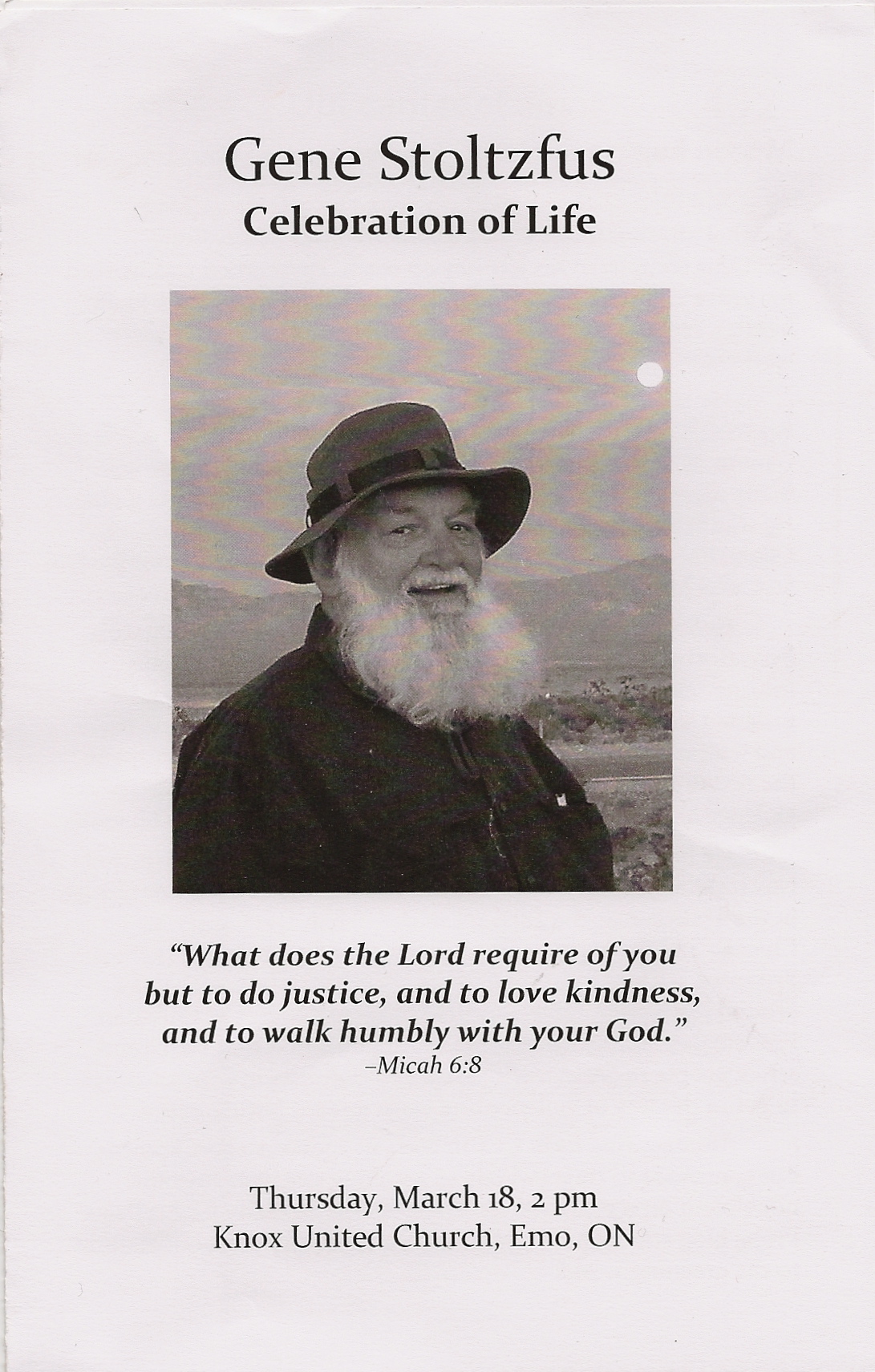
Gene Stoltzfus: celebration of life service

Last Thursday, I attended the celebration of life service for long-time peace activist and founding director of Christian Peacemaking Teams for 16 years, Gene Stoltzfus (1940-2010), which was held in Emo, Ontario.

The service was relatively small, as Stoltzfus and his wife Dorothy Friesen now lived in Fort Frances, Ontario, some distance from family roots and former places of work such as Chicago, where they resided for many years. (Memorials will also be held in Goshen, Indiana, and other places.) So it felt intimate and informal, with some of his favourite songs (including multiple singings of “Ubi caritas et amor” – “where charity and love are found, God is there”), Scriptures upon which his work was based, words from his writings, and many personal remembrances.

We sat in a kind of oval shape around a table with flowers, candles, a twig basket he had fashioned, and the copy of the Martyrs Mirror passed on to him by his father, which was so significant in shaping who be became. He spoke of this in his last article at his blog, Peace Probe, but also a May 4, 2006 column called “Beyond Imagination.” Continue reading