Road trip

I’m writing this five days into a road trip H. and I are taking, from Manitoba to B.C., then down the Oregon Coast, eastward to Denver, Col., to visit my brother and his wife, then back home to Winnipeg by mid-September. The first day, across the prairies, was the familiar section of the drive, not uninteresting, but too often done and too well-known to be really interesting, so we added some interest by reading aloud in Shop Class as Soul Craft by Matthew B. Crawford, which is the first book in this year’s “Take and Read” session with Paul Doerksen of MBCI. I’m probably going to have more to say about this book once we’re finished and we have the book discussion, but just to say now, it’s great!

We took the # 3 highway through the Rockies, stopping for brief visits with my aunt and a friend in Lethbridge at the gateway to the route. Our drive through the mountains was wonderful. For a good while the last day we drove blissfully along a section of the # 3A, not realizing we were off the route we intended. This error in reading road signs cost us several hours time, but since it’s a holiday, we enjoyed the unexpected detour and also the ferry ride that got us back on track. “And it’s free!” the woman at the little grocery where we stopped to inquire about our situation, once we realized we’d gone off course, announced. Apparently it’s the only free ferry in the province; I guess that’s why she was so eager to say so. Still, it was a long day, and that night, in bed, I felt my brain was still turning into the corners of all those winding roads as we traversed one mountain range after the next.

Yesterday we helped our daughter move into more permanent digs in Vancouver, in rain that was pouring buckets all day, and now we’re in Tsawwassen with our son and his wife and their four children. This morning H. and I took the oldest two of them to the local bird sanctuary. Our grandson, 8,  is amazing with birds: four times he had a chickadee land on his hand just by patiently waiting for it. He and his sister each have more energy than two of me would have, but they’re growing up into it well. Not only did they remember their mother’s instructions to thank us for the outing, but at lunch at the DQ, after he’d started his meal, our grandson said, “Just to get the lunchtime conversation started, what was your highlight from the bird sanctuary, Grandma?” Well that both impressed me and made me proud. Isn’t it wonderful when children learn the arts of conversation?

Travelogues (this sketchy, I mean) aren’t the richest of blog posts, I confess, but we’re travelling, and I just wanted to let you know. Friday it’s off to Oregon. Next time I’m near a computer (we don’t bring one along), I may stop by again.
More from Stanley Hauerwas

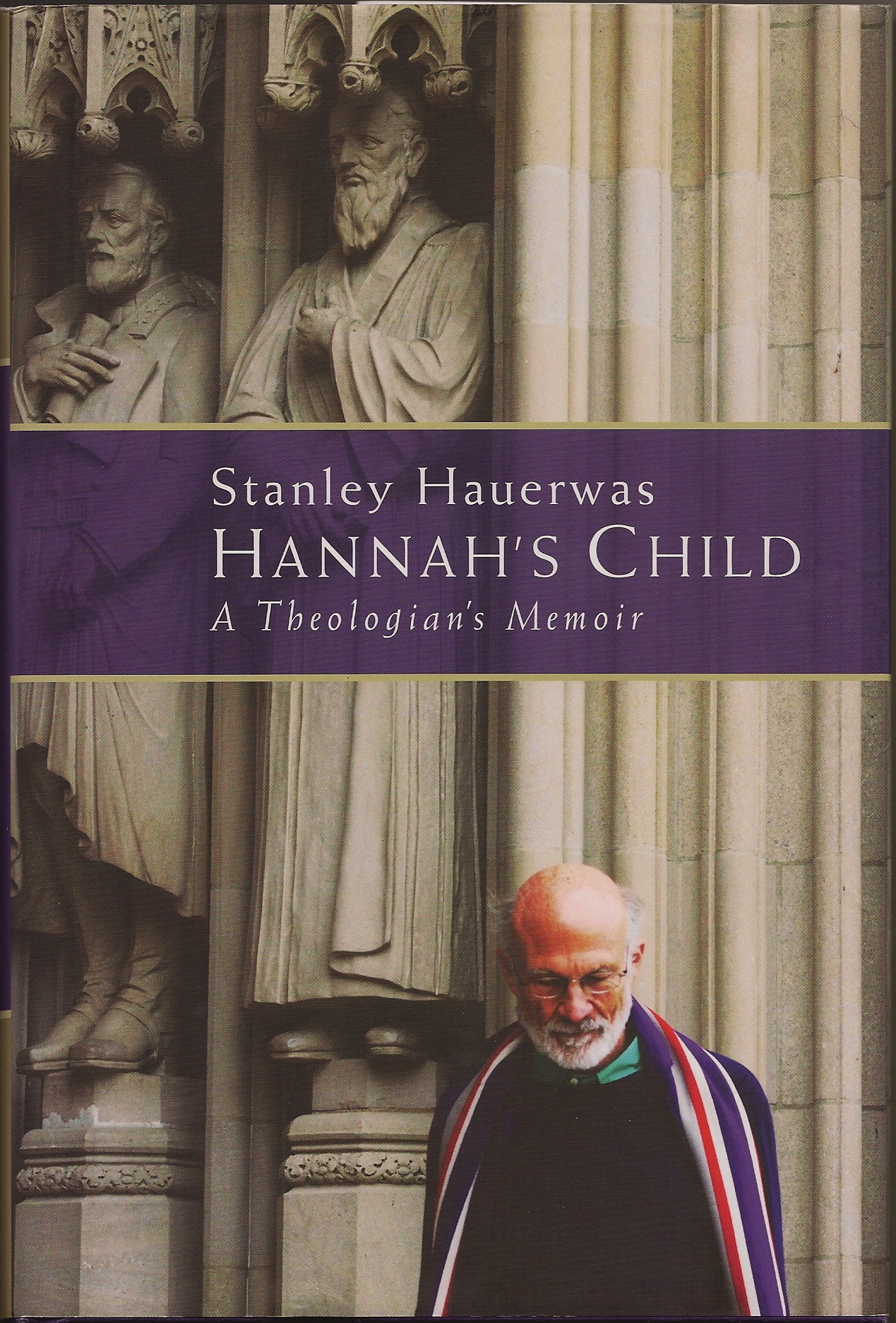
Hannah’s Child, by Stanley Hauerwas, which I reviewed in the previous post, is one of those books I could not read without a pencil at hand, to mark spots I especially enjoyed with a tiny check mark in the margin, rather like notching a tree, I suppose, in case I wanted to come back and look again.

Here’s a quote or two from those markings.

On the influence of John Howard Yoder:
Yoder forced me to recognize that nonviolence is not a recommendation, an ideal, that Jesus suggested we might try to live up to. Rather, nonviolence is constitutive of God’s refusal to redeem coercively.

On the contingent nature of our existence:
To say that our lives are contingent is to say that they are out of our control. Being “out of control” is the central image that runs through The Peaceable Kingdom and much of my work… the image came to me because of the influence of Yoder, who taught me to think that following Jesus means you cannot anticipate or ensure results. Learning to live out of control, learning to live without trying to force contingency into conformity because of our desperate need for security, I take to be a resource for discovering alternatives that would otherwise not be present.

On friendship:
What it means for me to be a Christian and to be a friend has become so intertwined that I cannot untangle one from the other, nor do I wish to.

An interesting — surprising? — observation on institutions:
I have learned… that the patience and time it takes to build and sustain institutions like the church and the university are themselves an alternative to war.

And last, on having a novelist’s eye in his writing as ethicist, for what it also says about the novelist’s task:
We are complex creatures constituted by contradictions we refuse to acknowledge. The novelist must help us see our complexity without providing comforting explanations…. Reading novels will not necessarily make one better able to see without illusion, but it can help.

A theologian’s memoir

In 2001, TIME magazine named Stanley Hauerwas “the best theologian in America.” Hauerwas found the designation absurd, he said, responding that “‘best’ is not a theological category.” But there it was, he was thus named, and he was famous.

Hauerwas’ memoir, Hannah’s Child, which I recently enjoyed, seems an attempt to come to terms with that particular “Stanley Hauerwas.” He puts “the great man”in his place, as it were, by thoroughly reminding us of his unlikely qualifications as low class Southerner and hardworking bricklayer’s son (where he learned the earthy language he only reluctantly dropped many years into his theological career — “I hated the hyprocrisy that niceness cloaks”), and of his impatience yet slowness at knowing “how to be a Christian.”

“I live most of my life as if God does not exist,” he confesses. (Something most of us probably will have to confess as well.)

“[B]y writing I learn to believe,” Hauerwas also says, early on in the book. One feels that he is doing that with the topic of his life as well, picking his way as truthfully as he can, reaching some understanding as he goes about who he is and who he has been.

About his writing (which is prolific) — Hauerwas says, similarly,

My writing is exploratory because I have no idea what I believe until I force myself to say it. For me, writing turns out to be my way of believing. (136)

And another time,

Writing is hard and difficult work because to write is to think. I do not have an idea and then find a way to express it. The expression is the idea. (235)

This awareness of what he’s up to in writing seems a figure of one of Hauerwas’ key contributions as theologian: the expression is the belief. His work, he says, “was to demonstrate the link between the truth of what we say we believe and the shape of the lives we live.” He doesn’t consider “belief” of much value detached from what we do.

For a while, as I read, I jotted down every time I came across a phrase something like “I had no idea” or “I am not sure” or “it never occurred to me” or “I did not understand.” They are frequent, and one might get the impression from them that Hauerwas bumbled through life, knowing very little of anything. Not true, but they do express his sense of being an outsider, of life’s surprises, and of his debt to others for that which he’s been able to learn and teach. He expresses his gratitude easily — for his friends, his son Adam, his second wife Paula. His first marriage, to a woman who was mentally ill, was difficult, and there have been other conflicts along the way. Some of these wounds still seem raw, at least judging by how he nurses them in these pages.

One looks to life writing, however, not for perfection, but for honesty and grace. And there’s plenty of both evident here. I found myself challenged by Hauerwas’ life, and was fascinated by how he works at describing what it means to be him.

What it meant first off, as his mother with her “white-trash energy” informed him, was to be the answer to her prayers. She had married late and like the biblical Hannah, she was desperate for a child. Mrs. Hauerwas prayed a prayer like Hannah’s and was also given a son. He wasn’t thrilled to be told, as a youngster, that he was “destined to be one of God’s dedicated.” It was fine for her to pray the prayer but did she have to tell him about it?

Along the way, of course, being him meant a lot more than that, but in the end, Hauerwas comes back to his mother’s prayer, and himself as its answer.

However, I am quite sure, strange servant of God though I may be, that whatever it means to be Stanley Hauerwas is the result of that prayer. Moreover, given the way I have learned to think, that is the way it should be.