Yesterday, our congregation celebrated its 15th birthday.
Granted, fifteen years isn’t really that long in terms of most church or even congregational histories. There are a few factors in our case, however, that make this both unique and significant.
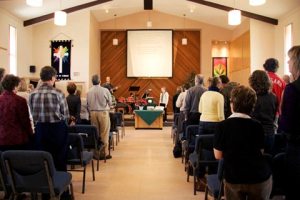
Jubilee website photo
Jubilee Mennonite Church represents the coming together of two congregations with their own particular earlier histories (dreams, successes, struggles) which extends the story back a couple of decades. To make these individual long stories short, the one group (Northdale Mennonite) had a building but for various reasons had seriously declined in membership. The other group (Valley Gardens Community Church — MB) had people, including a lot of children and youth, but had been meeting in a school and longed for a place to call home. (Although this group had purchased land, it began to doubt the wisdom of mortgaging the future to an expensive new building.) A casual conversation between friends from the two congregations over an evening bonfire resulted in the beginning of talks, and eventually the chartering of a new entity with 77 members in 1995.
The merger was described yesterday as “a marriage of convenience,” and in many respects it was. It solved the problems of two groups, and produced something stronger than either of them alone could become, something viable for the future.
But the phrase hides how carefully both congregations approached the merger, for there was another factor in all this that needed study and honest conversation. The two “courting” congregations happened to be from different Mennonite denominations — the Mennonite Brethren (MBs) and Mennonite Church Canada (formerly known as the General Conference Mennonites or GCs). We were the first, and are still, as far as I know, the only “dual conference” church of these two groups in the province, and I don’t think there’s more than two or three in the country.
To the casual eye, this may appear unremarkable. Isn’t a Mennonite a Mennonite a Mennonite? Yes, in a way, but like many broad movements of faith, the Anabaptists too splintered and then splintered some more. At the founding of the Mennonite Brethren in 1860 in Russia, and hence separation of the two streams that our two founding congregations represent, relations were anything but cordial. (I realize I’m over-simplifying things a little, as the General Conference, now called Mennonite Church, was founded in the U.S., also in 1860, but because it was this conference that many of the Russian Mennonite immigrants from the main Russian Mennonite church joined when they came to Canada, differences originating in Russia were brought along to the New World, and perpetuated in further ways.) Alike as they may have been at the root, each group developed its own culture over time, not to mention negative stereotypes of one another.
These separated groups were now contemplating becoming a congregation that would choose to be not one or the other, but both. We set up various task forces to look at our confessional statements, polity, and so on. We consulted with conference leaders and asked the advice of ministers from each conference who had worked in churches belonging to the other. I recall some resistance at the national level of the MB conference, but since it was provincial jurisdiction to accept new churches and provincially, both denominations, were supportive, our proposal to merge won approval.
I’m glad it happened. The dual part of it is important, both symbolically and for the resources we have at our disposal, but more so the life we’ve shared and shaped together for 15 years. The fact is, denominational identity doesn’t seem to be a huge deal for the younger generation anyway. We’re still a relatively small church, in the 130-person range, and we’ve had our share of ups and downs as I suppose any congregation does, but I was reminded again yesterday of how much we’ve learned together, perhaps from the blending of our respective traditions, but more often just in the simple process of being church together.
I appreciated too the reminder of our pastor Dan Nighswander in his sermon on Hebrews 12:1,2 and 12-17 and its instruction to keep our focus on Jesus. (This was one thing the Anabaptist reformers got right, he said, this insistence on the centrality of Jesus — an emphasis, he went on, that is proving especially relevant for the church in a post-Christendom world.) Such a focus will shape our identity (for primarily it must be that we’re a group of people following Jesus together), our character, and our relationship with God.
There was a great spirit of celebration yesterday, in the service and the lunch that followed. Happy birthday, Jubilee!