What’s true about fiction

Among my earliest memories are the storybooks my mother read me. Both parents, in fact, modelled that books were important and worth spending time on. My mother, who with eight children never kept up with her housework, would leave tasks unfinished in the evenings, and sit and read.

While we children might be reading stories, however, she read “Christian” books, that is, of a devotional or theological nature, or if story-based, tales of missionaries or other spiritual stalwarts. Somewhere, perhaps from her example, and from admonitions I must have heard in the wider church community, I gathered that one advanced from “made up” stories to the “real” and more solid meat of books such as those as one progressed into maturity. It had to do with the adult requirement of being useful, I suppose.
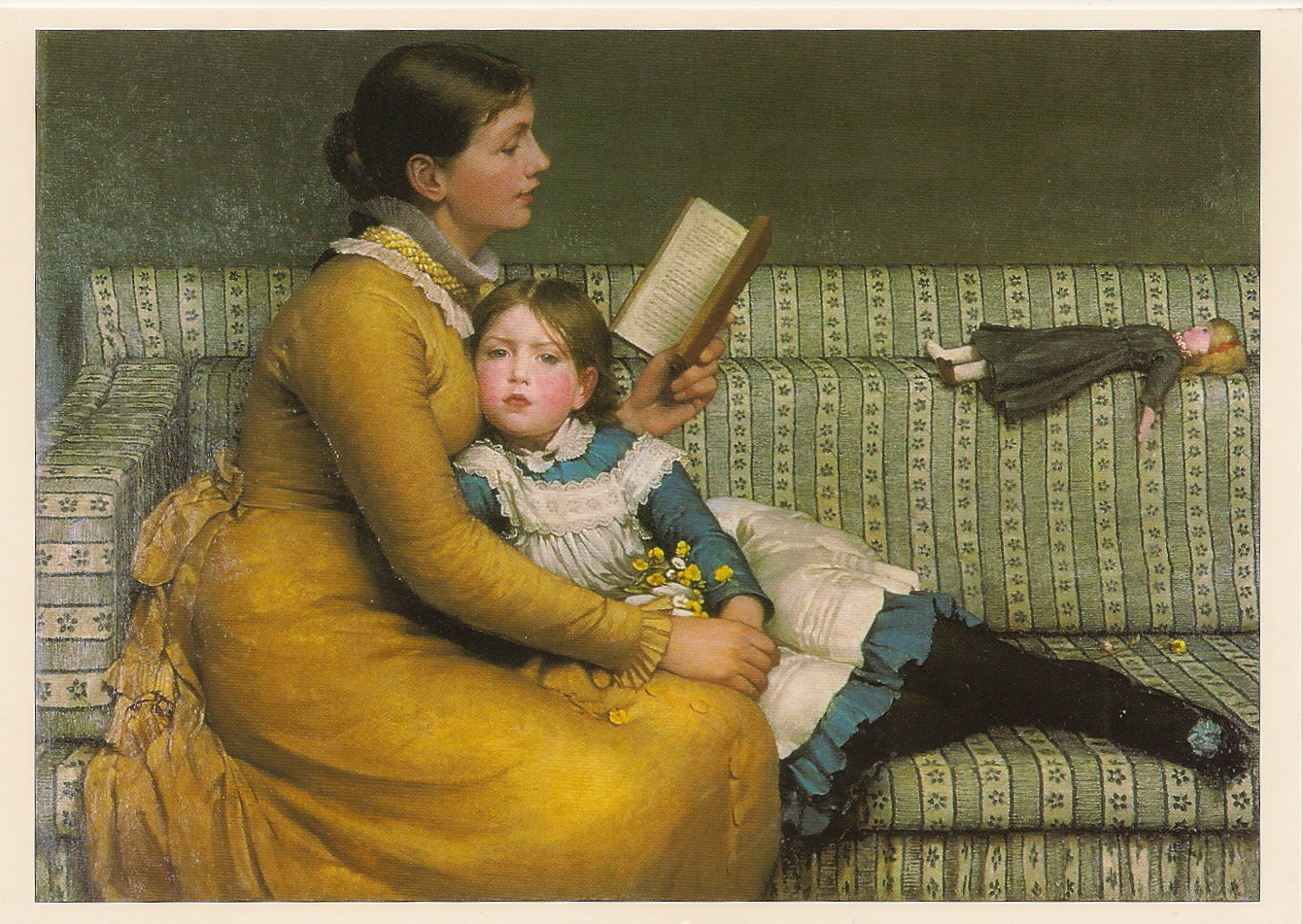
Art card: "Alice in Wonderland" by George Dunlop Leslie


Not that long ago, in reference to the reading habits of some of her peers in the seniors’ home, whose fare was mostly fiction,  my mother muttered impatiently, “I like to read what’s true!”

Another time she sighed, “I can’t help it that I like to read what’s real.”

She forgets, in those moments, that I, her daughter, have not only persisted in reading fiction, I’m involved in writing it. I don’t take it personally, however, for she is among the most affirming of mothers when it comes to the endeavours of her children. Her resistance to fiction, and the subtext her remarks contain about ranking kinds of reading, and even her definitions of “real” or “true,” are what she absorbed in her upbringing and church environment. It fits the earnestness that life in this environment seems to require. Continue reading

Changing the look

If you’re a regular visitor to this site, you’ll see that I’ve changed the header image. After half a year at this blogging business, it seemed to me that the site needed something visually fresh. WordPress regularly introduces new “themes” or blog templates but none so far quite duplicate what I like about my current Cutline theme.

So I’m sticking with Cutline, but the header can be changed, and perhaps for now, that’s fresh enough. Continue reading

News and notes

1. The launch of my book, This Hidden Thing, is about a week and a half away now. I expect that for a short time, at least, the book will have something of a life of its own, so I’ve given it a separate page, above. I’ll probably say something about the launch event here after it happens on May 19, but I’ll park reviews and other stuff related to it there. Already up, the news release Jonathan Dyck of CMU Press put together, the book flyer, and order information. 

2. I’ve agreed to serve on the advisory council for the Chair in Mennonite Studies at the University of Winnipeg for the next three years. This is a relatively easy and also pleasurable task, involving free lunch twice a year at the university and listening/responding to a report of what Royden Loewen, as well as students and other professors involved with the Chair are up to. They’re up to a lot, actually, including the planning of two conferences this year, one on Mennonites in Siberia which is taking place in Omsk, Siberia in June, and one in Winnipeg, Oct. 14-16, called “Mennonites, Melancholy and Mental Health: Historical Reflections.” I’m under no obligation to “do press” for the Chair, but some of the papers proposed for the latter (examples: “Madness in my Family’s Journey,” “Duke Ferdinand vs Pilgram Marpeck: Lunatics or Preachers of Care,” “Trauma, War and Soviet Mennonite Women Refugees”) sound so interesting I’m keen to offer advance notice. Further information here.

3. Another event that greatly intrigues me, which unfortunately I not be able to attend as we’ll be away on holidays then, is “Celebrating 150 Years!” This has been organized by Canadian Mennonite University (CMU) for June 5-6 in Winnipeg. I’ve mentioned the 150 year celebrations of the Mennonite Brethren in this blog. This conference recognizes that anniversary, but also the 150-year anniversary of the formation of the General Conference Mennonite Church formed in Iowa in 1860. (This body is now Mennonite Church Canada and Mennonite Church USA.) These two 150-year-old bodies are the  supporting denominational bodies of  CMU — “two compelling stories…brought together in a special way.”

“[I]t is appropriate to reflect on what we have experienced and learned with and from ‘the other’,” states the conference invitation. Presenters of workshops and discussions have been drawn from both bodies and topics include “Exploring Stereotypes,” “Marriage across the MB-GC Divide,” and “Periodicals as Windows.”