Further to “Original Sin”

I promised, in my previous post, to say something about our “Take and Read” evening around the book Original Sin: A Cultural History by Alan Jacobs. I can report that the weather was cold, the roads icy, attendance about 17, and the desserts delicious. (No apples, but a hint of fruitiness in the lemon chiffon cake. The chocolate torte and Toblerone cheesecake, however, were temptation enough on their own.) 

More to the point, though. In summarizing Jacobs’ work, Paul Doerksen stated his discomfort with Augustine as he hardened his views about “sin, sex, and unbaptized babies.” With these disclaimers, Doerksen also urged us to consider “a more robust view” of original sin. As Jacobs points out, the doctrine does have its positives: it’s liberating (versus anxiety — if I can get it right, am I getting it right?), it’s democritizing (proceeding from an egalitarian spirit), and it has explanatory power (the only way we can understand ourselves). 

If we did take on a more robust view, what would that mean? One of the discussion questions posed to us was, How would an embrace of the doctrine of original sin shape the vocation in which we find ourselves? Doerksen reflected on his job as a teacher, for example. Was he more Wesley or Rousseau in his approach to his students? Thinking more of the image of God in them or of their shared sinfulness? The former has its difficulties and the latter offers some surprising potential, implications like Yes, they need guidance, but I do too, so mine shouldn’t be punitive but gracious, etc. 

The discussion ranged across many facets of the book, as such discussions do, but many participants felt that Jacobs had not done as well as he might have in placing original sin within its larger theological context of grace. Sin has to be seen by the light of the cross.

I took home with me a number of matters to reflect on further.

The matter of Mennonites, for example. They have not embraced Augustine much, being accused rather of semi-Pelagianism, said Doerksen, and thus prone to legalism, to a kind of uptightness, wanting the church to be pure, trying to getting it right. How many divisions there have been because of that!

There’s much about the origins of my own group, the Mennonite Brethren, that I love — that stirring up, under the preaching of Eduard Wuest, a Lutheran, of the sinner to see “the bottomless pit that opens itself at his feet” but then grasping “Christ’s own blood and righteousness / My beauty are, my glorious dress,” and the willingness to open mouths long closed by traditional practices of silent prayer, to pray aloud, to speak of these things, to find new and passionate language for what was experienced within, and that receptivity to the ideas and spiritual practices of others, like a new lens in a telescope revealing more stars.

But I also hear the hard words of the Document of Secession erecting new boundaries  — “Therefore, we herewith completely dissociate ourselves from these decadent churches, though we pray for our brethren, that they shall be saved…” If they’d been more Augustinian, could they have stayed and continued renewal within? Some of that separatist, uptight spirit lingers with us still.

Then there’s the matter of my vocation — as writer and editor. What would a greater awareness of my sinfulness look like there?
Do we have to believe that we’re bad to the bone?

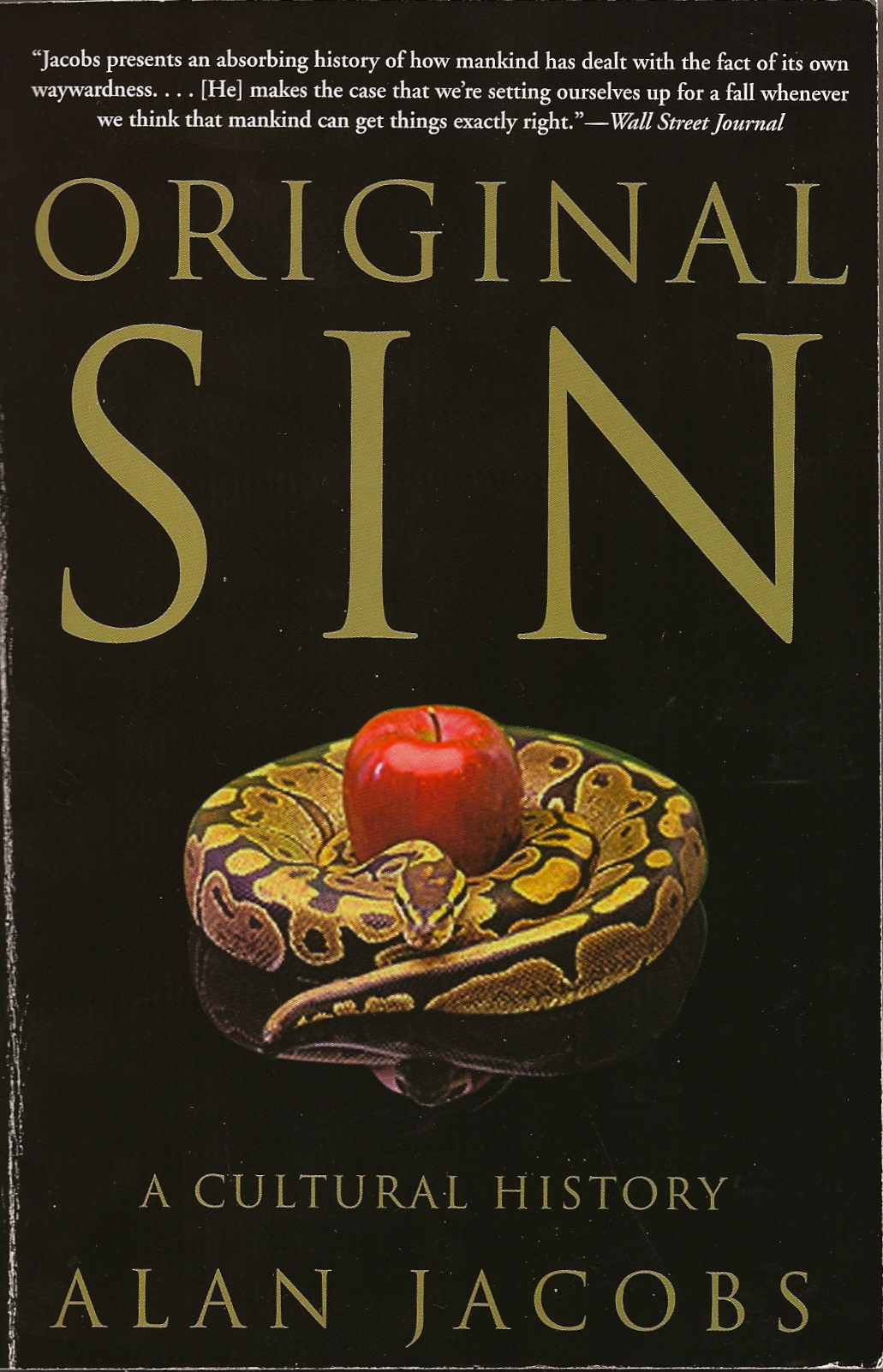
The third in the latest “Take and Read” series — a book analysis, discussion, and dessert group led by Paul Doerksen of MBCI — happens this evening and the book we’ll be talking about is Original Sin: A Cultural History by Alan Jacobs, professor of English at Wheaton College in Illinois.

Jacobs’ book is not a theological study of original sin (by which is meant “sin that’s already inside us, already dwelling in us at our origin, at our very conception”), but rather, as the subtitle suggests, the story of how this doctrine has worked itself out through (Western) history. Nor is the fact that humans do wrong under debate. That seems obvious enough. Anyone with self-awareness or knowledge of others, or with even a rudimentary sense of the 20th century knows how unloving and selfish, how truly cruel, we human beings can be. 

“Where does this wrongdoing come from?” asks Jacob. “What is its wellspring, the source of its ongoing prevalence and power?” In contemporary culture, scholars like Steven Pinker emphasize the biological determinants of human behaviour, but even they can’t explain “why selfish and violent are pejorative terms for us.” It’s time to re-consider peccatum originalis,  Jacobs says, “the belief that we arrive in this world predisposed to wrongdoing.” Continue reading

On cards and other gestures

For more than 25 years, H. and I have been observing an almost daily ritual. We get up at six and drink maté, a Paraguayan tea.* During the half hour we’re imbibing our caffeine, I wake up (as a morning person, H. is already wide awake), we usually read Rejoice!and we cross-check our schedules for the day. Then we get on with it.

Weekends, it may all take a little longer, and may include reading the paper and listening to music.

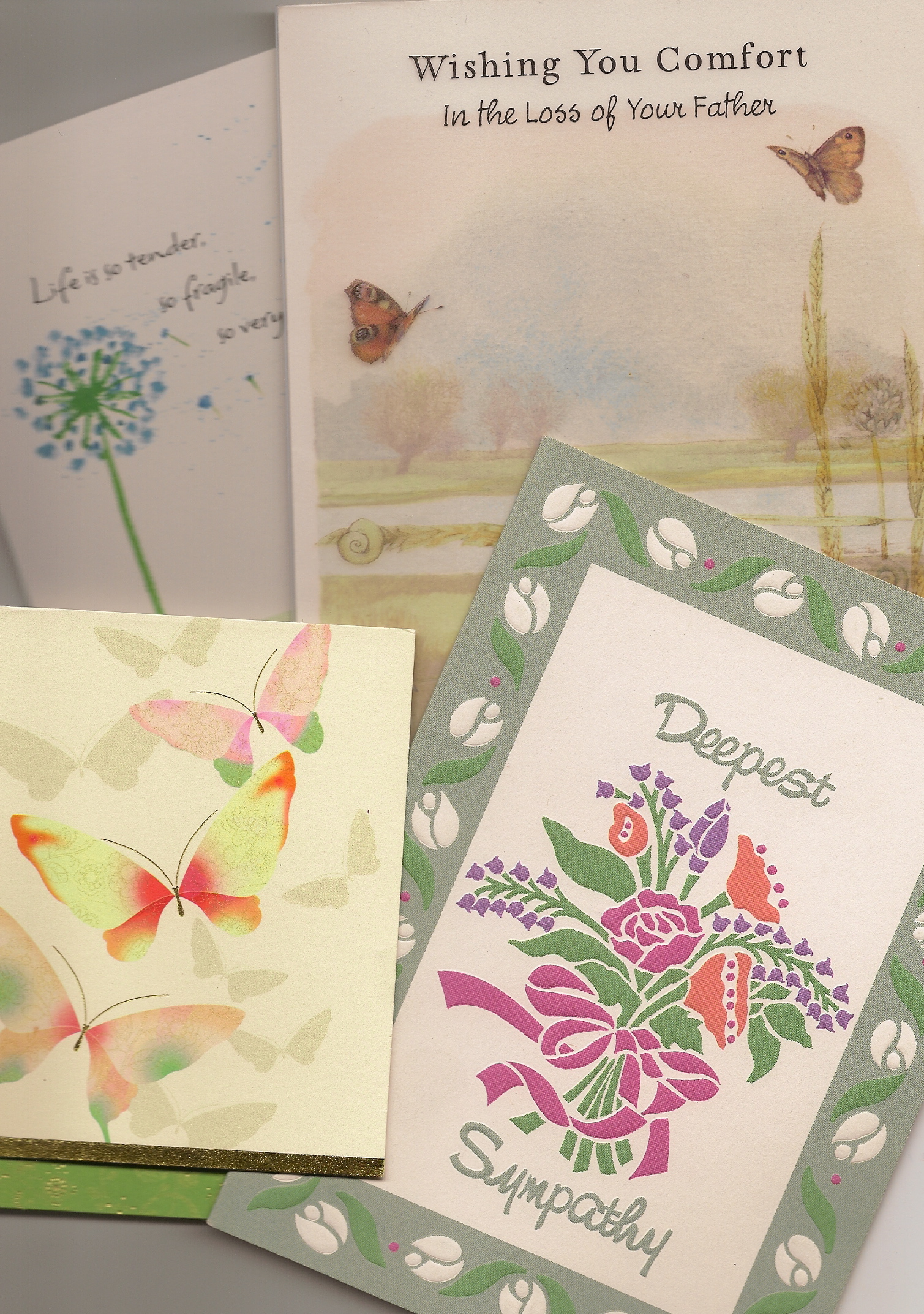
The past weeks we’ve added something else to our maté routine. We’ve been re-reading — three or four of them a day — the sympathy cards we received after my father’s death in December. We think about the senders and what they and the cards have said, and we include them with gratitude in our morning prayers.

I hope it won’t hurt anyone’s feelings to say that most of these cards then land in the recycling bin. The point I want to make is how much the cards have meant to us. Sometimes a person forgets the power of the small gesture — and how large small can be — until one is on the receiving end of one after another after another.

Some cards came from people we would not have expected to send one, and the surprise of that touched us. Some people who knew Dad took the time to share their memories – memories that enlarged our own memories of him. Some added a poem or reflected on similar experiences. Each card was unique, each one was appreciated.

We were the recipients of many other gestures-for-times-of-loss as well, such as emails and phone calls of condolence. Last week, we got the list of people who had donated money in honour of our father to the charity we’d chosen. Again, it was a humbling and touching experience, to see the names and think of what these gifts meant about Dad and us and these givers, and for the recipient mission agency.

Some gestures took the givers significant time. One friend spent the day baking cookies for us because she knew we were having a lot of out-of-town company. Several friends and a neighbour brought meals, including some of the most spectacular soups I’ve tasted in a long time. The church deacons came to visit, bearing  a fruit basket.

These are traditional ways of caring; they’re gestures and rituals we bring out for certain times. But like any ritual, whether it’s a daily one like our morning tea, or something practiced for specific circumstances, they build and maintain community. And what a wonderful thing it is to be part of community.

———-

*Drunk alternately as an infusion of hot water over yerba tea leaves in a container called a guampa and sipped through a metal sieve-straw called a bombilla. (Yerba leaves and paraphernalia pictured left.) Let’s just say it grows on you.