
“Atheist Delusions”: what I learned

I joined a book club this year — 4 books, 4 evenings with great desserts — led by Paul Doerksen, teacher at Mennonite Brethren Collegiate Institute, here in Winnipeg. On the menu tonight is Atheist Delusions: The Christian Revolution and Its Fashionable Enemies by David Bentley Hart.
It’s been a slog, frankly, reading this book, but that’s why one joins activities like this, I suppose — to persist in what’s good for one, not just the dessert! Hart takes on the current atheist apologists, none of whom I’ve read, and also considers in some detail the first four or five centuries of Christian history, with which I’m also not as familiar as I probably should be.

But here’s what I learned:

1. The current crop of church antagonists (Hitchens, Harris, Dawkins, Dennett, Pullman) are hardly worthy of the name. Theirs are “vacuous arguments afloat on oceans of historical ignorance.” The church used to have opponents of stature, of whom Nietzsche was the greatest, having at least had “the good manners to despise Christianity…for what it actually was — above all, for its devotion to an ethics of compassion…” 

2. The view of the past that modernity (whose “primal ideology” is nihilism) has given us — and one we’ve probably all absorbed — is just plain wrong. This false narrative, based on distorted history, tells us that the dark, confused Middle Ages gave way to “a new and revolutionary age of enlightenment and reason.” 

3. In fact, Christianity brought something entirely new and profoundly remarkable into the world (along with its single historical claim: Christ’s resurrection).  It was a “cosmic sedition” that gave “a vision…of humanity in its widest and deepest scope, one that finds the full nobility and mystery and beauty of the human countenance — the human person — in each unique instance of the common nature.” 

“For what it is to be human has been, in some real way, irrevocably altered.” 

This good news, he notes, evolving within a pagan culture of spiritual and moral decline, was “uncommonly attractive to women.” It imparted to the world “a deep and imperturbable joy.” And it started hospitals. (On the grounds of Christian charity, Hart gives not an inch — the range of Christians’ exertions on behalf of others was “astonishing.”)

Hart’s style is as vigorous and compelling as it is complex, and he has a magnificent capacity for what seems to me a kind of (usually) holy sarcasm. I’m tempted to quote him endlessly here, but first I want to hear how Paul Doerksen will pull Hart’s thesis together — he’s read the book at least twice — and what the rest of the participants of the group will have to say.

Left with a void: the new Mennonite memorial in Ukraine

Monuments often bear witness to those who are missing, but the design of the granite monument unveiled to “Soviet Mennonite Victims of Tribulation, Stalinist Terror and Religious Oppression” in Zaporizhia, Ukraine on October 10, 2009 is particularly poignant about absence. Designed by Paul Epp, it consists of three life-size silhouettes: a woman, a man, and two children. The base is meant to represent a mantel upon which we keep pictures of those who we want to remember, says Epp, except that here “we are left with a void, with all of what that can represent.”

The International Mennonite Memorial Committee for the Former Soviet Union, has erected a number of memorials in the former Soviet Union, but according to a report of the event by Anne Konrad, this is the first one within the former USSR to memorialize all Soviet Mennonites.

Mennonite memorial (photo credit: T. Dyck)


Committee co-chair Peter Klassen (left) said, “This monument bears enduring witness to the suffering of many thousands who cannot speak for themselves,” and co-chair Harvey Dyck (at mic) said, “The story of 30,000 Soviet Mennonites… chronicles a tragic past and opens us more fully to the suffering and heroism of Ukrainians, Russians, Jews, peoples of Siberia and Central Asia and people around the world.” 

My grandparents were among those fortunate to escape what World War I and then the Russian Revolution unleashed, not to mention World War II and the long terrors of the Stalinist regime in the Soviet Union. But as was the case in so many families, others in their family were not. The difference in the fates of those who left and those who stayed were often literally the difference between life and death.

I can’t get my head around how arbitrary it all sometimes seems, except to engage in the linked theological practices of thanksgiving and lament, but let me raise to the void of the new memorial just a few faces and names that belong there.

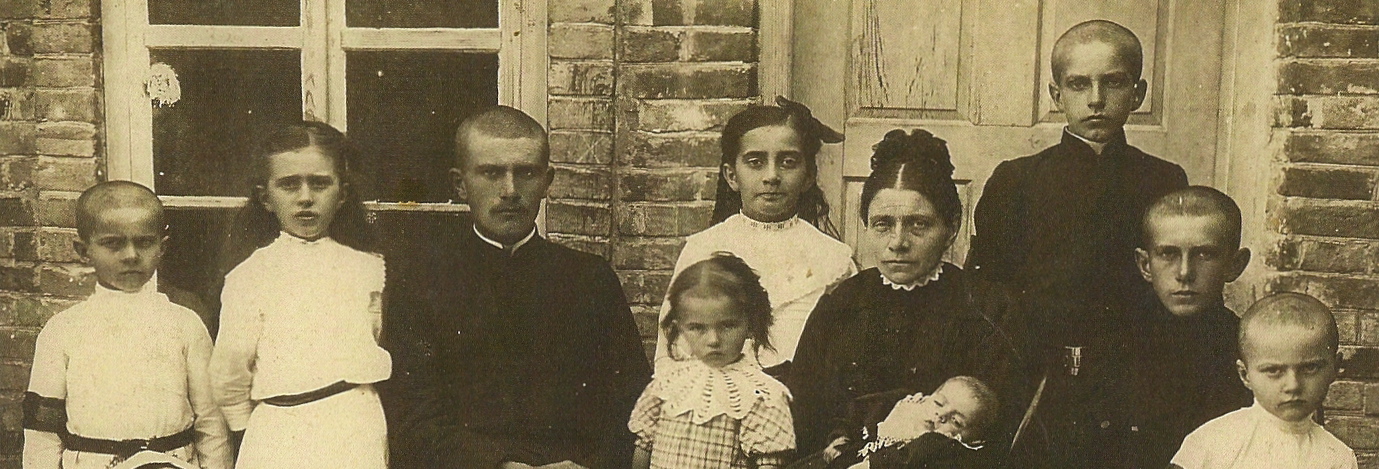
Tina Woelk and children, 1917


My grandmother Helena (Harder) and her family came to Canada. Her older sister Tina (Woelk) did not. Here is Tina with her 9 children, photographed at the burial of her husband in 1917. The oldest son, David, third from the left, was murdered in the political turmoil of 1919. As for the three boys on the right: Jakob reached Germany during the Second World War and did not return to Russia; Gerhard disappeared in that same war; Kornelius simply disappeared. Helena, second from the left, died of cancer in Siberia in 1956, Siberia being shorthand for the family’s exile to the work settlements of the north. Peter, on the left, died in Karaganda, that name shorthand for exile to the coal-mining southeastern region.

This is about all I know about these relatives of mine, told by the daughter of Katharina (standing at her mother’s shoulder), who grew up in the Soviet system and eventually, after the Cold War ended, moved to Germany with her husband.

So many empty spaces, children and youth without descendants. Just faces on a photo and names on a scrap of paper.

From the movie “Precious”

Precious, an abused and confused 16-year-old, barely able to read or write, pregnant with her second child, is enrolled in an alternative school with several other girls, each of whom is to introduce herself by name and her favourite colour and something she does well. At first Precious doesn’t want to say anything, but she listens to the others and then hesitantly raises her hand and says her name and that she likes yellow. Although she doesn’t think she does anything well, she finally acknowledges, at the coaxing of the teacher, that she can cook. Then — 

Precious: I never spoke up in class before…

Teacher: How does that make you feel?

(Pause)

Precious: … Here. It make me feel… here.