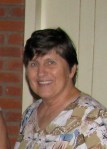
In Memoriam: Irene Janz (1947-2009)

Saturday evening, we decided rather last minute to go to a movie. I’d heard good things about My Sister’s Keeper and it was in the “cheap theatre” to boot, so off we went and watched it, and then, not many minutes after we were home again, we got the phone call: H.’s sister, Irene, had died, from her cancer. Just about an hour ago, they said.

While we were both crying during the movie, then, over the cancer death of fictional Anna.

I don’t mean to make a big deal of that coincidence. Whenever there’s bad news, things otherwise ordinary are thrown beside things that aren’t ordinary, and everything feels strange. Or maybe significant. I felt briefly guilty, maybe a little silly, that we’d been doing that, over a story, while this — a real death — was happening elsewhere.

The movie is a tear-jerker, no doubt about it, but on second thought, I know that in fact we were crying for Irene. We emerged from the theatre a little rueful over our mutual emotion. “Whoa, that was quite the movie to pick,” we said to each other, “under the circumstances.” We knew Irene’s cancer had returned with a vengeance, we knew the meaning of palliative care, we knew what was coming.

And we hadn’t realized the movie was all about that.

There’s been no end of other pictures running through our minds. Always her in the middle of it, someone who had energy for two, someone to whom the word housewife, or homemaker if you prefer, was a calling as wide as the Chaco of Paraguay, where she lived. Cooking, sewing, gardening, doing crafts, teaching Sunday school, hosting people, babysitting, running a milk farm for a while. Whatever was needed, she seemed able to do it. And a little extra. In 1984, when we were leaving the Chaco after our two-year sojourn there, we celebrated son S.’s eighth birthday at their place. Irene made him a chocolate cake and decorated it with a map of Paraguay.

We were crying for you, Irene, and for ourselves. The truth of the story and the truth of your dying were very much the same. Too young, too soon, but you, like Anna, yielded and ready, telling us not to mind, telling us you would be all right.

But we do mind, Irene Janz. And we’ll miss you.IMG_1256
The biography of B.B. and Liese Fast

admin-ajax.php
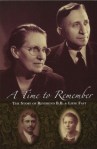
Last night, another book launch, another biography: A Time to Remember: The Story of Reverend B.B. and Liese Fast, privately published, 2009). B.B. Fast (1896-1964) was a teacher (in Russia and in Springstein, Manitoba) and also a businessman (with the company of C.A.DeFehr, his father-in-law), and a  longtime church leader in NorthEnd/Elmwood Mennonite Brethren Church of Winnipeg.

He was someone whose “strong contribution was not that of a dynamic pulpiteer,” according to MB leader and family friend, J.B. Toews, “but as a person who provided the model of life which in itself became an exposition of biblical truth…the model in which character reflected the truth of his expositions.”

The book was written primarily for the children and grandchildren of B.B. and Liese Fast, and so the launch was at the home of B.B. Fast’s youngest — Bill and Margaret Fast. And the reason I was there? Well, I wrote the book. But I must hasten to say that this was one of those projects with many layers of participation from many people, dreamt of and begun a long time ago, while all five children (Bernie, Bettie, Neil, Nellie, Bill) were still alive. They gathered and organized various materials, and they and the older grandchildren shared their memories. Helen Isaak, Herta Voth, Margaret Harder researched different aspects of the story; I pulled it into a narrative.

When I saw the finished book last night, for the first time, I have to say I was amazed. It was a bigger book than I’d imagined, and so beautifully put together. To the story of their parents, the family added a 6-page introductory essay by Waldemar Janzen (“How Menonites Came to Live, Prosper, and Suffer in Russia”) and lots of photos, maps, and scans of family artifacts, including a gallery of colour photos of B.B. and Liese Fast’s current descendants. It feels both warm and elegant.

Only two of the children are still living — Neil and Bill — and they seemed especially happy last evening that this dream of theirs had been completed at last. It’s a great thing to honour one’s parents — and an honour to participate in a small way in their doing so.

“A Generation of Vigilance”

The other evening, I attended the book launch of A Generation of Vigilance (CMU Press, 2009), the biography of Johannes and Tina Harder by Ted Regehr. Harder was leader of the Yarrow MB Church, a congregation that grew from some 200 to well over 900 members, the largest Mennonite Brethren church in Canada at that point. For several decades, he was the most influential MB leader in B.C.

The launch was rather sparsely attended, but it was a fine evening in spite of the few of us. Regehr strikes me as both gentle and suave, and I enjoyed hearing him read and talk about the project. I’d skimmed the book when it came into the MB Herald office for review and enjoyed that too. (Said review, by Abe Dueck, will appear in the November issue).

Regehr explained how he got involved in the project. Missionary/anthropologist Jacob Loewen “felt he’d contributed to Harder’s death and wanted to make amends,” so began collecting material for a biography but was unable to finish because of ill health. Regehr had “high regard for Jake,” he said, and curiosity too, “to examine some of the same forces, in a place where I knew no one, that had troubled me in Coaldale [Alberta, where I grew up].” Regehr accepted the invitation of the Yarrow Research Committee to do the biography and enlarged it to include Tina.

At the launch, Regehr read, and talked about, 3 sections of the book: the couple’s courtship, their first (Canadian) years in Winnipeg, and the “Rules” he and prominent MB leader B.B. Janz of Coaldale wrote for the Mennonite Brethren. When Janz got Harder’s draft he responded by saying he’d forgotten the most important thing: love. The Regeln (rules) became Richtlinien (guidelines) and the English version referred to “principles.”

In the discussion that followed, someone asked about parallels between Janz and Harder. Regehr explained that Janz was older and not in church office when “the wineskins burst.” (That focussed on his successor at Coaldale, J.J. Siemens.) But for Harder, it happened during his lifetime; “many things to which he’d devoted his life collapsed.” He felt he’d failed.

Harder had become increasingly insistent on immersion for membership, and when the MB conference agreed to widen the category, he went out of the meeting with a terrible headache and told J.B. Toews, “If I was younger, I would start another church.” It puzzles, that he was so adamant on this, for his wife Tina was only re-baptized after they came to Canada, and in his family of origin, some had joined the MBs and others not. His brother became a General Conference (now called Mennonite Church Canada) minister. A puzzle. Or are these explanations?