In the company of old words

My work priorities have shifted somewhat for December and January. Two weeks ago, N., the 17-year-old daughter of my husband’s nephew (which makes her our grand-niece I think), came to Canada from Paraguay to stay with us for two months, with the goal of improving her English. So we’re speaking our very best English and enjoying her being here and also setting her up with various local volunteer experiences.
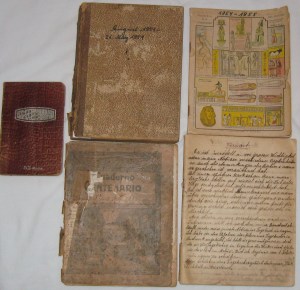
"Papa's Tagebuch" -- 5 notebooks brought by N. for me to transcribe.

“Papa’s Tagebuch” — 5 notebooks brought by N. for me to transcribe.

What this has to do with my priorities isn’t so much the presence of a teenager, however, but a time commitment I made on account of her coming. H’s father, who died before we were married, kept a diary for several years in the 1930s and then again for several years in the 1950s. His oldest sister had begun the work of transcribing these diaries for the benefit of the entire family. Thanks to her work, I’ve read the first two years of it in typed form — from Heinrich Dück’s leaving Russia in 1929 through the early years of settlement in the Chaco, Paraguay which included the deaths of his parents (his mother by lightning) and also his marriage. I confess I’ve been itching to read the rest of the diaries but my sister-in-law isn’t well and so she hasn’t been able to proceed. Continue reading

Miscellanea: December

1. I bumped into numerous web “shares” of Miriam Toews’ keynote speech at the Edinburgh World Writers’ Conference in Toronto on “Is there such a thing as a national literature?” but want to lodge it here as well because I think she’s making such an important point, familiar as it may seem: “A writer can only serve her nation [or other ‘nationalisms’] by serving her story.” Toews began by talking about “national literature” from the perspective of people’s curiosity about her as “Mennonite writer,” but in both Canadian and Mennonite — and probably in any category concerning identity to which we belong — there are expectations and wishes by other members of those groups or identities about how they wish to be portrayed. This is as true for her from secular Mennonites as conservative ones, Toews said. Group authorities and narratives promise “certainties and definitions and boundaries,” but “[t]he imagination is inherently subversive and cannot be mandated.” Continue reading

On disappointment

I’d anticipated writing a cheery post this week about Saturday’s trip to Dauphin, a small city about four hours northwest of Winnipeg. I was quite sure there would be something interesting to share — about the drive up, perhaps, or the afternoon reading I was doing at the Dauphin Public Library together with aboriginal writer Niigaanwewidam James Sinclair or the planned tour of the Ukrainian Orthodox Church or dinner and lodging with friends.IMG_1788

But, unless I write fiction, there’ll be none of that. We didn’t go. All the highways to our destination were closed because of severe icy conditions, so there we sat Saturday morning just outside Winnipeg, which was as far as we’d been able to drive, making phone calls, making our decision to turn around (not a real decision, though, since there was no option but to cancel) and feeling disappointment seep into our spirits. Continue reading