
Claiming a blessing

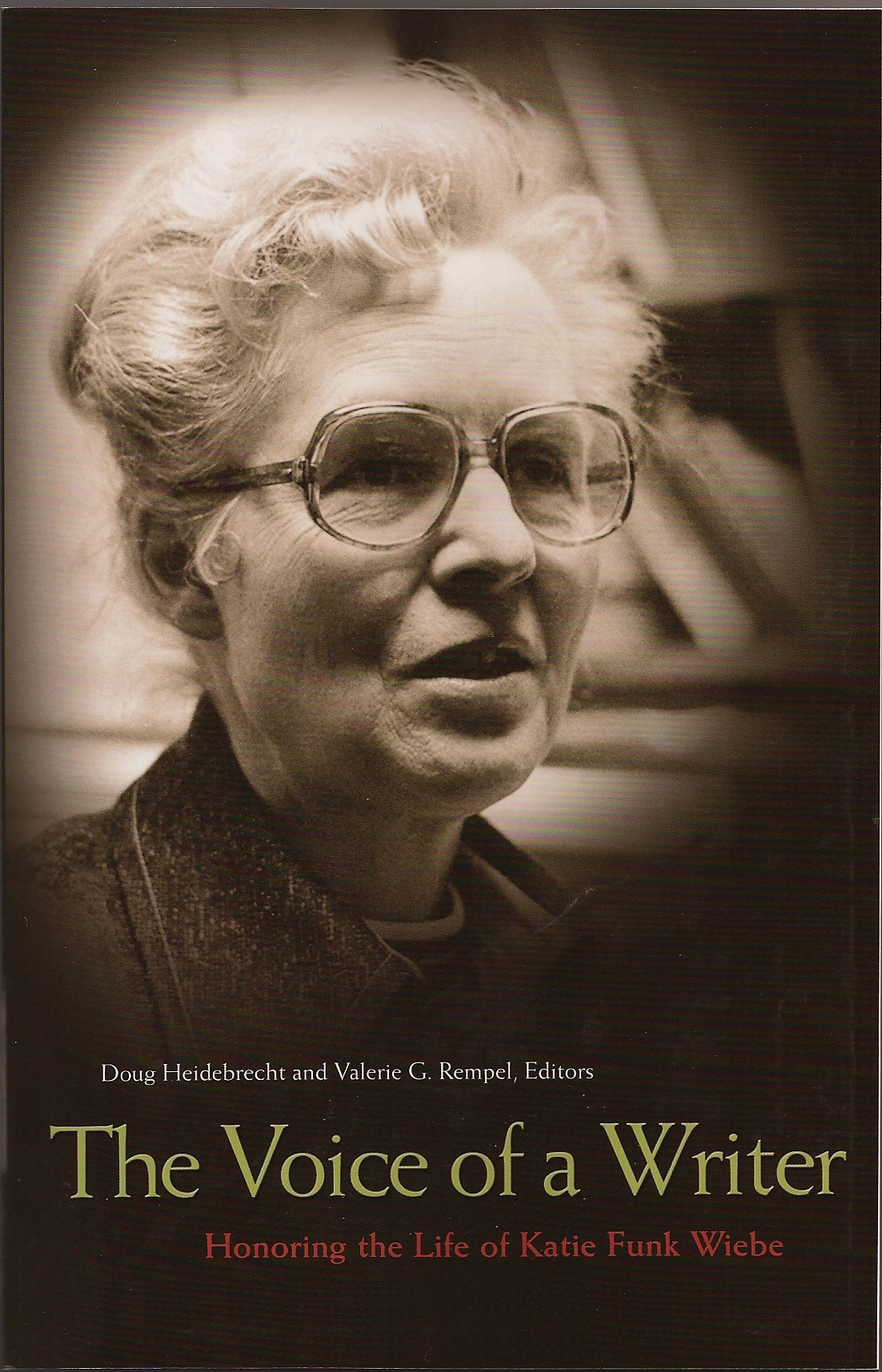
Katie Funk Wiebe longed for a blessing from her church — the Mennonite Brethren — and she’s getting it tomorrow evening (April 24) at Tabor College, Hillsboro, Kansas, with the presentation of a festschrift in her honour: The Voice of a Writer: Honoring the Life of Katie Funk Wiebe, edited by Valerie Rempel and Doug Heidebrecht.

I’ll be reviewing the book for the MB Herald, but I haven’t read it yet. Instead, after finishing the biography of Gloria Steinem mentioned in an earlier post, I re-read Funk Wiebe’s own telling of her story, in You Never Gave Me a Name (Cascadia, 2009). I’d read it in manuscript form in order to contribute a blurb for the cover, but wanted to come back to it in book form.

Which I’ve done….

The title strikes me as unusual, even a little odd. But it’s provocative, and in that provocation leads directly into the arc and accomplishment of Katie Funk Wiebe’s  life.

The plain name she was given by her immigrant parents didn’t seem nearly sophisticated enough for the dreams of the talented young woman; she preferred Kay. When she married, she became Mrs. Walter Wiebe, and when he was ordained, she was Mrs. Rev. Walter Wiebe, both names marking a certain (increasing) status but hiding her own. As a professor at Tabor College she was Mrs. Wiebe at first, and then as formalities disappeared for a new generation, simply Katie.  To her children she was Mom. Then, as a writer and speaker she used Katie Funk Wiebe, and gained name recognition.

Other things were given her: a particular heritage; a church unsure of its identity (evangelical, Anabaptist, fundamentalist?) and limiting of women; and the challenges of widowhood, single parenting, and college teaching. Inside what she was given is implied all that she wasn’t given as well — which she had to discover,  wrestle with, accept, or create.

In the “namelessness” of being a widow, a woman in the Mennonite Brethren church, and an older person, Katie Funk Wiebe named herself. She knew the loneliness of being set aside, hidden, unblessed, but she persevered to assert herself, to speak up for herself and others, and to claim blessing for herself even when it wasn’t granted by people or institutions. Continue reading
“Leaders Who Shaped Us”

I will, as promised in the last post, write about Katie Funk Wiebe and her book You Never Gave Me a Name, within the week I hope, but first this….

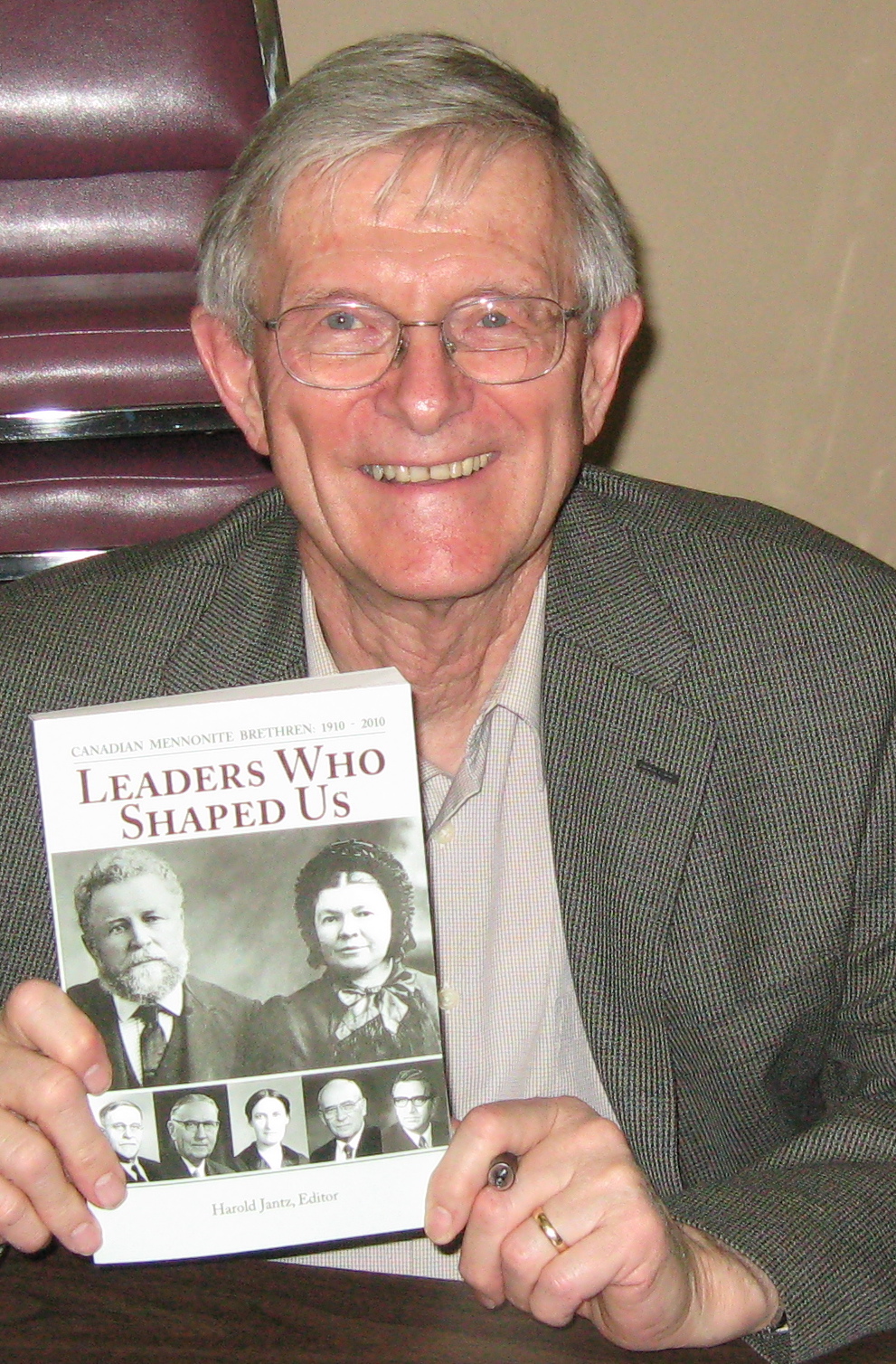
I’m just back from the launch of Leaders Who Shaped Us, a book of 25 biographies of Canadian Mennonite Brethren. (This year marks the 150th anniversary of the Mennonite Brethren denomination, and the centennial of the Canadian part of it.) Harold Jantz (left) planned the book, served as its editor, and also wrote six of the biographies. This evening, in his usual passionate and persuasive way, he highlighted the significance of some of them. Abram Kroeker, for example, not only a key early player in the potato growing industry of Manitoba, but a tireless promoter of Sunday school in churches, so much so that he became known as Mr. Sunday School. And entrepeneur C.A. DeFehr who was always on the scene, it seemed, when it came to building up the institutions of the church. 

It was while he was on holidays, Jantz said, and thus energized, that the idea for the book came to him. He realized that he knows a great deal of early Canadian MB history, and he also knows how quickly memory can disappear. He put together a list of 25 names out of a great many he could have chosen — 25 people who demonstrate influence and “shaping” of the Canadian church in various ways over the century. A number of the biographical subjects, including Herb Neufeld, John Redekop, Nick Dyck, and others,  are still alive. David Ewert, who is also written of in the book, is unfortunately very seriously ill following a stroke several days ago.*

Nineteen writers contributed to the volume in all, and those of us from Winnipeg who were around — Ingrid Koss, Dorothy Siebert, Sarah Klassen, Doug Heidebrecht, and myself — participated by reading a portion of our piece or talking about the experience of researching and writing our particular subject. I had written the article on B.B. Janz, “Moses” to some 20,000 Mennonites who managed to leave the Soviet Union in the 1920s and subsequently a leader in many aspects of Mennonite life here in Canada. I found him quite compelling. He was intelligent, sensitive, and persistent to the point of stubbornness. I liked his position on how conscientious objectors might have participated during World War II (as non-combatants, but providing service in the interests of life even on the battle front), though he annoyed conservative Mennonites by it and had no success with the government in developing such a program either. There was even a small personal connection, as my mother whispered to remind me after my little spiel tonight; B.B. Janz had ordained my father for church ministry.

I saw the completed book for the first time this evening. It looks great and I can hardly wait to read it.

Dorothy Siebert contributed 2 biographies: on Marie Wiebe and H.S. Rempel


Ingrid Koss wrote about Anna Thiessen


Doug Heidebrecht wrote about Katie Funk Wiebe


Sarah Klassen authored the story of missionary Katy Penner

 *David Ewert died April 23, 2010. See post in his honour.

Further to “Original Sin”

I promised, in my previous post, to say something about our “Take and Read” evening around the book Original Sin: A Cultural History by Alan Jacobs. I can report that the weather was cold, the roads icy, attendance about 17, and the desserts delicious. (No apples, but a hint of fruitiness in the lemon chiffon cake. The chocolate torte and Toblerone cheesecake, however, were temptation enough on their own.) 

More to the point, though. In summarizing Jacobs’ work, Paul Doerksen stated his discomfort with Augustine as he hardened his views about “sin, sex, and unbaptized babies.” With these disclaimers, Doerksen also urged us to consider “a more robust view” of original sin. As Jacobs points out, the doctrine does have its positives: it’s liberating (versus anxiety — if I can get it right, am I getting it right?), it’s democritizing (proceeding from an egalitarian spirit), and it has explanatory power (the only way we can understand ourselves). 

If we did take on a more robust view, what would that mean? One of the discussion questions posed to us was, How would an embrace of the doctrine of original sin shape the vocation in which we find ourselves? Doerksen reflected on his job as a teacher, for example. Was he more Wesley or Rousseau in his approach to his students? Thinking more of the image of God in them or of their shared sinfulness? The former has its difficulties and the latter offers some surprising potential, implications like Yes, they need guidance, but I do too, so mine shouldn’t be punitive but gracious, etc. 

The discussion ranged across many facets of the book, as such discussions do, but many participants felt that Jacobs had not done as well as he might have in placing original sin within its larger theological context of grace. Sin has to be seen by the light of the cross.

I took home with me a number of matters to reflect on further.

The matter of Mennonites, for example. They have not embraced Augustine much, being accused rather of semi-Pelagianism, said Doerksen, and thus prone to legalism, to a kind of uptightness, wanting the church to be pure, trying to getting it right. How many divisions there have been because of that!

There’s much about the origins of my own group, the Mennonite Brethren, that I love — that stirring up, under the preaching of Eduard Wuest, a Lutheran, of the sinner to see “the bottomless pit that opens itself at his feet” but then grasping “Christ’s own blood and righteousness / My beauty are, my glorious dress,” and the willingness to open mouths long closed by traditional practices of silent prayer, to pray aloud, to speak of these things, to find new and passionate language for what was experienced within, and that receptivity to the ideas and spiritual practices of others, like a new lens in a telescope revealing more stars.

But I also hear the hard words of the Document of Secession erecting new boundaries  — “Therefore, we herewith completely dissociate ourselves from these decadent churches, though we pray for our brethren, that they shall be saved…” If they’d been more Augustinian, could they have stayed and continued renewal within? Some of that separatist, uptight spirit lingers with us still.

Then there’s the matter of my vocation — as writer and editor. What would a greater awareness of my sinfulness look like there?