Truth and Reconciliation Commission: Day Two

Day Two at the TRC event in Winnipeg (Thursday) was grey and rainy, a tempestuous contrast from the first day’s heat. It made no difference, it seemed, except that the women’s sharing circle was paused earlier than expected in the afternoon because of tornado warnings. (Fortunately, a tornado did not materialize.)

It was another full day. I began at the interfaith tent, which hosted a panel discussion on “Native traditional spiritualities in conversation with Christianity” and ended the day at “Writing Truth, Imagining Reconciliation” featuring a strong line-up of writers, including Basil Johnston, Beatrice Mosionier (In Search of April Raintree), and Giller Prize winner Joseph Boyden, speaking or reading from their work.
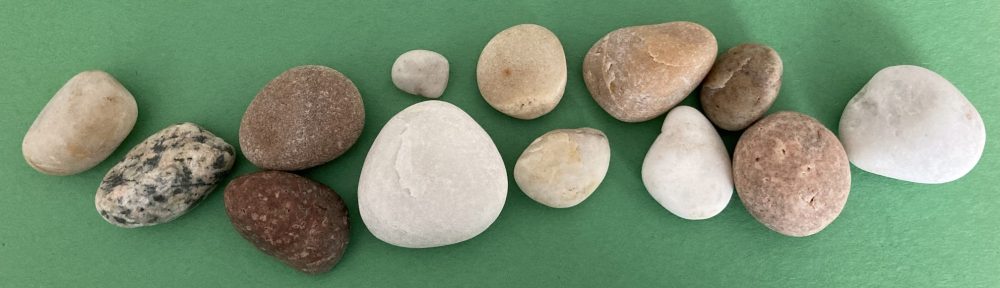
But the heart of the event is the sharing/healing circle, so once again I sat witness as best I could, first in the tent where there was a men’s circle, and then in the tent where there was a women’s.

What I was witnessing, I realized, was not only the impact of Indian residential schools, via the sharing of survivors, but a constant ministry of community support. A painted stone (painted by children) waiting on the chair of each person in the sharing circle itself, to hold while speaking. Traditional spiritual supports like opening prayers, “blessed” water to drink for participants, the smudge, eagle feathers. And more contemporary supports, like kleenex and the blue-vested “counsellor” people constantly in attendance. (Tear-soaked tissues are not garbaged but gathered to be offered on the sacred fire later in the day.) When the telling gets especially difficult, a family member (though everyone is addressed as “relatives” in the circles) might be standing behind the speaker, hand on their shoulder. Continue reading

Truth and Reconciliation Commission: Day One

I spent the day at the Truth and Reconciliation Commission’s first national event, here at the Forks in Winnipeg. My heart is full, and — to borrow the expression Marie Wilson, one of the commissioners, used — it’s also “leaking.” The day felt weighty and often emotional. I can only imagine how intense it must have been for the many survivors of the residential school system and their families in attendance.

Honourable Justice Murray Sinclair, commissioner, speaking at the opening ceremonies

This event will likely be well covered by the media, so I’m not going to give any kind of journalistic play-by-play but simply a few of my own impressions and experiences.

1. Personalized

I’m attending the event in response to the call by the TRC to come and bear witness to the dreadful legacy of the residential school system in Canada, a system set up by the government and implemented through various church groups to “civilize and Christianize” native people by forcible assimilation through education. The intent, stated most bluntly, was to “take the Indian out of Indians.” Continue reading

Defining big words

The experience of Alaska’s coastal scenery, which was part of our recent vacation, falls very quickly into cliche, into big broad adjectives like spectacular and beautiful. These words seem good enough for short answers (“how was it?”) but don’t really communicate that much. Not to others, not to one’s own perception or memory either.

Some extra attentiveness, it seems to me, is required. For most of us, today, the default solution is to point and click the digital camera. A quick capture, that, of what’s worth capturing, with the possibility and intention of looking again and remembering. Perhaps that’s enough. Still, sometimes I sat watching with my journal open, trying to find specific words, trying to put some content into the repetitious inner “oh wow” of this mountainous, green, and blue terrain. What is the green of this particular green, the blue of this particular blue? How to describe the sound of glacial ice calving, an eagle in a tree, the sight of whales when evidence  as slight as a tail above water or a spume of spray can set a whole deck-row of folks exclaiming, clicking, and training binoculars as a kind of burrowing for more?

It’s harder work than one expects, this describing, this paying attention, when it’s — yes — simply spectacular and one wants to leave it at that, except that one knows only too well that the big disappears more quickly than the intentionally-apprehended, which is often smaller.

As for the culture of cruising, that’s hard to describe as well. When I used that expression to someone we met on ship, he asked, “What do you mean?” Good question. What did I mean? Vaguely Las Vegas says something but is also cliche, a big-word stereotype. Slow Vegas for a lot of people over 50 gets closer. Not good enough, though. What exactly? This too needs reflection, definition by detail and story. I feel like it needs analysis.  I’m a woman at the end of  my holiday, however, not a travel writer. Let’s just say it was a “great” (big word) time for now and I’m much too relaxed to work at it further at the moment! For my own future, I’ve got some photos and notes.