Concern and influence

While I was picking blackberries on my way home from Tsawwassen Commons, a man on a bicycle passed me on the path and exclaimed, “You’re stealing from the birds!” He sounded quite serious, though he must have been joking because there are thousands and thousands of blackberries on those bushes. I called back cheerfully, “I don’t think so!” He was too far down the path for me to say, instead, “The birds get the best ones — the ones out of reach!” or “These crazy thorn-covered branches protect their own!” As happens frequently, afterwards I think of better things I might have said.

I ambled along the trail and filled up the yogurt container I carry in my little backpack since there are blackberry bushes bursting with berries in many of the places I happen to walk, but after I’d mulled a more clever answer to the bicycle man, I was thinking about whether to respond further to certain situations of which I’m aware — situations of harm done and subsequent pain — and if I did, how? I was thinking of a pastor friend’s blog post about his awful experience with denominational authorities, and authorities in the same denomination recently censoring an anthology of women’s stories I edited, and the collapse of a beloved congregation with grief in its wake, and it seemed something further must be done about these situations, though not regarding the beliefs involved as much as the behaviour contained within them. In a panic to control belief, I thought, all manner of bad actions had been done, had been justified, and were sliding into the past now without accountability.

…thinking about whether to respond further… and if I did, how?

Many years ago, when it was the wisdom-book of the day, I read Steven Covey’s The Seven Habits of Highly Successful People. One of his insights, which continues to help me, was the relationship of concern and influence. Covey pictured our concerns as a circle. Inside that circle is a smaller circle labelled influence. In other words, my concerns are often much bigger than my influence upon those concerns. What I take from this insight/diagram is to look at my concerns and, in my inevitable desire to effect some change, consider carefully what influence I can possibly, realistically, bring to them.

So as I was filling up my container, trying not to get snagged by out-reaching branches, which I swear leap forward if one is anywhere in close proximity, I wondered how much influence I had left, if any. I’d spoken up in several ways in the above scenarios and also worked on a small committee that organized a petition for redress for the pastor friend, which unfortunately yielded little besides pieties and excuses. Was there any point, I wondered, in telling a story much on my mind these days — the story of the time when I worked at the denominational magazine in 2004 and all the staff were women and a leader friend told us of a recent Board of Faith and Life meeting in which a board member unleashed a rant about us, using the worst labels he could think of, it seemed, without quite calling us Beelzebub? We laughed it off and went back to work but what hurt was the stunned silence he told us had followed, no one speaking up in our defence, the chair then carrying on with the meeting.

The story had a happy ending, however, because some weeks later our friend, perhaps bothered in retrospect by his own silence, told us he’d rallied his fellow board members and they’d given the ranter an ultimatum: withdraw the remarks or resign. Apparently said ranter did the former, and while it’s possible he didn’t change his mind about us, a line about charitable behaviour had been established and our friend and his colleagues had used their influence to establish it.

…a line about charitable behaviour had been established, and our friend and his colleagues had used their influence to establish it. 

Would there be any point indeed, I wondered, to tell such a story? The story, in essence, seems a model and a plea to those who have influence where I have none, folks like pastors and seminary professors and colleagues of the denomination’s pinnacle leaders, who, as far as I know, though I don’t know for certain, have been mostly silent on these matters. Was there any hope of persuading them to prioritize behaviour, of persuading them that the health of their denomination is surely their concern, of pleading that they rally and declare that these harming actions must be withdrawn or somehow addressed or we no longer have confidence in the leaders responsible?

I reached home, and still had no answer about whether I had a wee edge of influence left to touch my concerns or rouse the influence of others or whether a simple story and plea would be like shouting after a bicycle man already out of earshot. I saw the half-finished jigsaw puzzle on the coffee table and thought of the enjoyable slow rhythm required for its completion; the patience of many pieces and a steady process of finding the one by one. Maybe, I thought, it’s a puzzle piece I’ll place when I find the spot it fits.

Or maybe I’ve already placed it.
In spite of fear and hesitation

When we push through and accomplish something we’ve been afraid of, or dreading, the satisfaction at the other end is often enormous: relief, surprise, happiness, pride. Even if it’s nothing particularly remarkable in the eyes of others, it’s the doing in spite of hesitation, the overcoming of inner resistance, that makes it seem a personal triumph.

An example for me is my recent road trip to Alberta: eight days away, about 2500 kilometres. Helmut and I enjoyed road tripping, but he did most of the driving. I might spell him off for an hour or two, by which time I was tired but he’d had a snooze and was good to go again. He liked driving; I felt he was better at it than I was. I suppose it was just one of those intuitive patterns couples fall into over the years. In fact, I ‘d never filled up the car with gas until the last year of his life, when it occurred to me I might need to know how, and he showed me. He had always kept track of everything about our vehicles. Besides, if need be, there were gas stations like Domo or Co-op where I could pull in and they did it for you.

Anyway, back in winter when everything concerning summer seemed possible, I agreed to attend a school reunion with my long-time friend Miriam, and decided to combine it with visits with other long-time friends — Eunice and Ruth — in Edmonton and Calgary, as well as my grandson Ben. As July neared, however, I grew nervous at the prospect and kept wanting to change my mind! But I’d promised, and I knew I should give it a try.

And I did. Every destination I reached, thanks to the lovely guiding voice in google maps (whom I thanked aloud more than once, as if able to speak she must also be able to hear) boosted my confidence. The visits were good, and the reunion after 50 years, though a “time warp” in Miriam’s words, had its surprises and gifts. I was kept safe and returned home with the satisfaction of it all, and perhaps a little more pluck.

C11E7899-0701-4031-850A-FA458A5FC39C

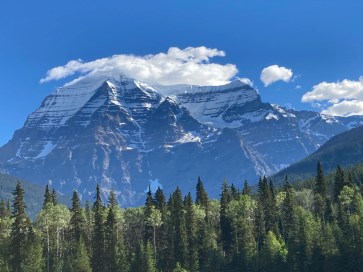
Mount Robson

Out of quite a few, just two memorable moments: my first glimpse of Mount Robson, highest peak in the Rockies, crowned with clouds, as I rounded a curve on the Yellowhead Highway from Yalemount towards Jasper. And, finding that, unbidden, tears were sliding down my face during the grand entry (with its drumming, colour, glory), thinking especially of the women, at a powwow my photographer friend Ruth took me to in southern Alberta.

1D7419F6-77AB-40DC-B0B1-37CC4E4D6BCC

Credit: Ruth Bergen Braun. See more of her powwow photos at https://www.facebook.com/Ruth-Bergen-Braun-Photography-479109028950448

Do you have any recent stories of “pushing through” to reward on the other side?

Forgotten treasures

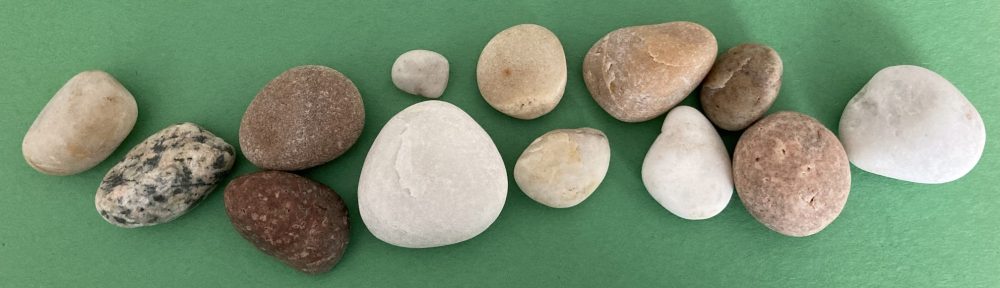
Sometimes, looking into my journals for one reason or another, I come across bits of my life I’ve completely forgotten. In truth, a great deal of my life is completely forgotten, but you may know what I mean when I speak of bits we encounter again, how they’re like pretty stones or shells children pick up and tuck as treasures into drawers or the bottoms of backpacks, how they’re delightful all over again.

A23F3A3C-2F88-4769-BF65-23F855A52F71

stones in a story nest

In a recent example, in my 2003 journal I saw mention of the first session of a “Writing Your Memories” class I taught at a local seniors centre. Six participants. I noted their names. (I’ve changed them here.) “It went well,” I wrote, saying further that I was drawn to the person and accent of Katharine, who had lived in India, England, and now Canada. And that Florence was rough, always ready to talk, and said she’d had polio in high school. Perry, the oldest at 84, had related his earliest memory of seeking his mother’s breast only to find she’d turned her blouse around; hence, his weaning. This reminded Alice, who complained she couldn’t hear and didn’t want to write and hadn’t realized the class was two hours long, of her own drawn-out breastfeeding as a child, and her weaning, and her refusal, ever since, to drink milk! The suggestion of breastfeeding as birth control reminded Delores of what a women who stuttered had said, that by the time she’d managed to say “t-t-t-that’s enough,” she had five children!

I paged forward a week in my journal. I’d mentioned the second class. “I felt sort of panicky, because I feel like I’m out of my league. The class itself went well–but …I’m leading people forward not knowing where I’m going myself.” Florence, I noted, told me I was a good teacher, which encouraged me, but I wasn’t sure I believed her, for to be honest, I hadn’t done much memory writing myself at that point. I also didn’t tell her I wasn’t sorry she wouldn’t be able to attend the last two classes. She was talkative, in a dominating way, and I didn’t know how to manage that.

I’d had the class make a timeline of major events in their lives, as a way of breaking personal chronology into manageable sections they could write about. Alice’s #3 on her list said “period.” She explained that she let a boy kiss her. When her period didn’t come the next month she figured she was pregnant and was so scared, she looked for a rope in the shed to hang herself. Her period came, but after that she didn’t let anyone kiss her until her wedding, when she heard the minister say “you may kiss the bride.”

“I like these people,” I told my journal. “I like people generally, I’d say!” Shy Delores. Alice who didn’t write but came anyway, talking. (“Look at them write,” she said to me. “I’d have two words.”) Perry with his long and amazingly detailed memories of a northern town in Alberta where he’d lived. Katherine with lovely memories of her Ayah in India.

I looked ahead in my journal to the next Monday and the next, but there was nothing further about the class or any of these people. My husband and I were busy building a new house at the time and I talked about that instead. Looking at these brief notations now, I remember a little — very little — but am given pleasure in what’s there, and in a fresh awareness of the vast number of human stories that exist, and I wonder if those six people got further with their memories than what they wrote and related in the class. I wonder if anyone else jotted down some of Alice’s life so she would have more than two words left behind.