Ten Sentences about Mennonite/s Writing Ten

  1. On the flight home from Winnipeg to Vancouver, I scan my notes and discover they’re so pathetically cryptic, they’ll be useless for saying anything meaningful about the conference sessions.
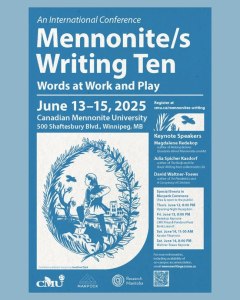
  2. Nevertheless, I can state the facts: this was # 10 in a series of conferences called Mennonite/s Writing, held every 3 years or so, and this time at Canadian Mennonite University in Winnipeg, Manitoba, June 13-15, under the theme “Words at Work and Play.”
  3. The conference happened against the news of nearly 300 dead in an Air India crash, Israel attacking Iran, ongoing National Guard/ICE craziness in Los Angeles, yet here we were, maybe 110 (?) of us, thinking and talking about writing, for in her keynote, Julia Spicher Kasdorf said her response to global concerns is to become more local, and these days, this was our local.
  4. I really enjoyed the conference — the sessions and keynotes of course, but also the collegiality, the many conversations with old and new friends, a happy sense of belonging because even though I don’t label myself a “Mennonite writer” (what does that actually mean, never mind these regular gatherings trying to figure it out) I still know that in some real way this is my tribe and besides, they’ll have me, which is always a happy and satisfying thing.
  5. The keynotes were highlights: Magdalene Redekop in an almost poetical trail of insights and juxtapositions on “translation” — a task we all take up in our lives — and David Waltner-Toews tackling “the meaning of everything” via science, that is, each of us “an unstable patchwork at our very core” yet interconnected, and Julia Spicher Kasdorf ruminating on Mennonite identity, noting “identity politics reduces complexity” and “identity work can wear a body out” yet calling us — stirringly — to commit to writing as practice and conversation.
  6. I very rarely — honestly — notice what people are wearing, though there were several memorable, if minor, exceptions this time, for I glimpsed a well-known writer in his pyjamas in the residence hallway and I think they were blue and white, and Di Brandt wore a garland of (cloth?) red flowers and leaves on her head during her presentation, and my longtime friend Sarah Klassen looked classy in a neat, belted teal dress, but I do notice space and felt the conference metaphorically balanced by having parts in the aged, wood-toned ambience of the Great Hall and its connecting corridors and other parts in the newish light-filled Marpeck Commons.
  7. Most of the sessions ran concurrently with others, which meant that every choice meant missing something else, but the personal program I selected began wonderfully with David Elias on his grandfather’s brother and Elsie K. Neufeld on her work as a personal historian and Linda Umble on reading Mennonite texts, and ended as wonderfully Sunday morning with three poets — Jeff Gundy, Julia Spicher Kasdorf, Ann Hostetler — reading their work, and in between I presented too (“Thinking about Oneself: Desire and Discovery in the Personal Essay and Memoir”) alongside Mary Ann Loewen who gave a memoir talk about herself and her granddaughter, both of which went well, we thought, and provoked some good discussion..
  8. A good number of younger people attended, and some presented, as in a session I attended featuring readings by Joelle Kidd, James Bergman, and Geoff Martin (whom I had “met” before, in a manner of speaking, when essays we’d written sat side-by-side in The New Quarterly — his was the winning one!) and it was great to hear new and younger voices in the mix.
  9. On the Thursday evening before the conference began, In Search of a Mennonite Imagination, edited by Robert Zacharias, containing key texts in Mennonite literary criticism, was launched at McNally Robinson Booksellers and I bought it, all 700+ significant pages of it, and later some other books besides, not as many as I may have wished but more than I could carry in my full backpack, but then a friend who lives in the next town over kindly offered to transport some of them, including the massive tome, in his luggage.
  10. The conference included an optional “literary tour” of Steinbach, which I selected to do, and it was interesting to see places associated with writers such as Miriam Toews and Patrick Friesen and ended with a delicious faspa at the Mennonite museum, where my final “Mennonite” sight of the weekend was a sculpture of the famous Dirk Willems story, which makes me wonder — in terms of two words Julia Spicher Kasdorf set against each other —  whether it represented, and could be told, as “continuity” rather than “rupture.” 

Thinking about arches

I like arches. I’ve been thinking about them–their sense of invitation and transition. The way they frame what’s ahead. I don’t mean famous arches like L’Arc de Triomphe in Paris or the Gateway Arch in St. Louis. but simple arches I’ve encountered.

This first one is created by trees meeting over a path to the dike I often walk, and just beyond it is View–of the bay, which is sometimes beautifully spread with water and sometimes, when the tide is low, less beautifully spread with mud.

The next is also local, also of greenery. Enter this portal and you’ll be in a peaceful, quiet Tsawwassen place of trees, flowers, and plants called The Secret Garden.

And I love detouring through this one on my way to the library. It’s structural, yes, between two parts of a condo building but leads to a large reflective pool with koi.

I have a few favourites from travels. First one is in Turkey, one arch opening to another. It seems both holy and mysterious. Second, somewhere in Europe, Freiburg I think (and don’t you just want to go through and around the corner to that street?) Third is in Central Park, New York. The ceiling nearly grabs all the attention but there, at the end, three arches, stairs, and light.

And as metaphor? In the ordinary, daily life? For me a book or story is like an arch that summons me into another place. The exercise of gratitude is an arch as frame around the day’s happenings. Any shift of thought or action that leads me toward a different, perhaps wondrous view or next steps is an arch to go through gladly.

A ritual procession down 56th

A good funeral, poet/undertaker Thomas Lynch says, gets the dead where they need to go and the living where they need to be. When my husband Helmut died four years ago in the middle of the Covid pandemic, the usual mourning rituals had to be significantly modified. Not all of this was disappointing. It was a privilege for me, for example, to wash his body myself and, with the help of a son, dress him after death. The funeral service had us as a family separated into three “bubbles” but was meaningful nevertheless, as music, readings, eulogy, and homily flowed smoothly via the technological help of one of our pastors. We very much missed the physical presence and hugs of other people but, as a livestream production, it was possible for local friends and family as well as those in faraway places like Winnipeg and Paraguay to participate.

Once Helmut knew his diagnosis was probably terminal, he built his ashes box himself, of two favourite woods–maple and walnut. The plan was for cremation and then interment in a columbarium niche. The first part happened, and then four years passed with the box and ashes in the apartment with me. I didn’t mind at all, to be honest. But the time had come, and the opportunity, for the second part. This month, the whole family was together in B.C. for the wedding celebration of our daughter and her wife who were married five years ago, also during Covid, but sans the party. The couple graciously yielded a day of their celebration week for the interment of Helmut’s ashes.

I decided I wanted to walk to the cemetery and all the children and available grandchildren (some were in university classes and couldn’t come) gladly joined me. It’s about two kilometres from my apartment to the cemetery, but everyone’s fit to walk. The nearly-nine-year-old granddaughter wanted to know why we were doing this and I told her about the practice of pallbearers, about the symbolism of carrying our dead where they need to go. It took us about half an hour, down 56th Street, the main street of Tsawwassen, and whoever wished to, had their “turn with the urn.” (It was heavy!). I enjoyed this walk and the various conversations enroute, this carrying of our husband, father, father-in-law, grandfather at the pace of our feet.

A granddaughter takes her turn.

At the cemetery, we gathered under a canopy. I shared a few thoughts and memories, as did others, the granddaughters read some selected scripture texts, we spoke a litany of commital together, and the three children placed the box in the niche. Then the cemeterian came and closed the niche and placed the plaque over it. It felt emotional for many of us, but good.

I’ve startled a few people already with the photo of the niche plaque, because my name is also there. Please don’t be, it’s what my parents did with their cemetery stone, and it feels perfectly comfortable for ours. A niche has room for two “urns” and it’s where my cremains will go as well. Whenever; year only to be added.

After the ceremony, we gathered at the home of the oldest son and family, not far from the cemetery. Since I’d baked cinnamon buns for our lunch together and since I needed to be alone for a bit after the interment, I walked back down 56th Street, just me this time, and that felt necessary and symbolic too, and I picked up the pans of buns and brought them to the house in the car. We had a lovely day together, all of us gradually turning our thoughts to the upcoming marriage celebration. (Which turned out to be a wonderful day too.)