Well beyond time to show up here if I’m going to call myself a blogger, but honestly, nothing original is urging itself upon me to say. How about a few days of my journal from seven years ago then? The prose is a bit loopy in places, but it’s a journal — one is talking to oneself! My words from the past often seem strange to me, events already over and long forgotten, but there I was, in those days. (Do you remember these episodes in “the news”?)
Tuesday, August 8, 2017
8 p.m. Enjoying cool air of balcony. Fallen flower petals litter the floor, cherry tomatoes now eager to ripen. Helmut at Habitat [for Humanity work site] today and I did revisions [to a story and essay].
Per David Brooks, who opined at NYT that he was trying to divest his brain of Trump, and Garrison Keillor who had a great column about his high school reunion and how the man’s name didn’t come up at all, and then how what’s (more) important is tomatoes, I didn’t watch news in the afternoon hour I often allow myself to puzzle, but listened instead to an Eleanor Wachtel interview with Edna O’Brien. “Oh wow,” I said to myself when it was done, “that was good.” Truly rich in ideas, emotion, compassion-capacity. – So all good, and turns out I have an Edna O’Brien short fiction collection on my shelves. –
But during my brief victory away from the news, there is a new “development” that occurs. Bombast from North Korea, bombast from D.T. who promises “fire and fury…and force,” “like the world has never seen.” Shock, for he sounds just like Kim Jong Un. It’s really quite frightening, this build-up of tension, both of them nuclear powers.
Friday, Aug. 11, 2017
Two quite opposite emotions today—one a sense of fear/sick/disgust/worry—who knows how to describe it, as the rhetoric continues, and continues—ON THE U.S. SIDE. It’s quite frightening really, and as leaders urge the rhetoric be lowered, D.T. carries right on. His poll #s continue to drop, as markets are too, and it’s as if he thinks he’ll gain people back by talking tough. “People like it,” he says…. It really did quite bother me. I bleat it all Godward, yes, but am mostly bothered by piety [when someone says] well we’re in the last days, we don’t understand, just “watch and pray.” That is good advice, but are we really in the last days? I think we have to resist warmongering like that. Poor Koreans and others in Asia, Guam, etc. Lord have mercy.
But, the world is coming to an end, so why not buy a painting? Was compelled by a “R. Lake” I saw in the thrift shop yesterday, a landscape, flat though low mountains on horizon, a large tree centre, some small buildings. It’s not like real detailed, you have to stand back, but there’s something about the blues. Anyways, it was still there this morning, had in the meanwhile looked up R. Lake, which is Randall Lake, born 1947, of Utah, ex-Mormon, his paintings recently more political—gay man, taking on Mormon Church for their damage to LGBTQ etc. $65. So happy with this acquisition, now in our bedroom.
Haircut today too, some puzzle fun, and some work (revisions), though not as much as I should have, if I wasn’t so anxious about nuclear war or busy rearranging our walls.
Saturday, August 12, 2017
So yesterday I posted my feelings on FB—re North Korea, my cries for Korean people, opinion that DT brought world to brink—….quite a few comments, which is always a little surprising… Karla B. alerts me to tomorrow’s Sunday of Prayer for Peaceful Reunification of Korean Pen. Betty B. says Australia feels very close. John L. proposes how both leaders will spin this. Carol Ann W. recalls Cuban Missile Crisis, how she played Bach. Dayna D. shares Anne Lamott:
What to do in the face of Locked and Loaded? The usual: Help! Thanks. Wow. Radical self-care. Trust & surrender. Serve the poor. Breathe.
So, interesting conversations that FB provokes. I just “like” everyone and leave it at that.
BUT, End of the World is so yesterday, she says (to herself) sarcastically. Who’s even thinking about that?! Today it’s Charlottesville, VA. Neo-Nazis, KKK, Alt Right gathering, violence and counter protests. A car rams counter-protestors, a woman killed, 3 deaths in all. DT generically calls for unity and condemns violence “from many sides, from many sides.” Dos not condemn white supremacists who chant Heil Trump and wear MAGA hats, David Duke who reminds who elected him. I listened to the statement and agree, it was tepid, he who can be so specific in his criticisms. He… can’t name it for what it is.
Someday, maybe 10-20-30 year from now, if someone reads this, they may say, well is she just hyperventilating, worrying… Believe me, it is this bad on this continent, this sense of division, this sense of something terrible unleashed from the top. “Blood and soil,” they chanted, as they walked with their tiki torches. And “Jews will not replace us.”
Well, the Sabbath nears. Breathe, dear heart. Read your Edna O’Brien book. Think of your new painting-print. Your kids and grands… [Gratitude] for this day. For the blackberries we picked this morning. For the Staples store that opened nearby today. For a pot of yellow mums. For Helmut.

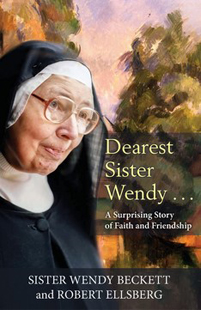 I was alerted to Daniel Ellsberg again this past year by occasional mention of him by in the book Dearest Sister Wendy…, which consists of letters exchanged between Daniel’s son Robert Ellsberg, publisher at Orbis Books, and cloistered nun Sister Wendy Beckett, whom I had come to admire from the BBC documentaries on art she did back in the 1990s. She would stride into art museums with her black habit billowing behind her, about as far from hot pants fashion as you can imagine, bringing love and insight and utter lack of pretension to all she saw. (These can be viewed on YouTube.) Hers was a brief and unlikely fame, and come to think of it, in that unlikeliness, she was very similar to Daniel Ellsberg, who a friend of his called “one of those accidental characters of history who show the pattern of a whole era.” (Read an interview with Robert about his father
  There’s a wonderful painting of Sister Wendy on my “mantel” (over a television, not fireplace), painted by my artist friend Melody Goetz. I’m finding that hardly anyone who sees the painting has heard of Sister Wendy, but she’s been an inspiration to me through the documentaries and also her books about art and now this recent book of letters, compiled by Robert. Her cloistered world was small, yet large in its generosity and assurance of God’s love for and within people. As, for example — opening the book at random — in these sentences in response to his frustration over the then-president:
 I’m drawn to her prayerful composure, to her enviable peace about aging, to her hands. And I’m reminded of the hands of my great-grandmother, Katharina Mandtler Derksen, who led a very different life than Sister Wendy (a difficult marriage, and birthing 11 children with only three surviving to adulthood) but exhibited, according to my mother’s recollections as a child, a similar calm and praying presence in their home in the last years before her death.


 Borrowing Bones