A nest that remembers

There’s lots of discussion these days on the future of the book. Everyone seems aware that digital reading and publishing is changing the way we write and read and publish, that it’s changing what we’ve assumed for a long time, namely that books adhere to paper and pages and bound volumes of various kinds, so lovely to hold and open and read through and close again and set on shelves.

I’m not here today to offer my opinions on these changes (though if you’re interested in the future of books topic, there’s a series of writers, booksellers, publishers talking about it at the online Winnipeg Review), but rather to mull on an art exhibition we attended last evening. “Bound by Nature,” at the Mennonite Heritage Centre Gallery in Winnipeg, May 6 to June 18, reflects on books in a very different way. Officially it’s described as an exhibition “inspired by nature, landscape and books” and it’s all that (and a really fascinating juxtaposition when you are made to stop and think about it) but it was “book” at the heart of the pieces that especially drew my attention.

So, for example, book spine covers used to create a series of “horizon” landscapes by Deborah Danelley reminded me of the world we see but also what one sees in books. They made me think of those large books I’ve known, yes with their cloth/paper spines fraying and loosening, maybe books of art or photos, a treasure of things and also a kind of borrowing from one medium to the other.

There’s a whimsical display called “Wildflowers,” by Deborah Danelley and Carol Leach, featuring what I can only call a “bed” of flowers fashioned from the pages of recycled garden/landscape/nature books. Erwin Huebner has a number of interesting pieces that reflect on the “books” of small places like eggs (think of all the information an egg contains) and the stunning color and shapes of substances seen via the microscope. Other artists had made accordion books and match box books; there was richly textured paper.

"Nest as destiny" by Agatha Doerksen

I knew that my sister-in-law, Agatha Doerksen (Denver, Colorado), had a number of pieces in the exhibition, so of course I was curious to see where the theme had taken her. I was not disappointed; her pieces were a highlight for me. A number of them were intricately altered books opening into nests, and her author’s statement asked some intriguing questions:

If a seed becomes a tree, does the tree remember the seed?
If a tree becomes a book, does the book remember the tree?
If a book becomes a nest, does the nest remember the book? 
Where can I find a nest that remembers the seed?

I left the exhibition with a sense of the seamlessness of story/book and nature, of book as memory, of book as something something primeval, even primitive, vulnerable though resilient. I left feeling, strangely perhaps, optimistic about the future of the book.

—-

"I want to tell a tree my secret" by Agatha Doerksen (seed pods with book pages rolled tightly into its cavities)

Note:  Canvass has a statement about the exhibition, and on the third page, images of some of the other work. Eleven artists participated, and the exhibition was curated by Deborah Danelley.

A hunger for beauty

Manitoba autumn

Manitoba is not the Autumn Glory centre of the world, I’ll grant you that. It has to do with our particular climate, the kinds of trees that grow here, and so on. The “East” is definitely the place to be for spectacular oranges and reds in fall.

Still… we do have autumn and we do have much to enjoy and celebrate, and this year the season has been especially warm and lovely. Last Tuesday, since he had a day free between projects, and since I wanted to do some research/observation for the writing I’m working on, H. and I set off for a drive into the country, down to the Pembina Hills area, as far south and west as Manitou. The colours in the trees and also ditches were a treat for our eyes and spirits.

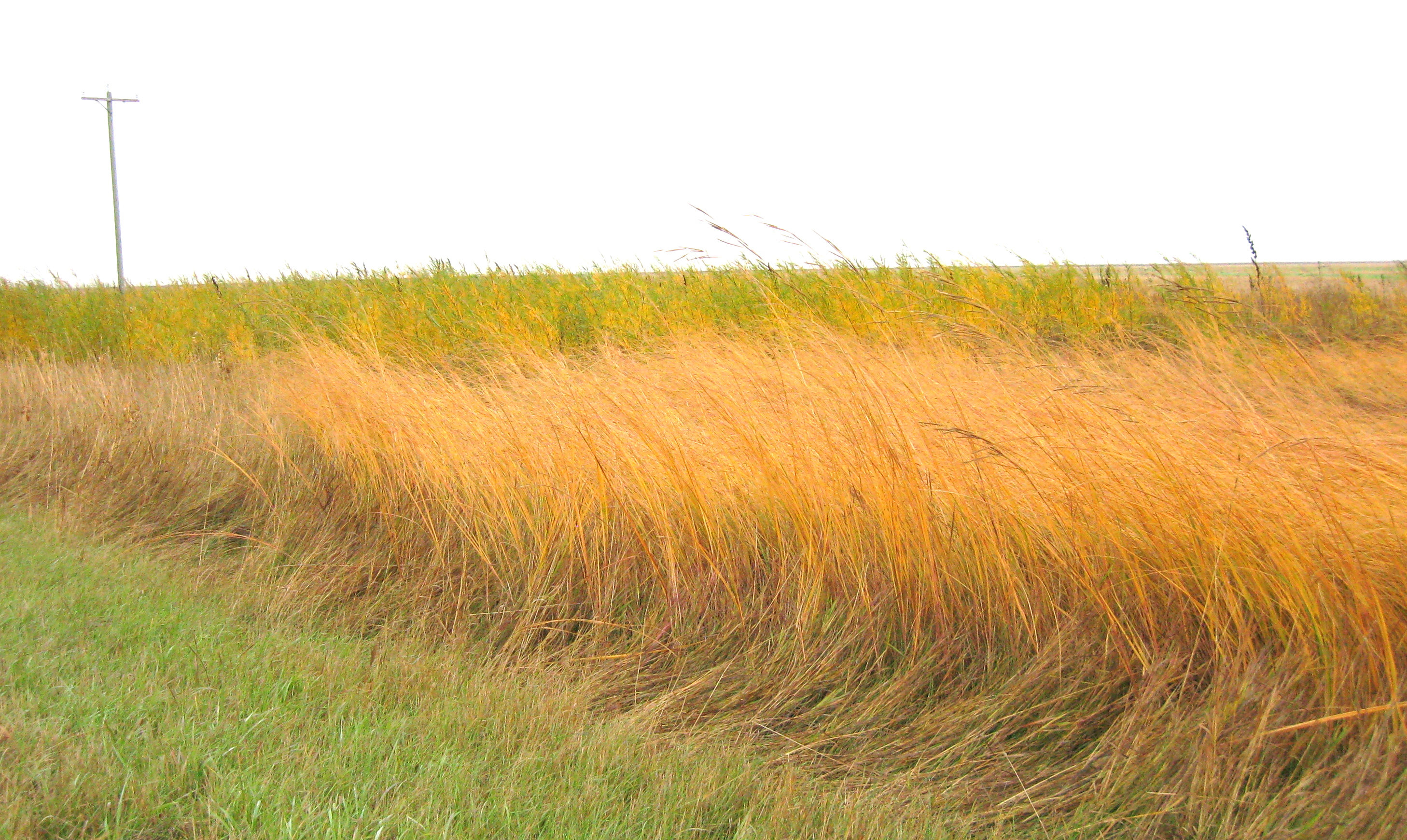
Even the ditches put on a show!

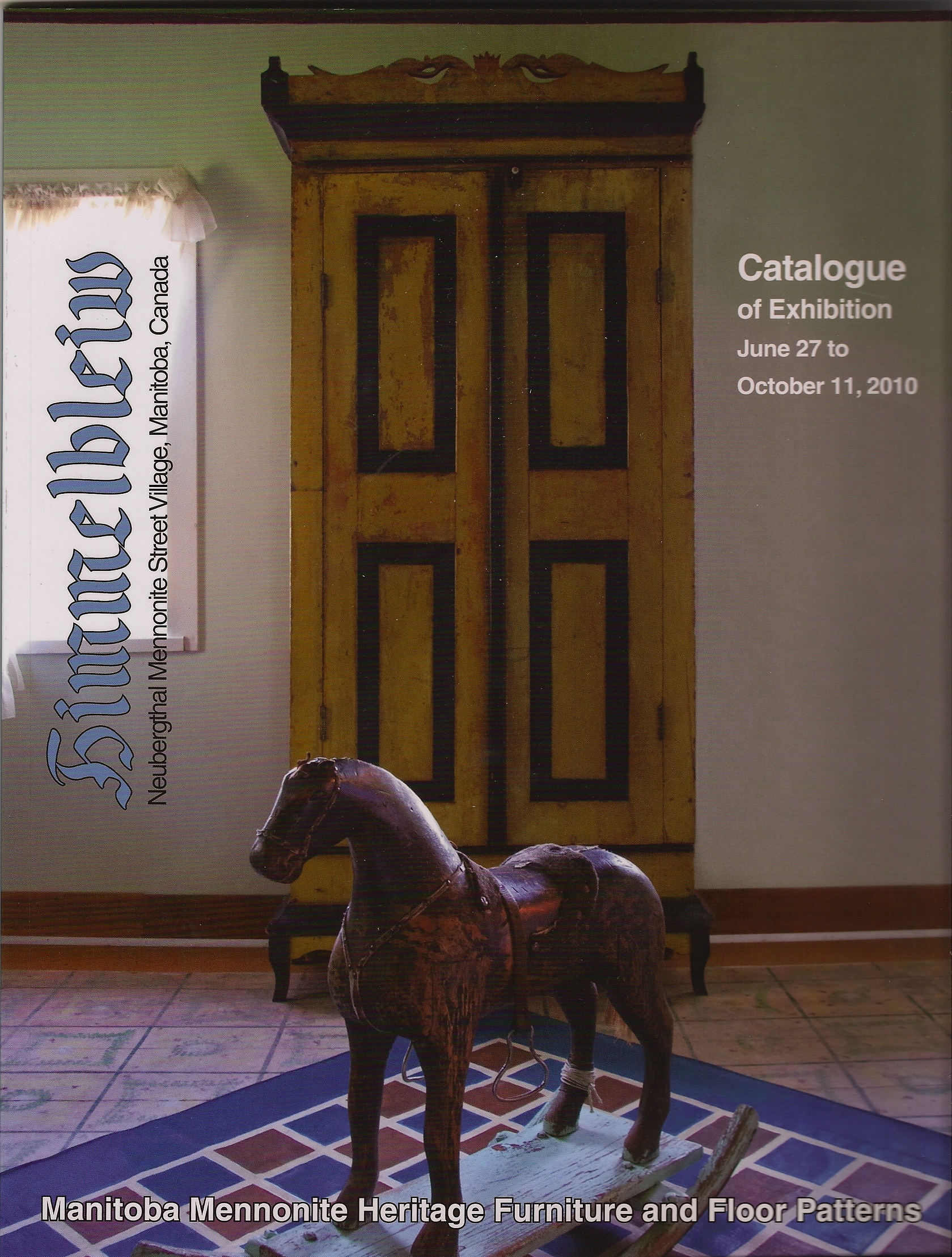
After lunch at the Kopper Kettle in Morden, a favourite local eatery it seems, we continued to Neubergthal, a village that is also a Canada heritage site because of the number of Mennonite house-barn structures it still contains. Here we viewed Himmelbleiw, an exhibition of Manitoba Mennonite heritage furniture and floor patterns. (Himmelbleiw is Low German for “heavenly blue, a colour used to paint walls and decorate furniture that expresses joy and hope.” – Catalogue)

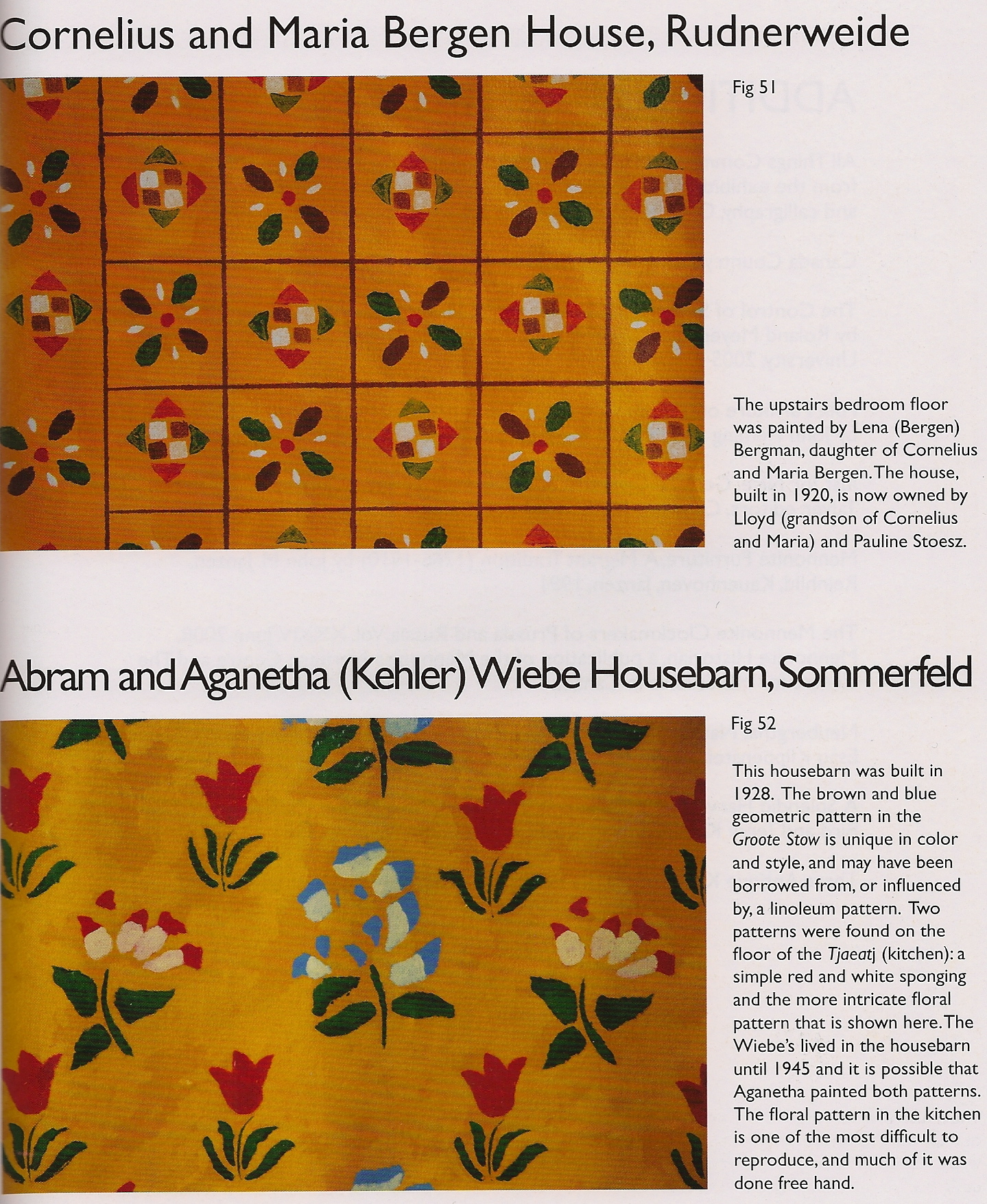
We enjoyed seeing the cupboards, tables, cradles, clocks, toys, and floor patterns on display in the Friesen Housebarn Interpretative Centre. Nearly every item would have been useful in some way, but aesthetic appeal and satisfaction — through skill of construction, decorative detail, or colour — was added to functionality  as well. I was especially taken by the floor patterns. From the late 1800s to the mid 1900s many Mennonite women painted the floors of their homes. (Note the samples in the catalogue page below.)

The Mennonites lived simply. Ostentation was not a community value. Nevertheless, they took opportunities to express artistry within the parameters of their lives.

It all made me think of Steve Bell’s yearning rendition of the Jim Croegaert song, “Why do we hunger for beauty?” It’s a rhetorical question. We love to look at “the leaves,” here today and gone tomorrow, and we paint chairs and floors, which will be worn by sitting and walking. We do hunger for beauty, so we seek it and create it.

William Kurelek’s joy

This week, in the local used books establishment, I found a real treasure: Kurelek’s Canada (Pagurian Press, 1978), which is no longer in print. It contains more than 30 reproductions in colour, as well as some in black and white, of the paintings of William Kurelek (1927-1977), and also his writing about them. And all this for only a dollar!

I’ve liked Kurelek’s work ever since I first encountered it, through A Prairie Boy’s Winter (1973) and A Prairie Boy’s Summer (1975), and then his wonderful A Northern Nativity, which pictures the holy family in a variety of ethnic and geographic settings — from a fisherman’s hut to an Amish Mennonite buggy to a boxcar to a soup kitchen. For many years, until they became just too faded, we had four framed calendar prints of some of the prairie scenes hanging on one of our walls. 

Kurelek had an unhappy childhood in many ways and a complex relationship with his father — both hating and worshipping him, he said later. He was the oldest of seven children of a hardworking prairie couple (Alberta and Manitoba), his parents of Ukrainian immigrant origin. He was painfully shy, sensitive, artistic, but inept at those mechanical and physical things that might have earned his parents’ praise. So powerful was his desire to do art, however, that he risked their disapproval to study it. 

In 1957, Kurelek risked his parents’ disfavour once again by converting to the Roman Catholic church (his family had been nominally Orthodox). His mother, he writes, was “particularly vocal in expressing her view that religion killed joy.” Yet the theme of Kurelek’s Canada is joy, he says in his foreword, “my view of joy, both remembered and observed, in this my native land.”

Kurelek was also a “message painter,” doing a series of 160 paintings on the Passion of Christ, for example, housed at the Niagara Falls Art Gallery, but there’s no didacticism in these paintings of ordinary people in the various parts of this country doing such ordinary things. They stir joy in me too, over the colours, over his sense of the land, its diversity and yet the way its parts cross-reference each other: the land in Manitoba “so flat it is like being on an ocean” and then the ocean off Nova Scotia giving him “the same feeling as the prairie in winter when the landscape is an endless series of wind-sculpted snowdrifts…”

Kurelek’s sensitivity to this country’s landscapes and history, and his sensitivity to the pleasures and dreaminess of being young, have always resonated with me. It’s as if his memories are my memories too, no matter how different the details.

"Skating on Spring Run-Off," pages 98-99


But in studying and enjoying my “new” book this week, I find this artist is giving me something else. He’s giving me memories of my father. What do I mean? Well, it occurred to me that the specific references in so many of these works belong to Kurelek’s generation, which of course, is my father’s generation as well. That’s obvious enough, but I never thought of this before, because I didn’t need to, I suppose, just delighting in them for my own reasons. Now, however, my dad (88) has Alzheimer’s disease and is so very gone from us already, and in the last weeks declining even further. 

I took the Kurelek book along when I went over to see him yesterday afternoon. He was in bed, mostly sleeping. When he opened his eyes, I showed him “Skating on Spring Run-Off.” He looked at it but he didn’t seem to see it.

I see it though. I see his being, his memory, there. He was a boy of the farm, a boy of hard work, close to his horses and dogs, a boy sensitive to the land and the seasons, an athletic boy too, amazingly athletic actually, and here he is again, skating where the ice is found, “skim[ming] over the prairie surface with breath-taking ease,” feeling as the artist also remembered it when he painted the scene, “as though you have wings on your heels.” 

Has this ever happened to you, a familiar story or beloved artist’s work suddenly meaning something else for you altogether?