- On the flight home from Winnipeg to Vancouver, I scan my notes and discover they’re so pathetically cryptic, they’ll be useless for saying anything meaningful about the conference sessions.
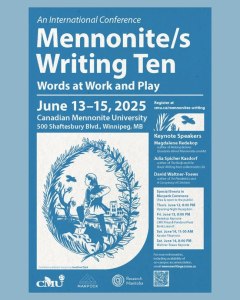
- Nevertheless, I can state the facts: this was # 10 in a series of conferences called Mennonite/s Writing, held every 3 years or so, and this time at Canadian Mennonite University in Winnipeg, Manitoba, June 13-15, under the theme “Words at Work and Play.”
- The conference happened against the news of nearly 300 dead in an Air India crash, Israel attacking Iran, ongoing National Guard/ICE craziness in Los Angeles, yet here we were, maybe 110 (?) of us, thinking and talking about writing, for in her keynote, Julia Spicher Kasdorf said her response to global concerns is to become more local, and these days, this was our local.
- I really enjoyed the conference — the sessions and keynotes of course, but also the collegiality, the many conversations with old and new friends, a happy sense of belonging because even though I don’t label myself a “Mennonite writer” (what does that actually mean, never mind these regular gatherings trying to figure it out) I still know that in some real way this is my tribe and besides, they’ll have me, which is always a happy and satisfying thing.
- The keynotes were highlights: Magdalene Redekop in an almost poetical trail of insights and juxtapositions on “translation” — a task we all take up in our lives — and David Waltner-Toews tackling “the meaning of everything” via science, that is, each of us “an unstable patchwork at our very core” yet interconnected, and Julia Spicher Kasdorf ruminating on Mennonite identity, noting “identity politics reduces complexity” and “identity work can wear a body out” yet calling us — stirringly — to commit to writing as practice and conversation.
- I very rarely — honestly — notice what people are wearing, though there were several memorable, if minor, exceptions this time, for I glimpsed a well-known writer in his pyjamas in the residence hallway and I think they were blue and white, and Di Brandt wore a garland of (cloth?) red flowers and leaves on her head during her presentation, and my longtime friend Sarah Klassen looked classy in a neat, belted teal dress, but I do notice space and felt the conference metaphorically balanced by having parts in the aged, wood-toned ambience of the Great Hall and its connecting corridors and other parts in the newish light-filled Marpeck Commons.
- Most of the sessions ran concurrently with others, which meant that every choice meant missing something else, but the personal program I selected began wonderfully with David Elias on his grandfather’s brother and Elsie K. Neufeld on her work as a personal historian and Linda Umble on reading Mennonite texts, and ended as wonderfully Sunday morning with three poets — Jeff Gundy, Julia Spicher Kasdorf, Ann Hostetler — reading their work, and in between I presented too (“Thinking about Oneself: Desire and Discovery in the Personal Essay and Memoir”) alongside Mary Ann Loewen who gave a memoir talk about herself and her granddaughter, both of which went well, we thought, and provoked some good discussion..
- A good number of younger people attended, and some presented, as in a session I attended featuring readings by Joelle Kidd, James Bergman, and Geoff Martin (whom I had “met” before, in a manner of speaking, when essays we’d written sat side-by-side in The New Quarterly — his was the winning one!) and it was great to hear new and younger voices in the mix.
- On the Thursday evening before the conference began, In Search of a Mennonite Imagination, edited by Robert Zacharias, containing key texts in Mennonite literary criticism, was launched at McNally Robinson Booksellers and I bought it, all 700+ significant pages of it, and later some other books besides, not as many as I may have wished but more than I could carry in my full backpack, but then a friend who lives in the next town over kindly offered to transport some of them, including the massive tome, in his luggage.
- The conference included an optional “literary tour” of Steinbach, which I selected to do, and it was interesting to see places associated with writers such as Miriam Toews and Patrick Friesen and ended with a delicious faspa at the Mennonite museum, where my final “Mennonite” sight of the weekend was a sculpture of the famous Dirk Willems story, which makes me wonder — in terms of two words Julia Spicher Kasdorf set against each other — whether it represented, and could be told, as “continuity” rather than “rupture.”
Category Archives: Books
March notes
Besides resolving to appear here monthly in 2025, I had a second New Year’s resolution: to read Moby-Dick. Which I have just accomplished, thus plugging one of many holes in my education. It wasn’t exactly a page-turner (not to mention there are a lot of pages to turn) so I read it alongside other books, aiming for two chapters a day. But I enjoyed it. I learned a great deal about whales and whaling, and was carried along by Captain Ahab’s mad quest for the White Whale and by Ishmael’s erudite and often humourous voice. About the latter, Alfred Kazin says:
But the most remarkable feat of language in the book is Melville’s ability to make us see that man [sic] is not a blank slate passively open to events, but a mind that constantly seeks meaning in everything it encounters.
Speaking of meaning, I commend to you a link that young friend Chris Friesen included in a comment to last month’s post, in which I talked about the present “moment.” It’s a sermon he preached at the church we attended in Winnipeg. He weaves together his love of bugs, coming to the edge of meaning, and the strange scriptural book of Ecclesiastes. His conclusion has stuck with me: “the moment becomes the site of meaning.” It’s worth a read.
I think I mentioned some time ago that I have a new book of short fiction coming up, for publication next spring, with Freehand Books. I’m in the edits stage now, and have just gone through the manuscript again and sent it back to my editor. With that task done, I was able to welcome, with an unfettered schedule, my daughter and her wife and two children, who returned to B.C. from their new digs in Nova Scotia this week to celebrate their wedding, which actually took place five years ago but during Covid and thus minus the intended public celebration. All my children and grandchildren will be together for that, and we’re looking forward to it.
And, this month, two additional books to mention. I’m not Catholic, but I admire Pope Francis and I’m enjoying Hope, his recent autobiography. There’s a warm lively aspect to his recollections, also honesty about “errors and sins,” as well as an embrace of sentiment as “a cherished value: not to be afraid of feeling.” I remember following the election of a new pope in 2013, after Benedict’s resignation, scanning the various possibilities and so on. I checked back in my journal to see what I’d recorded (and see that I wrote in the second person, as I do now and then):
…you feel you should see where matters stand with the Vatican conclave. Well. The white smoke has billowed forth, not 10 minutes ago. So you join Peter Mansbridge (CBC) to watch live, and who is it? The one you hoped for from that list of 20 [in the newspaper], the man from Argentina, and on what basis did you hope? Well none are anything but traditional but there was a note, wasn’t there, of openness to women? On that basis. He is a Jesuit, of pastoral personality and warmth, simple habits, etc. What you’re reading seems affirming. It’s a surprise, of course; he was not in the upper group of likelies. He’s 76. Latin Americans are thrilled.
Actually, women’s position in Catholicism has not changed much, as far as I know, but I’m only about a third in so perhaps he will comment on it further in. (Here’s the Guardian review.) Another book I’m reading is the graphic edition of Timothy Snyder’s On Tyranny: Twenty Lessons From the Twentieth Century. The illustrations by Nora Krug add power to Snyder’s 20 points; the whole thing is just incredibly relevant.
What I did today (Jan. 20)
The sun rose as usual this Monday morning, with a gentle coral hue that turned briefly pinker and then resolved into the yellowish cast of regular sunshine. Not a regular Monday morning, though, I remembered as soon as I woke. I couldn’t help it: my brain was like an alarm clock, signalling that the inauguration would soon be underway in Washington D.C. I’d already decided that, like Michelle Obama, I would not attend, though of course I had no invitation to do so in person, only the voracious maw of television inviting me in.
It wasn’t that hard, actually, to resist the watching. I find it deeply unpleasant to see or hear the new president; I won’t bother rehearsing the reasons. But not thinking about it at all, well, that was harder. But I had my coffee, did my morning reading, ate breakfast, began to tackle today’s tasks.
High on the list was the need to dust. I’m very happy in my Tsawwassen apartment but honestly, I’ve never lived in a place (besides the Chaco of Paraguay in the season of wind) that gets dusty as quickly as this one, dust particles rising from the open rail cars of coal coming to the nearby port, I’ve been told, and of course when it’s beautifully sunny like today, the dust layers are even more obvious. So I did that, and I vacuumed too, and also, I attended a Livestream event with Rebecca Solnit and some guests, deliberately scheduled for this day. It scarcely referenced what was happening (besides the comment that the empty Washington Mall seemed a metaphor), but offered analysis and ideas about moving forward. She and her guests talked about resistance with tenderness, choosing a world of abundance rather than scarcity, spending time with art and music. One said, “Despair is a room we move through,” and another, in the words of the spiritual, “Ain’t gonna let nobody steal my joy.” All this and more. It was encouraging. (It can be viewed on YouTube as “The Way We Get Through This is Together.”)
While listening, I was working on a jigsaw puzzle. Puzzling is when I listen to podcasts or the like. One favourite is the CBC podcast “Front Burner,” a daily short (less than half an hour) conversation with an expert about some issue in the news. A podcast I’ve recently discovered is “What Matters Most” with host John Martens. There are more than 50 episodes to select from, including fascinating matters such as “Reading gender in Revelation” and “Leonard Cohen and the Apostle Paul.” When I walk, my podcast of choice is “This American Life,” stories that fill up about an hour, the perfect length for a walk.
It’s still January, so perhaps I can mention that while I don’t generally make resolutions, I did determine to read Melville’s Moby-Dick this year, and I’m doing it, two chapters a day, and quite enjoying it. Other books I’ve read recently and warmly recommend are Orbital by Samantha Harvey, Clara Reads Proust by Stephane Carlier, and Clear by Carlys Davies. And I’m through Part V of Jon Fosse’s 7-part Septology, which might not be to everyone’s taste, but which I find strangely mesmerizing and compelling.
And since it’s still January, I wish you all a very happy New Year.
How did YOU spend this (historically significant) Monday?