What I did today (Jan. 20)

The sun rose as usual this Monday morning, with a gentle coral hue that turned briefly pinker and then resolved into the yellowish cast of regular sunshine. Not a regular Monday morning, though, I remembered as soon as I woke. I couldn’t help it: my brain was like an alarm clock, signalling that the inauguration would soon be underway in Washington D.C. I’d already decided that, like Michelle Obama, I would not attend, though of course I had no invitation to do so in person, only the voracious maw of television inviting me in. 

It wasn’t that hard, actually, to resist the watching. I find it deeply unpleasant to see or hear the new president; I won’t bother rehearsing the reasons. But not thinking about it at all, well, that was harder. But I had my coffee, did my morning reading, ate breakfast, began to tackle today’s tasks.

High on the list was the need to dust. I’m very happy in my Tsawwassen apartment but honestly, I’ve never lived in a place (besides the Chaco of Paraguay in the season of wind) that gets dusty as quickly as this one, dust particles rising from the open rail cars of coal coming to the nearby port, I’ve been told, and of course when it’s beautifully sunny like today, the dust layers are even more obvious. So I did that, and I vacuumed too, and also, I attended a Livestream event with Rebecca Solnit and some guests, deliberately scheduled for this day. It scarcely referenced what was happening (besides the comment that the empty Washington Mall seemed a metaphor), but offered analysis and ideas about moving forward. She and her guests talked about resistance with tenderness, choosing a world of abundance rather than scarcity, spending time with art and music. One said, “Despair is a room we move through,” and another, in the words of the spiritual, “Ain’t gonna let nobody steal my joy.” All this and more. It was encouraging. (It can be viewed on YouTube as “The Way We Get Through This is Together.”)

While listening, I was working on a jigsaw puzzle. Puzzling is when I listen to podcasts or the like. One favourite is the CBC podcast “Front Burner,” a daily short (less than half an hour) conversation with an expert about some issue in the news. A podcast I’ve recently discovered is “What Matters Most” with host John Martens. There are more than 50 episodes to select from, including fascinating matters such as “Reading gender in Revelation” and “Leonard Cohen and the Apostle Paul.” When I walk, my podcast of choice is “This American Life,” stories that fill up about an hour, the perfect length for a walk. 

It’s still January, so perhaps I can mention that while I don’t generally make resolutions, I did determine to read Melville’s Moby-Dick this year, and I’m doing it, two chapters a day, and quite enjoying it. Other books I’ve read recently and warmly recommend are Orbital by Samantha Harvey, Clara Reads Proust by Stephane Carlier, and Clear by Carlys Davies. And I’m through Part V of Jon Fosse’s 7-part Septology, which might not be to everyone’s taste, but which I find strangely mesmerizing and compelling.

And since it’s still January, I wish you all a very happy New Year.

How did YOU spend this (historically significant) Monday?

The mysterious Irene P., etc.

Earlier this month, I was a panelist at a Delta Literary Arts Society (DLAS) event here in Tsawwassen, with writers Raoul Fernandez, Debra Purdy Kong, and S.J. Kootz. Along with an honorarium, each of us was gifted a book from “the abandoned library” of a woman known as Irene P.; mine was Bird by Bird by Anne Lamott. “Do books long for a new owner?” asks a note pasted into the flyleaf. Assuming they do, “Just such a case has brought this book to you… once one of thousands in a collection owned by one Irene P.”

I asked the event organizer about her. She didn’t know much beyond the fact that when the woman’s house sold, there were thousands (6000, did she say?) books left behind, and hundreds about writing which somehow came to the DLAS and are used as unique thank yous. With all that advice on her shelves, did Irene P. write? I don’t know that either; hers is a story still to be told perhaps, but at any rate, I now have her 1995 edition of the Lamott classic, and it gives me pleasure. Since I already own the book, I’ll pass my copy on to someone else. And I think I’ll see if I can’t get more information about our mysterious donor.

*

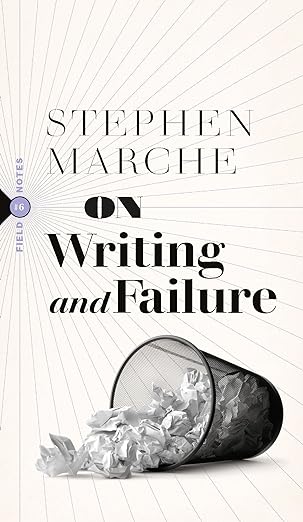
Speaking of writing advice, I recently read a small (80 pages) book by Stephen Marche called On Writing and Failure. Marche is no slouch, he’s written books and essays for all kinds of prestigious magazines, but he’s honest about the reality of the life: rejection. He kept track of them, he says, until they reached 2000, and hardly notices any more. He offers examples from other writers, and the point of it is not the promise of some inevitable arc to success, but his subtitle: On the Peculiar Perseverance Required to Endure the Life of a Writer. The book is full of quotable quotes:

English has provided a precise term of art to describe the writerly condition: Submission. Writers live in a state of submission. Submission means rejection. Rejection is the condition of the practice of submission, which is the practice of writing.

In an environment where some 300,000 books are printed yearly in the U.S. alone, and only a few hundred of those are what could be called creative or financial successes, there’s certainly no urgency for anyone to join the ranks. But if one’s there already, nothing for it, he says,81l-0zGg3GL._SY522_ but to keep at it, to keep submitting the work. “No whining,” he insists repeatedly. “The desire to make meaning…is a valid desire despite the inevitability of defeat.”
*

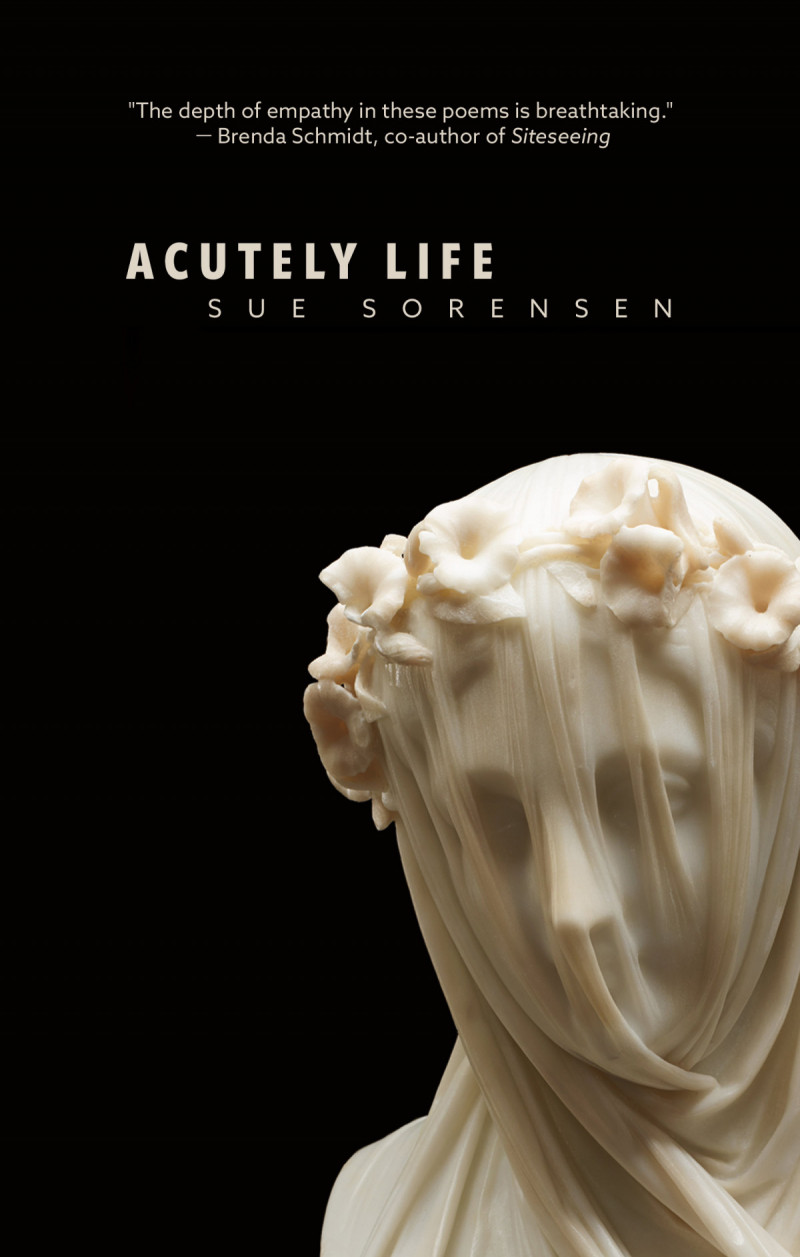
And, speaking of small but profound books, Sue Sorensen’s new poetry book, Acutely Life (At Bay Press), is an absolute delight. Whether she’s considering Freud or a musician or art or gardening/marriage or Mary the mother of Jesus, Sorensen registers on the page with both brilliant wit and deep emotional insight. Somewhere I read (though I can’t find the exact quote), one doesn’t interpret poetry as much as experience it. That’s how it’s been reading this book. I intend to read/experience it again.AcutleyLifeCover_(1)_800_1257_90

Konstantin Paustovsky & Hildi Froese Tiessen: there, then

I’ve been working my way through Konstantin Paustovsky’s 6-book Story of a Life this month. I heard about Paustovsky on The Mookse and the Gripes podcast and was drawn to his work when I discovered he was an almost-exact contemporary of my grandfather, about whom I’ve been thinking on account of last fall’s trip to the Caucasus. My grandfather was born in Molotschna Colony, Ukraine (then Russia) in 1890 and Paustovsky was born in Kiev, Ukraine in 1892.

I was also pleased to discover that the entire series is held at the Vancouver Public Library. I took them all out.

Since I may — someday — do a personal essay about my grandfather in the Caucasus during WWI, reading Paustovsky is a kind of research, though of the most pleasurable variety, for he writes vividly, not at a distance but from within each experience as it occurred. During the war he worked on a medical train, as did my grandfather. He was in Moscow during the early revolutionary period, when the city was “one solid, seething, endless public meeting.” He was in Kiev during part of the 3-year period when Ukraine underwent civil war and 17 political upheavals.

The first three books were especially compelling, but I will persist to the end because after a year in Odessa during the blockade (Vol. 4), Paustovsky spends time in the Caucasus in Vol. 5, which I’ve reached too. I look forward to his descriptions of that region.

Mennonite/s writing

I’ve also worked my way this month through On Mennonite/s Writing, selected essays by Hildi Froese Tiessen — “a scholar widely recognized as the primary critical figure in contemporary Mennonite literary studies” — recently published by CMU Press. The selecting of 18 essays, from her more than 80 contributions in the form of essays, book chapters, special journal issues, and so on–was done by Robert Zacharias. He also provides a fine introduction to Froese Tiessen’s overall work and this collection.

This is an important book, both in terms of honouring Froese Tiessen and of encapsulating a history of critical engagement with Mennonite literature. It was also fun to read.

I think I may have read some of the essays before, and certainly had some sense of the emergence of a so-called Mennonite literature, but I enjoyed starting at the beginning with her first essay in 1973 about Rudy Wiebe’s work, and seeing, in real time as it were, her continuing and developing insights into what was going on, especially in the relationship of Mennonite writers and their Mennonite community.

I read this book as a reader of Mennonite literature — and do recommend it to other readers and to students of literature — but I also enjoyed it as one of those “writers who happens to be Mennonite,” whose work came along rather later, in the wake of the period she especially observes. Reader or writer, we will all likely share the question of what comes next, and may have our opinions about what should or could, for as Froese Tiessen makes clear, the field has changed and continues to change. Her last essay describes the shift as one of “Mennonites as a community written about” to “Mennonites as a community writing.”

Two asides, or additional points of interest for me. The essay on the “forever summer, forever Sunday” trope of the Mennonite past in Russia, which entered the work of Rudy Wiebe, Sarah Klassen, David Waltner-Toews, and Sandra Birdsell (“Between Memory and Longing”) struck me as almost ironical as Froese Tiessen discerns/articulates an effect she herself could be said to have created. (She and her husband published a book of Peter Gerhard Rempel’s photographs of Mennonites in Russia with that title.) Perhaps an element of such circularity also characterizes her wider contribution to the field.

And then, in the middle of the book, in the essay “The Case of Dallas Wiebe,” three poems! His voice “distinctive enough to unsettle or inspire,” she says quite rightly. From the poem “God Speaks to the Geriatric Convention,” lines that sprung out to me:

You should imagine
that when you walk
through the valley of the shadow of death
that I am the one
who casts the shadow.

Reflecting on her life’s work, Froese Tiessen says, “[D]uring that irruption of Mennonite writing concentrated in the last two decades of the last century I had found myself, so often, right there, right then.” We can be grateful she was there, then, for her thinking is astute, her writing is clear and accessible, and her impact was enormous.