Unlike Philip Roth, I’m still reading fiction

A tiny tempest, perhaps, but a tempest nevertheless, when renowed and prolific novelist Philip Roth announces he no longer reads fiction, and this with no further explanation than “I don’t know. I wised up…”

So it’s fallen to others to puzzle it out, to wonder, to agree or disagree. As, for example, Laura Miller at Salon, who finds that Roth isn’t alone in the company of fiction quitters and suggests it’s a function of aging, and Russell Smith at The Globe and Mail, less willing to let Roth off the hook, who says it may be, subtly, the desire to be rid of “the noise, the competition, the striving” —

And to switch off all the insecurity that reading others’ work gives a writer, all the reluctant admiration and envy and performance anxiety. Not to mention the sheer stress of having to keep up with all the brilliance being spewed out by thousands of younger people, all the must-reads that pile up like the Sunday New York Times, piles of guilt.

Some decades ago when I was trying my own hand at fiction, timidly, with little experience and tons of insecurity, I picked up the notion — advice given by some writing guru, no doubt — that one ought to stay away from novels while working at one’s own. So I did, more or less, at least while in the heaviest throes of the project. I’m not sure, looking back, if that was good advice or not. I might have amended it, at least, to eschew only the writers I didn’t much admire (though read for various reasons) and allow myself to bask in the style of those I liked and wanted to emulate. Smith is surely right to wonder how a writer of novels can’t be reading them. “Reading fiction,” he says, “is still the best rehearsal for writing it.”

Miller’s piece draws a distinction between fiction and non-fiction — the latter offering “instruction or information” and fiction, “an experience.” I’m not sure it’s quite that clean. Both fiction and non-fiction can offer instruction and information — true stuff, if you like — and an experience. Either can feel easy, or effortful. So much depends on the book itself.

So, I’m reading non-fiction — and lots of fiction. If aging’s the issue, I’ve still got some good years of stories to go before I reach 78. And I’ve got an impossibly long way to go to reach his output, at which point, perhaps, one’s own stories reel endlessly in the self and are all the nourishment one needs.

I’m reading to rehearse, because I’m working on another novel. I’m reading for information, instruction, and experience —  and for stretching understanding and love (which I spoke of in “Some reasons why I write”). I’m reading to exercise my admiration and fight envy — to practice a kind of community life, as it were, by reading the books of my peers or betters, say in a geographical zone or genre. And, I’m reading for the sheer pleasure of story.

One can’t possibly keep up, that’s true. But it would be just as hard to stop!

A nest that remembers

There’s lots of discussion these days on the future of the book. Everyone seems aware that digital reading and publishing is changing the way we write and read and publish, that it’s changing what we’ve assumed for a long time, namely that books adhere to paper and pages and bound volumes of various kinds, so lovely to hold and open and read through and close again and set on shelves.

I’m not here today to offer my opinions on these changes (though if you’re interested in the future of books topic, there’s a series of writers, booksellers, publishers talking about it at the online Winnipeg Review), but rather to mull on an art exhibition we attended last evening. “Bound by Nature,” at the Mennonite Heritage Centre Gallery in Winnipeg, May 6 to June 18, reflects on books in a very different way. Officially it’s described as an exhibition “inspired by nature, landscape and books” and it’s all that (and a really fascinating juxtaposition when you are made to stop and think about it) but it was “book” at the heart of the pieces that especially drew my attention.

So, for example, book spine covers used to create a series of “horizon” landscapes by Deborah Danelley reminded me of the world we see but also what one sees in books. They made me think of those large books I’ve known, yes with their cloth/paper spines fraying and loosening, maybe books of art or photos, a treasure of things and also a kind of borrowing from one medium to the other.

There’s a whimsical display called “Wildflowers,” by Deborah Danelley and Carol Leach, featuring what I can only call a “bed” of flowers fashioned from the pages of recycled garden/landscape/nature books. Erwin Huebner has a number of interesting pieces that reflect on the “books” of small places like eggs (think of all the information an egg contains) and the stunning color and shapes of substances seen via the microscope. Other artists had made accordion books and match box books; there was richly textured paper.

"Nest as destiny" by Agatha Doerksen

I knew that my sister-in-law, Agatha Doerksen (Denver, Colorado), had a number of pieces in the exhibition, so of course I was curious to see where the theme had taken her. I was not disappointed; her pieces were a highlight for me. A number of them were intricately altered books opening into nests, and her author’s statement asked some intriguing questions:

If a seed becomes a tree, does the tree remember the seed?
If a tree becomes a book, does the book remember the tree?
If a book becomes a nest, does the nest remember the book? 
Where can I find a nest that remembers the seed?

I left the exhibition with a sense of the seamlessness of story/book and nature, of book as memory, of book as something something primeval, even primitive, vulnerable though resilient. I left feeling, strangely perhaps, optimistic about the future of the book.

—-

"I want to tell a tree my secret" by Agatha Doerksen (seed pods with book pages rolled tightly into its cavities)

Note:  Canvass has a statement about the exhibition, and on the third page, images of some of the other work. Eleven artists participated, and the exhibition was curated by Deborah Danelley.

Mainline memoir

A friend of mine stuck this book into my church mailbox recently, because she thought I’d enjoy it. I told her I had a stack of books waiting and it might take a while. But you know how it is… Suddenly you have a quiet Sunday afternoon at your disposal and you pick up the book, just for a look, and before you know it, you’re in, and before you know it again, you’re finished.

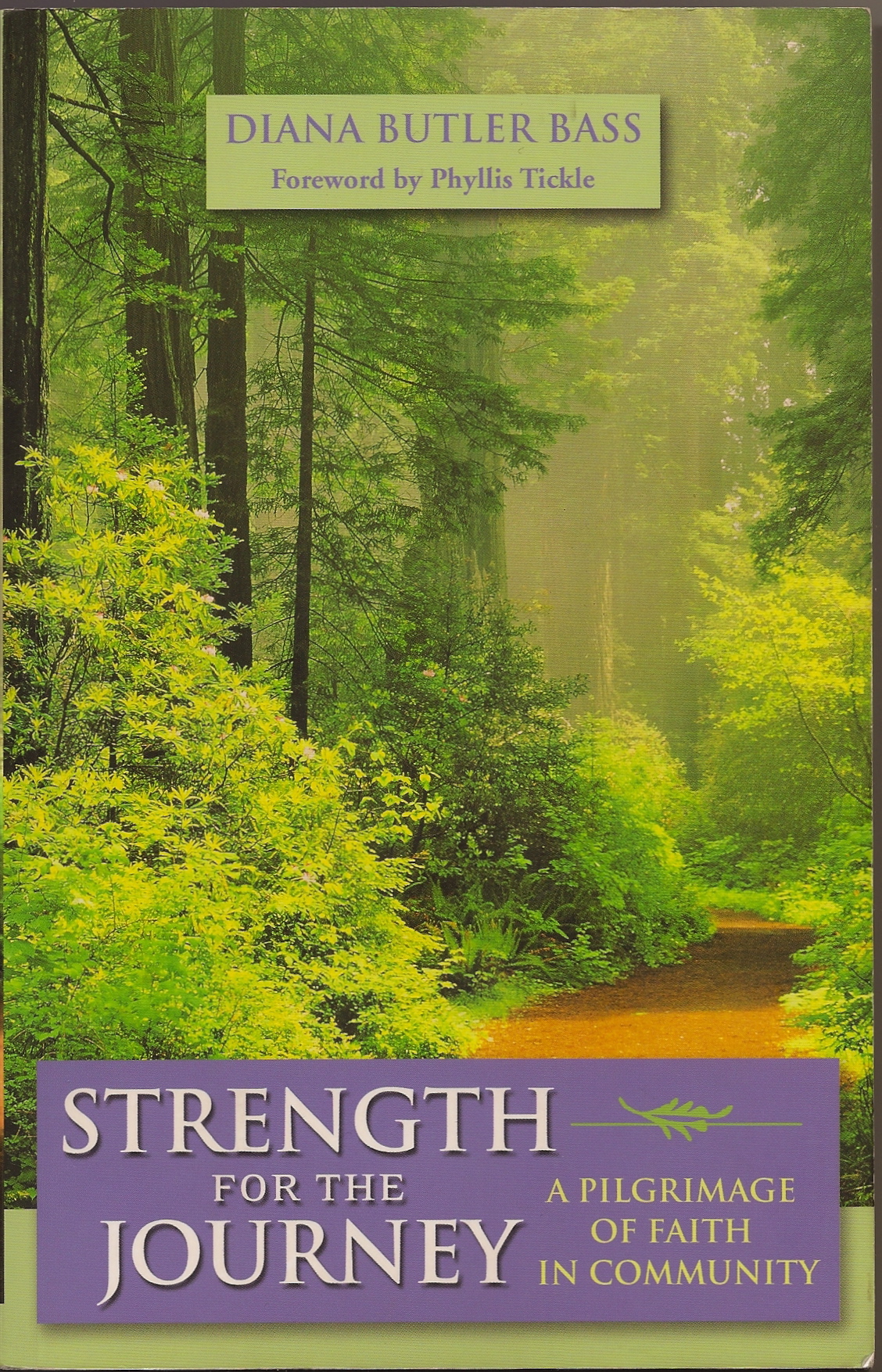
Strength for the Journey: A Pilgrimage of Faith in Community (Jossey-Bass, 2002) is an unusual memoir in some ways, for it’s the story of Diana Butler Bass’ personal spiritual journey  but told via the stories of nine Episcopalian (Anglican) churches she’s been part of over the years, in various parts of the U.S.A. Alongside this, Butler Bass provides journalistic analysis of the “old mainline” church story in America, from severe losses since the 1960s or so, through new identity as “culturally marginalized” (whereas formerly the locale of people with prestige in their communities), and about the renewal that’s happening — and possible — at that place of powerlessness.

Butler Bass’ journey takes her from an adolescent faith within evangelicalism that was “filled with fear” into a greater comprehension of, and living into, “the reality of a God who is completely Love.” She changes slowly and sometimes resistantly, often defaulting to a “knee-jerk fundamentalism” that likes to divide the world into camps, orthodox and liberal, for God and against. What is it that leads her to “a new theological place”? Liturgical worship.

I enjoyed this book. The author’s story differs in almost every detail from mine, not to mention that Butler Bass is nearly ten years younger, and yet as I read I felt our paths curiously similar. I think it’s interesting how in the last years I’ve been bumping into “mainline” in all kinds of ways, through people I’ve come to know, through services we’ve attended, through Christian Century, through this book, and in all of these, the assumptions and stereotypes I held or encountered decades earlier simply don’t stand. Well, of course it was inevitable, went the general line of those assumptions, all those losses, because___ (fill in the blank, but probably include the scary word “liberal”!). I don’t mind at all being tugged away from too little knowledge into a more nuanced historical analysis, and most importantly, into a wider awareness of and love for the church.