A nest that remembers

There’s lots of discussion these days on the future of the book. Everyone seems aware that digital reading and publishing is changing the way we write and read and publish, that it’s changing what we’ve assumed for a long time, namely that books adhere to paper and pages and bound volumes of various kinds, so lovely to hold and open and read through and close again and set on shelves.

I’m not here today to offer my opinions on these changes (though if you’re interested in the future of books topic, there’s a series of writers, booksellers, publishers talking about it at the online Winnipeg Review), but rather to mull on an art exhibition we attended last evening. “Bound by Nature,” at the Mennonite Heritage Centre Gallery in Winnipeg, May 6 to June 18, reflects on books in a very different way. Officially it’s described as an exhibition “inspired by nature, landscape and books” and it’s all that (and a really fascinating juxtaposition when you are made to stop and think about it) but it was “book” at the heart of the pieces that especially drew my attention.

So, for example, book spine covers used to create a series of “horizon” landscapes by Deborah Danelley reminded me of the world we see but also what one sees in books. They made me think of those large books I’ve known, yes with their cloth/paper spines fraying and loosening, maybe books of art or photos, a treasure of things and also a kind of borrowing from one medium to the other.

There’s a whimsical display called “Wildflowers,” by Deborah Danelley and Carol Leach, featuring what I can only call a “bed” of flowers fashioned from the pages of recycled garden/landscape/nature books. Erwin Huebner has a number of interesting pieces that reflect on the “books” of small places like eggs (think of all the information an egg contains) and the stunning color and shapes of substances seen via the microscope. Other artists had made accordion books and match box books; there was richly textured paper.

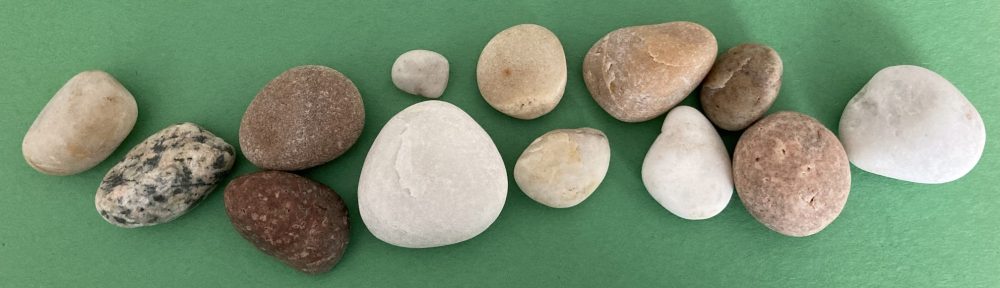
"Nest as destiny" by Agatha Doerksen

I knew that my sister-in-law, Agatha Doerksen (Denver, Colorado), had a number of pieces in the exhibition, so of course I was curious to see where the theme had taken her. I was not disappointed; her pieces were a highlight for me. A number of them were intricately altered books opening into nests, and her author’s statement asked some intriguing questions:

If a seed becomes a tree, does the tree remember the seed?
If a tree becomes a book, does the book remember the tree?
If a book becomes a nest, does the nest remember the book? 
Where can I find a nest that remembers the seed?

I left the exhibition with a sense of the seamlessness of story/book and nature, of book as memory, of book as something something primeval, even primitive, vulnerable though resilient. I left feeling, strangely perhaps, optimistic about the future of the book.

—-

"I want to tell a tree my secret" by Agatha Doerksen (seed pods with book pages rolled tightly into its cavities)

Note:  Canvass has a statement about the exhibition, and on the third page, images of some of the other work. Eleven artists participated, and the exhibition was curated by Deborah Danelley.
Mainline memoir

A friend of mine stuck this book into my church mailbox recently, because she thought I’d enjoy it. I told her I had a stack of books waiting and it might take a while. But you know how it is… Suddenly you have a quiet Sunday afternoon at your disposal and you pick up the book, just for a look, and before you know it, you’re in, and before you know it again, you’re finished.

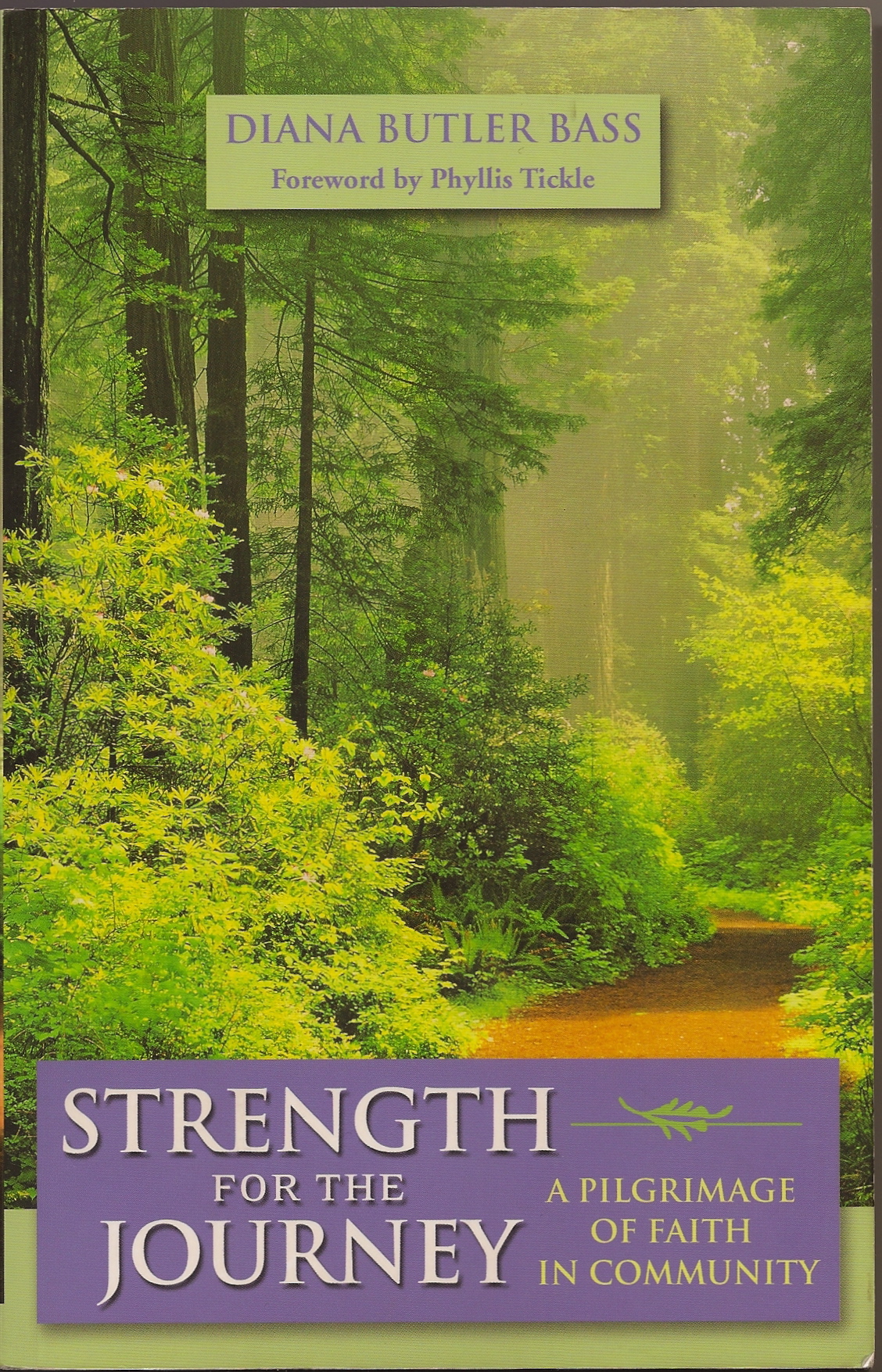
Strength for the Journey: A Pilgrimage of Faith in Community (Jossey-Bass, 2002) is an unusual memoir in some ways, for it’s the story of Diana Butler Bass’ personal spiritual journey  but told via the stories of nine Episcopalian (Anglican) churches she’s been part of over the years, in various parts of the U.S.A. Alongside this, Butler Bass provides journalistic analysis of the “old mainline” church story in America, from severe losses since the 1960s or so, through new identity as “culturally marginalized” (whereas formerly the locale of people with prestige in their communities), and about the renewal that’s happening — and possible — at that place of powerlessness.

Butler Bass’ journey takes her from an adolescent faith within evangelicalism that was “filled with fear” into a greater comprehension of, and living into, “the reality of a God who is completely Love.” She changes slowly and sometimes resistantly, often defaulting to a “knee-jerk fundamentalism” that likes to divide the world into camps, orthodox and liberal, for God and against. What is it that leads her to “a new theological place”? Liturgical worship.

I enjoyed this book. The author’s story differs in almost every detail from mine, not to mention that Butler Bass is nearly ten years younger, and yet as I read I felt our paths curiously similar. I think it’s interesting how in the last years I’ve been bumping into “mainline” in all kinds of ways, through people I’ve come to know, through services we’ve attended, through Christian Century, through this book, and in all of these, the assumptions and stereotypes I held or encountered decades earlier simply don’t stand. Well, of course it was inevitable, went the general line of those assumptions, all those losses, because___ (fill in the blank, but probably include the scary word “liberal”!). I don’t mind at all being tugged away from too little knowledge into a more nuanced historical analysis, and most importantly, into a wider awareness of and love for the church.

Almost there

A few posts back, I mentioned that my book (This Hidden Thing) had been nominated for a couple of this year’s Manitoba Book Awards, and even more recently suggested that very soon, when the excitement of the shortlists and gala was over, we’d all be able to slip back to our quiet desks or reading chairs. Well, let me conclude this matter, since I brought it up, by saying I’m almost there, almost solid again after the emotional pudding I turned into for a couple of days, but still very happy and more grateful (in so many directions) than I can possibly express. Of the categories I was nominated in, David Bergen won the Margaret Laurence Award for Fiction and I took home the McNally Robinson Book of the Year Award. If you’re interested in news of the event, photos, or the jurors’ comments on the book, all of it is at the THT page or Events.  Off to my cozy corner now, where I’m reading last year’s Pulitzer winner, Tinkers, by Paul Harding, a slow and evocative book about an old man returning to his childhood, via memory, in the days before he dies.