
Feeling the fire

Believe me, I’ve been tempted to jump into the internet heat around Rob Bell’s latest book — apparently on hell — but no, this isn’t about those flames. (And if you haven’t already had enough of that topic, let me tip to two pastors of my denomination who have thoughts on it, here and here, or you may want to follow the links and commentary at Brian McLaren’s blog.)

This is about Tongue Screws and Testimonies: Poems, Stories, and Essays Inspired by the Martyrs Mirror (edited by Kristen Eve Beachy), a book I’ve spent a good number of hours reading the past weeks, more hours in fact than I usually spend on a book, because I’m reviewing it for Rhubarb. So I’ve been reading slowly, and taking notes. It’s been, at times, a surreal experience, reading of burnings and drownings and the other torments of the martyrs, and all the while the house so quiet and the weather so cold these days, the snow still thick , the sun bright, yes, but shining with a serene beneficence rather than heat. How far it all seems from the noise of those long ago public spectacles, and the rising flames and the rising songs (except, of course, when the tongue screws prevented them), though I’ve been stirred just the same, as I often am by words, such a diversity of them, some pulling me close to the fire, to feel it, others pushing me away, to consider what to think of it all.
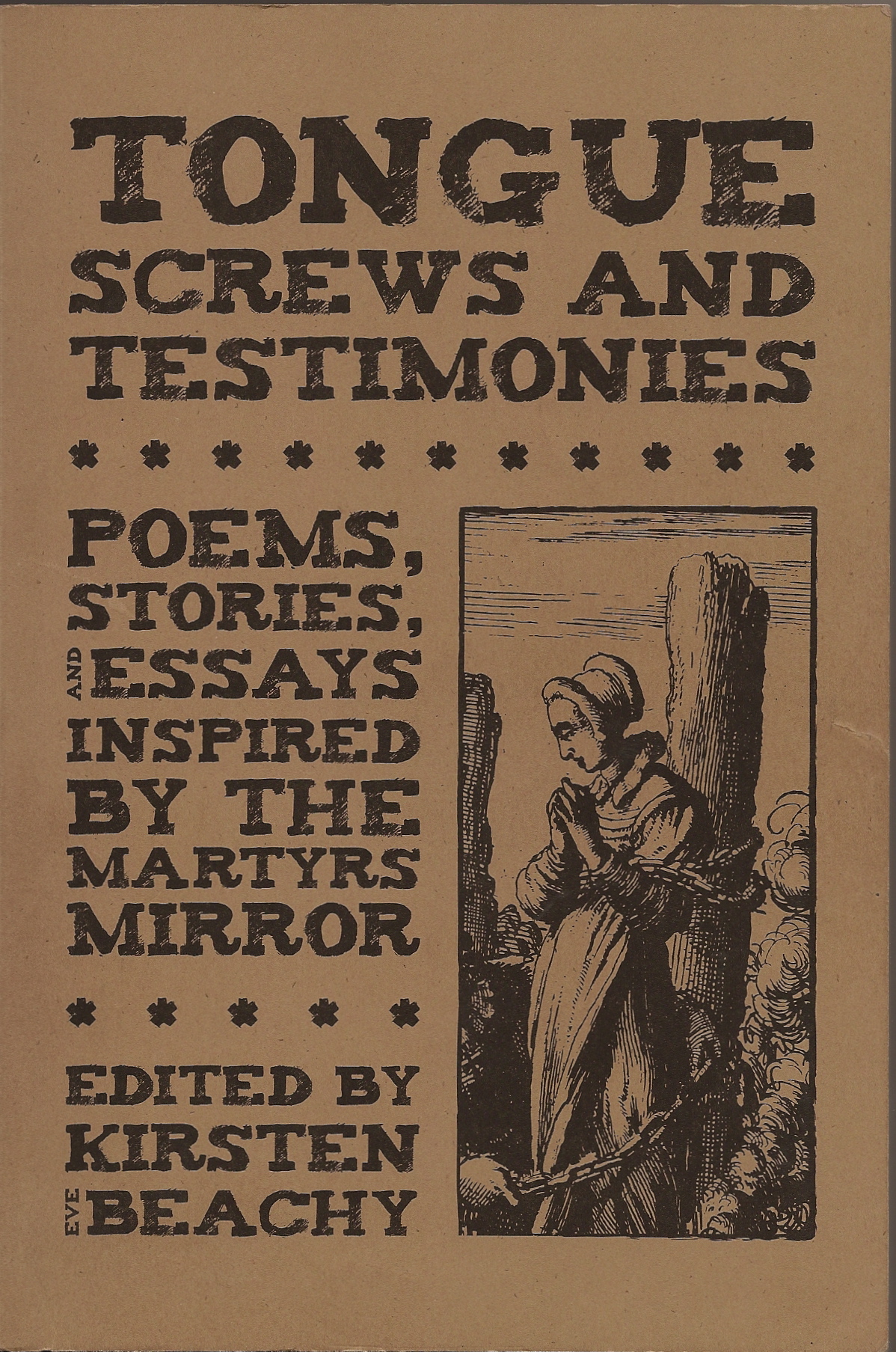
The book offers a whole variety of responses to the Martyrs Mirror and its effects, ranging between adulation and critical resistance. I’ve got to save the details for the review, which  so far, is just an awful draft. But one fact is clear enough: it was very costly back in the time of the Anabaptist martyrs, to speak or act against the grain of accepted ideologies. So great was the trauma, it spawned a kind of silence. Mennonites became “the quiet in the land.” (“we wrapped our silence/ around a kernel of fear. This fear fed us…” from a poem by Sheri Hostetler.)

Well good thing we don’t burn or drown folks for their new or contrary ideas, not here, not now. Then again, there’s more than one way to turn up the heat. So maybe the words of  “the woman with the screw in her mouth,” in the poem quoted above, will encourage anyone who risks speaking and living their convictions, including Rob Bell. Says she, “The dying / was worth it, every pain. We were chosen to bring something new / into the world….”

God in pursuit

In the late 90s, I went on something of a Graham Greene reading spree — because his books are good, but also in sympathy with our son, who had to read ten books by one author for a high school class and had chosen Greene. Recently, I’ve had the yen to re-read some of those books, and when two writers mentioned The End of the Affair in a Valentine’s poll of “Romantic readings”, I decided now was the time, for one at least, and that’s the one I returned to.

I had forgotten most of it, I confess, since my first reading in 1998, except for a lingering sense of the dark, rainy, brooding Common in London upon which the story opens in 1946. But, gradually it came back, and all the wonder and surprise of it too, for if it’s “one of the best novels ever written about love,” in Pasha Malla’s words, it’s probably also one of the most unconventional. Maurice Bendrix has had an affair with the married Sarah Miles, which she ends abruptly and without explanation. Turns out that the rival, whom the embittered Bendrix wishes to find out and ruin if he can, is [Spoiler Alert] none other than God.

Narrator Bendrix insists from the beginning that this is a story of hatred, though he doesn’t do much better at hatred than love. (He’s got a lame leg, which reminds of Jacob, another compromised fighter-of-God.) This is a book that explores the great passions of life, which include love, hatred, and jealousy, but also fear and faith. It’s such a pleasure, though the word feels too sweet for what I mean, to wrestle with faith along with writers like Greene and Flannery O’Connor, who let it in, full tilt, always at the service of their marvellous style, but never simplistically or unambiguously.

There’s a strange mystical turn to things in The End of the Affair, but I better not give anything else away, except for one fragment that caught at me, from a letter Sarah Miles writes the lover she’s left (though never stopped loving).

But what’s the good, Maurice? [Sarah wrote] I believe there’s a God — I believe the whole bag of tricks, there’s nothing I don’t believe, they could subdivide the Trinity into a dozen parts and I’d believe. They could dig up records that proved Christ had been invented by Pilate to get himself promoted and I’d believe just the same. I’ve caught belief like a disease. I’ve fallen into belief like I fell into love…[because of something unexpected that happened]… I fought belief for longer than I fought love, but I haven’t any fight left.

This might not pass as a testimony of faith in many of our churches (too irrational), but she’s getting at a truth we might pause to remember, and that’s the strength of God’s pursuit of us: relentless, faithful, and not always welcome either. We need to remember this when we begin to think it’s all about us reaching Godward to touch and worship, as I suppose many of us will Sunday (tomorrow) morning. In fact, we’re just as often wrestlers or runners-away, keeping company with Jacob, Hagar, and Paul (and Sarah Miles and Maurice Bendrix), and we just may be — finally wearied — undone or outrun.

The collected words of a prophet

Last week, in a reflection on John 4 in the daily devotional Rejoice!, Melanie Zuercher of Kansas said, “I’ve known at least one prophet: Gene Stoltzfus, the founding director of Christian Peacemaker Teams… From my experiences with him and from examples from the Bible, I’ve learned that prophets aren’t always easy to be around. However, my strongest memories of Gene are of integrity, passionate commitment to Christ’s justice and peace, a deep love for his work and for his coworkers, and a joyful spirit.”

This prophet she knew, Gene Stoltzfus, died suddenly in March 2010. Now, near the anniversary of his death, a book of his writings — Create Space for Peace: 40 Years of Peacemaking — is about to be launched. Gene’s widow Dorothy Friesen, who is a friend of mine from a former writing group, as well as CPT colleagues and others have been working on the collection. Here’s a short introductory video clip to his life, and a blog post with further information about the book.