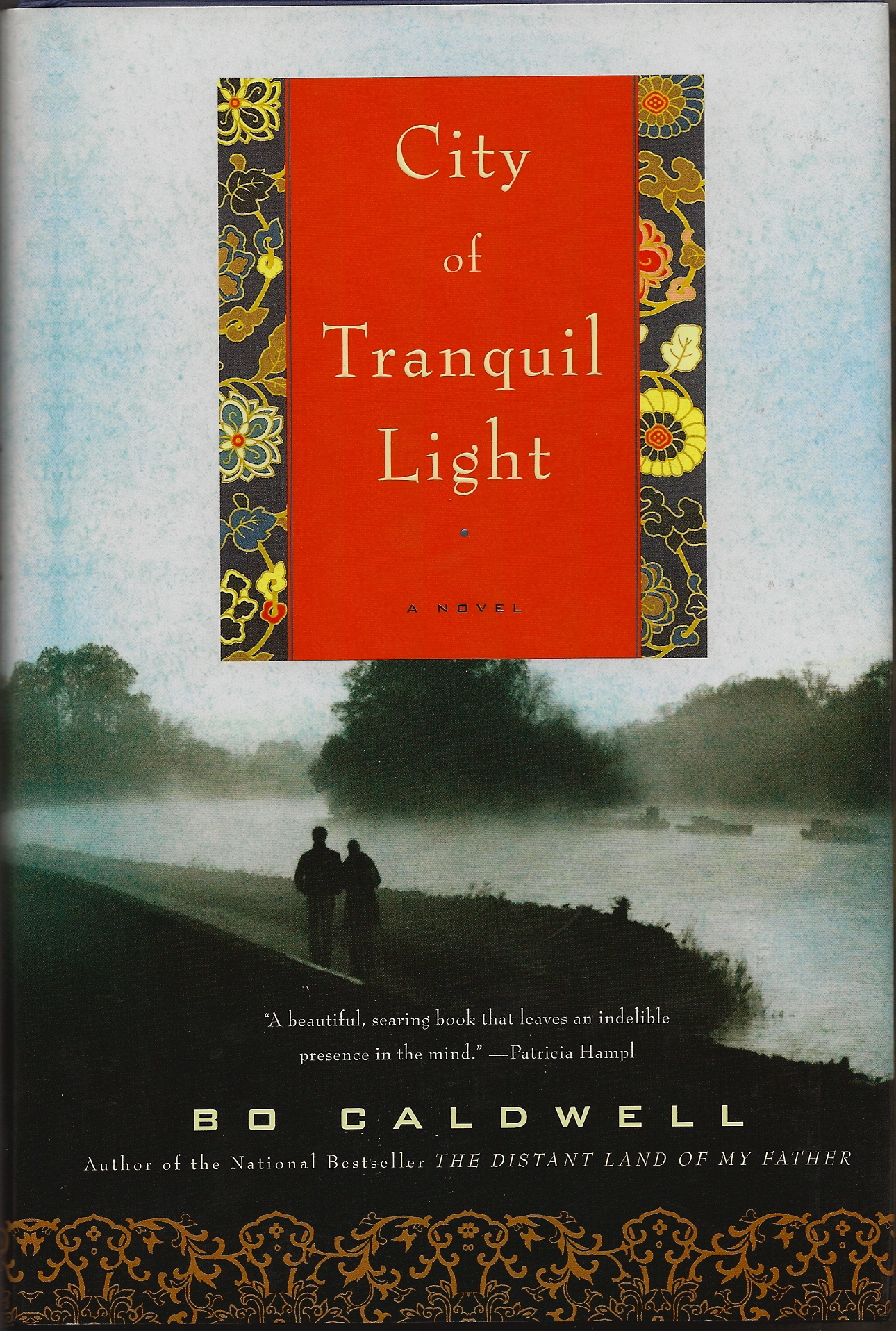
City of Tranquil Light

I recently read City of Tranquil Light by Bo Caldwell (Henry Holt and Co.). In this novel, the elderly widower Will Kiehn is looking back over his life. As a young man, he felt called to go to China as a missionary. There, he met and married fellow recruit Katherine Friesen. Will preached, Katherine did medical work, and together they experienced the formation of a sizeable Christian church in Kuang P’ing Ch’eng (meaning, City of Tranquil Light) and its outlying regions. They also experienced personal struggles and the trials of their adopted country: famine in 1918-22, civil war in 1925-28, the disintegration of an ancient civilization under imperial rule and China’s massive shift to communism.

Interspersed with Will’s backward look is Katherine’s voice, via her diary entries. The use of alternating voices – one with its perspective in the moment, the other through the gaze of memory – makes the story a kind of conversation as well as a telling. It’s a format that adds momentum to a story that feels — in spite of dramatic elements — quiet, gentle, and measured. (As one might expect from an older person’s recollections). It also deepens the thematic resonance of the book.

I liked City of Tranquil Light a lot. And what I like about talking about it here at my blog is that, unlike a more formal review, say for a newspaper or magazine, I can meander – or jump around – as I will. That at least, is how I understand the conventions of blogging. They allow a more personal, if partial, response – one that may, in effect, privilege the experience of reading over the book itself. (This doesn’t mean professionalism, fairness, and reviewing courtesies don’t apply.)

With that said, let me step back a little into my own context. City of Tranquil Light is a missionary story, and I grew up with missionary stories – in books and Sunday school papers and magazines, from the pulpit, in conversations all around me. They were stories of sacrifice, difficulty, and gut-wrenching inspiration. Missionaries were the heroes of an evangelical Protestant childhood; they were the Supermen and Superwomen of our world, and their ocean-crossing the equivalent of the costume change in the telephone booth. I don’t mean this cynically; it’s how things appeared to us. Continue reading

Thin Air

Last week, which seems a long while ago already, was Thin Air week in Winnipeg. Thin Air is the city’s annual writers festival. I was honored to have a small part in the event, with a campus reading of This Hidden Thing, but mostly the week was about listening to and engaging with a great variety of other writers from across the country. As the event’s subtitle says, “it’s for readers.”

I took in four of the evening events, and two of the afternoon book chats. Here’s a few highlights.

From the festival opener, a line by Ismaila Alfa, traffic reporter for CBC Radio and poet/musician:

Long live the figures of speech before and after me.

Long live indeed, figures of speech!

Since I'm not much of a coffee drinker, my sleek Thin Air mug has top spot as pens and pencils holder.

The festival featured many wonderful writers and their books, and I hate to single some out, but… I enjoyed hearing Richard B. Wright (perhaps best known for his Clara Callan), whose new book is Mr. Shakespeare’s Bastard. Wright had some interesting things to say about how he works, including the comment that reading poetry unblocks him when he’s stuck, reinvigorates him. And, finding myself once again involved in the terror and joy of a new novel project, I certainly  resonated with what Wright said about that:

You’re sitting in a room talking to yourself — it’s almost a form of madness… You hope what you’re indulging in will be liked and indulged by others… [But] I seem to need another life. A writer needs this other imaginary world.

And the books I’d like to read because of the festival? Wright’s, yes, and also David Bergen’s latest, The Matter with Morris, which landed on the Giller prize long list as the week opened. Opening reviews have praised it and the passage Bergen read from it intrigued me. (Another festival author and Winnipegger who made the long list is Joan Thomas, but I’ve already read her Curiosity, so I’m up at least one!) I’m also looking forward to Sandra Birdsell’s new book, Waiting for Joe.

Every time I attend readings I realize again what a pleasure it is to listen to ideas and words crafted with care. Poetry, especially, shines when read aloud; the genre almost requires an oral presentation. Novels are trickier to judge from their performance, I think, because they turn and deepen on extended development. But the fragments we hear are an invitation, and we honor authors when we take them up on it.

More from Stanley Hauerwas

Hannah’s Child, by Stanley Hauerwas, which I reviewed in the previous post, is one of those books I could not read without a pencil at hand, to mark spots I especially enjoyed with a tiny check mark in the margin, rather like notching a tree, I suppose, in case I wanted to come back and look again.

Here’s a quote or two from those markings.

On the influence of John Howard Yoder:
Yoder forced me to recognize that nonviolence is not a recommendation, an ideal, that Jesus suggested we might try to live up to. Rather, nonviolence is constitutive of God’s refusal to redeem coercively.

On the contingent nature of our existence:
To say that our lives are contingent is to say that they are out of our control. Being “out of control” is the central image that runs through The Peaceable Kingdom and much of my work… the image came to me because of the influence of Yoder, who taught me to think that following Jesus means you cannot anticipate or ensure results. Learning to live out of control, learning to live without trying to force contingency into conformity because of our desperate need for security, I take to be a resource for discovering alternatives that would otherwise not be present.

On friendship:
What it means for me to be a Christian and to be a friend has become so intertwined that I cannot untangle one from the other, nor do I wish to.

An interesting — surprising? — observation on institutions:
I have learned… that the patience and time it takes to build and sustain institutions like the church and the university are themselves an alternative to war.

And last, on having a novelist’s eye in his writing as ethicist, for what it also says about the novelist’s task:
We are complex creatures constituted by contradictions we refuse to acknowledge. The novelist must help us see our complexity without providing comforting explanations…. Reading novels will not necessarily make one better able to see without illusion, but it can help.