Do we have to believe that we’re bad to the bone?

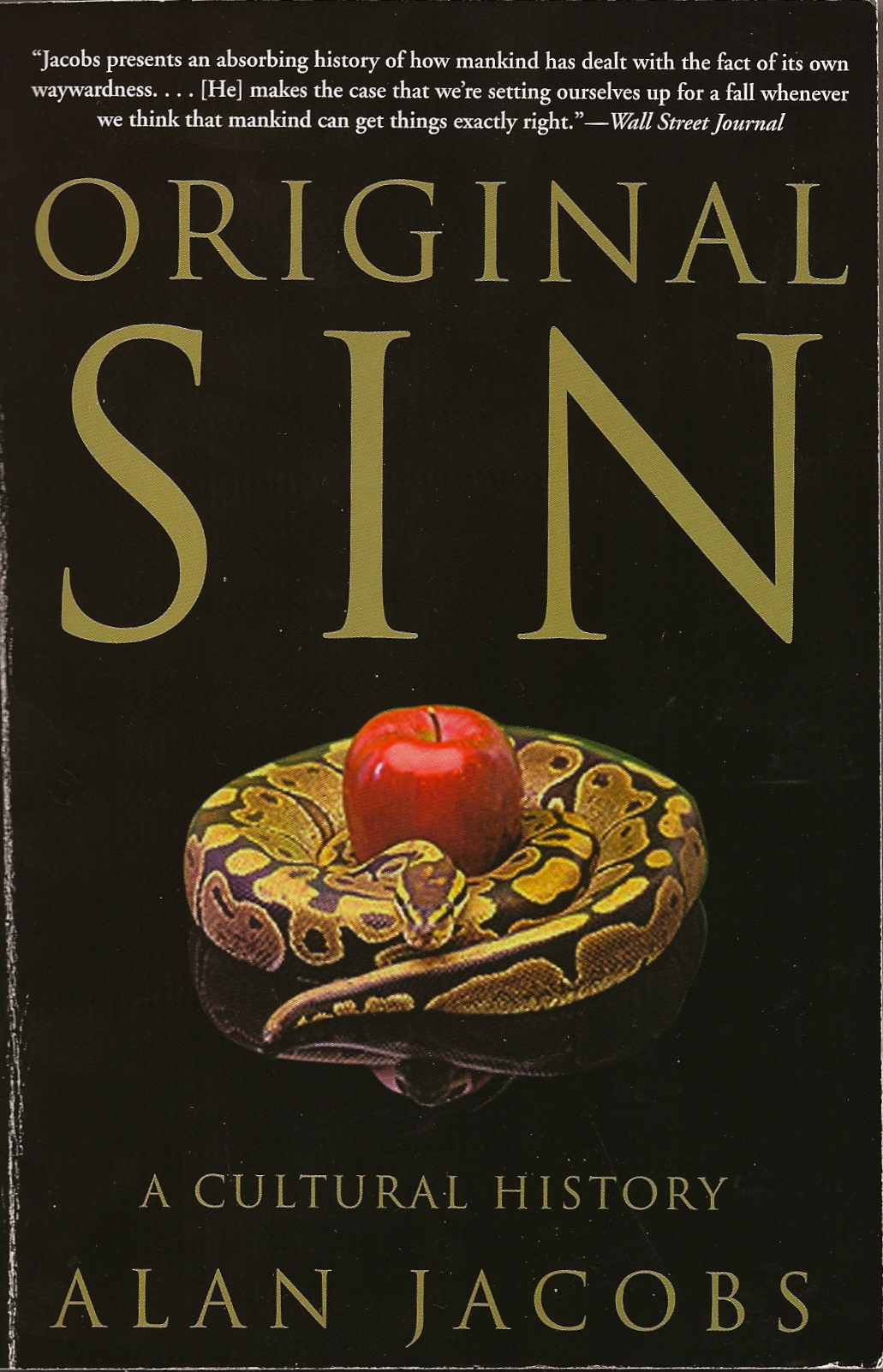
The third in the latest “Take and Read” series — a book analysis, discussion, and dessert group led by Paul Doerksen of MBCI — happens this evening and the book we’ll be talking about is Original Sin: A Cultural History by Alan Jacobs, professor of English at Wheaton College in Illinois.

Jacobs’ book is not a theological study of original sin (by which is meant “sin that’s already inside us, already dwelling in us at our origin, at our very conception”), but rather, as the subtitle suggests, the story of how this doctrine has worked itself out through (Western) history. Nor is the fact that humans do wrong under debate. That seems obvious enough. Anyone with self-awareness or knowledge of others, or with even a rudimentary sense of the 20th century knows how unloving and selfish, how truly cruel, we human beings can be. 

“Where does this wrongdoing come from?” asks Jacob. “What is its wellspring, the source of its ongoing prevalence and power?” In contemporary culture, scholars like Steven Pinker emphasize the biological determinants of human behaviour, but even they can’t explain “why selfish and violent are pejorative terms for us.” It’s time to re-consider peccatum originalis,  Jacobs says, “the belief that we arrive in this world predisposed to wrongdoing.” Continue reading

Mennonite chick lit

Mennonite in a Little Black Dress by Rhoda Janzen has all the marks of chick lit, which I don’t usually read. (If that sounds snobbish, let me rush to explain that it’s an age thing: I’m up for some well-written crone lit, actually, if it’s out there.)

Plus, Valerie Weaver-Zercher, reviewing the book in Christian Century, said Janzen “manages to reveal little of consequence about either herself or the church from which she came,” and “her wit at times obscures authentic self-revelation.” I thought I didn’t need to bother with it then.

But I also read other more positive reviews and a discussion of the book at the Center for Mennonite Writing. And, of course, there was the fact that, if chick lit, it was Mennonite chick lit — an oxymoron, perhaps, until now. I learned further that the “going home” of the subtitle was to the Mennonite Brethren, which happens to be my brand of Mennonite, and the author’s father is Edmund Janzen, for some years moderator of the General Conference of Mennonite Brethren Churches (although author Janzen calls him “head of the North American Mennonite Conference for Canada and the United States…the Mennonite equivalent of the pope”). Don’t most of us like to know what’s being said about “us”?

Given the intrigue of conflicting reviews, then, and my undeniable curiosity, I decided to buy the book and find out for myself.

Continue reading

Now found wanting

Here are some lines from Marilynne Robinson’s novel Housekeeping, which I’ve just finished reading (emerging from it as from a marvellous dream). I find them evocative — within their context, but without it too.

Imagine that Noah knocked his house apart and used the planks to build an ark, while his neighbors looked on, full of doubt. A house, he must have told them, should be daubed with pitch and built to float cloud high, if need be. A lettuce patch was of no use at all, and a good foundation was worse than useless. A house should have a compass and a keel. The neighbors would have put their hands in their pockets and chewed their lips and strolled home to houses they now found wanting in ways they could not understand….