For the people of Haiti

Last evening, at a gathering of the regional Mennonite-Catholic Dialogue (a group of six Mennonites and six Catholics which meets several times a year), John Long of the host parish led us in a prayer for the people of Haiti that he had adapted from Edward Hays’ Prayers for the Domestic Church (1979). It was deeply meaningful to gather up in prayer the many responses and emotions we feel as we try to absorb the news. John gladly gave me permission to share some excerpts here, from “Prayer upon Hearing of a Death.”

Blessed are You, Lord our God,
     who are the keeper of the Book of Life. 
This week we have learned of the death of many in Haiti
     and, as this type of news always does,
     it comes as a shock.
We know, Lord, that we all must die,
     and that You alone keep the dates of our death
     within Your Book of Life,
     but we still share the shock of death.
 That news carries with it the shadow of fear,
     for it is a reminder that, someday, we too shall die.
Today, then, we pray for all these
     who have passed through the doorway of death,
     and we pray for ourselves as well.
We remember in our prayer
     the members of the families
     who surely are lost in sorrow at this time.
Support them with Your Holy Spirit
     and grant them the courage to embrace this tragic mystery…. 

May we best remember these men,
     women, and children unknown to us
     by being grateful for life today
     and by loving You, our God,
     with all our heart, strength, and mind.
Lord, grant eternal rest to all who have died,
and divine consolation to all of the surviving families.

Blessed are You, Lord our God,
Keeper of the Book of Life. Amen.


The commitment of Peter J. Dyck

Peter J. Dyck. Photo credit: MCC


Peter J. Dyck (1914 – 2010), well-known in Mennonite circles for his work with refugees in post-World War II Europe and beyond, died in Scottdale, Pa. last week, at 95. 

He almost died as a child, in 1921, of typhoid and hunger because of the famine in Russia. Thanks to food assistance provided by the newly formed Mennonite Central Committee (MCC), he survived, however, and with his family was able to immigrate to Canada.

The memory of that food aid would later motivate him to serve with MCC in England during the war. After the war, he and his wife Elfrieda (Klassen), who was equally involved in their dynamic partnership, moved to the Netherlands to direct a huge relief effort. They also organized and led the transport of some 5,500 Mennonites in four ships to new homes in South America.

The couple worked with MCC and the Mennonite church in various capacities throughout their lives, but it’s the events associated with the refugee work that will probably remain most closely associated with their names. Certainly those stories of rescue and resettlement, full of drama and pathos, formed a significant part of my sense of how the world had unfolded during the brutal and turbulent years just before my birth. I’m not sure how they came to me, but it must have been through Mennonite periodicals, speakers, and books. Books like Helen Good Brenneman’s But Not Forsaken, and later Barbara Smucker’s excellent children’s novel, Henry’s Red Sea, about one of the most dramatic of the events, the movement of former Russian Mennonite refugees through Russian-occupied territory by train to reach a ship waiting to take them to a new homeland. Peter Dyck too was a great storyteller and did a great deal of public speaking, and with Elfrieda, co-authored a fascinating account of their postwar experiences, Up from the Rubble.

Yesterday, in the sharing time in church, one of the women in our congregation recalled with gratitude Peter Dyck’s life and service. She was three years old when her family crossed the ocean in one of those groups overseen by the Dycks. She also reminded us – as an encouragement to the younger generation – that Dyck was in his 30s when he was doing the work that made such a difference for her and so many others. I don’t know how aware the Dycks were at the time of the historical significance of their gathering and re-location of refugees. Perhaps they sensed it, but were probably mostly just busy giving their best intelligence, energy, and fortitude to their assignments.

Somehow it all begins to seem very long ago, and with the passing of Peter Dyck even longer. So I too commend Peter (and Elfrieda, who died in 2004) Dyck to our memory and the events of that era to our attention. I think there’s still a great deal to learn from those times, especially from watching ordinary people work out their commitment to compassion and service in complicated environments, and doing this, not only because they’ve been helped themselves, but also because that’s what Christian disciples do in a needy world.

* A report of Dyck’s death and fuller bio can be found at the MCC website, here. The article includes an invitation to share personal memories. Some have already appeared, to further round out and bless the legacy of this man.

Grief and gratitude

On Monday this week, my father died.

That’s the easy sentence to write. Now what do I say?

I can say that in some deaths, grief so out-powers gratitude of any kind, the latter cannot be found until much later. In this one, there’s also grief, but gratitude rises more quickly to the surface — because my dad was a good man, because he lived a long life (88 years and 8 months), and because his last years were ravaged by Alzheimer’s disease (and I use the word “ravage” intentionally with all the meaning it holds: “to work havoc upon, to do ruinous damage”) and so we’d already been grieving slowly and subtly and I trust it won’t be surprising to hear that we’re relieved the suffering of that illness is over.

I’m also grateful I could be at his side when he died. Although Dad had been declining physically as well as mentally, that decline had accelerated in the past weeks. When we left for our Christmas holiday travel, I said good-bye as if I’d not see him alive again. By Christmas Day, he was expected to die before the day was out, but when we returned on the 26th, he was still breathing. He lived a further two days. The staff at the care facility marvelled: such a palpable shutting down, no responsiveness, and yet his heart kept beating. We who knew him were less surprised. Not only had he always been strong and athletic, but this persistence was symptomatic of his temperament. He had a stubborn determination about him; he was not a quitter. Whatever he’d committed to, whether it was his commitment to Jesus Christ at age 14 or his commitment to our mother more than 62 years ago, it lasted by virtue of diligent going-on with it, one hour after the other.

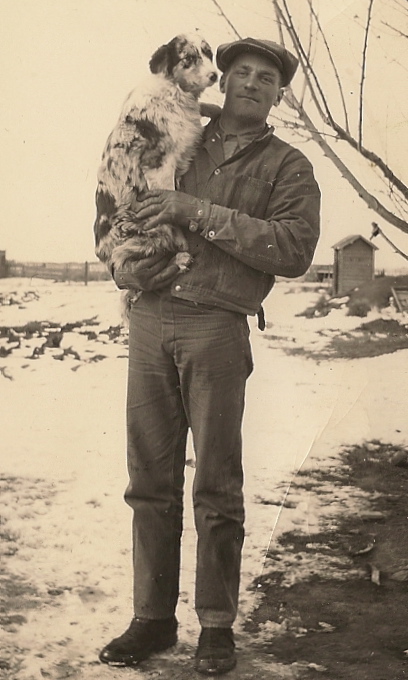
My dad as a young man, with Curly


Our last vigil at my father’s side was as much listening as watching. When life is so reduced, one only notices what’s left. In this case, it was his breathing. The day before his death, Dad would stop breathing for up to 30 or 40 seconds at a time, then resume a further round of it. The day of his death, another pattern ensued, with very few pauses but the breathing faster and shallower and noisier. While we waited and listened, my mother and whoever else was there passed the time talking, singing, reading. We often stroked Dad’s forehead or held a hand. Sometimes I found myself glancing from the black and white photograph on the wall, of my father as a lean young man, holding his dog Curly, to the shrunken body, mouth slack, eyes half open but seeing nothing. In his last hour, his extremities already cool and purplish, the eyes now open completely though still not seeing us (though “seeing” the unseen eternal, as per 2 Corinthians 4:18, perhaps), his breaths became very quiet and scarcely deeper than his throat. Then, each one quieter and shallower, they stopped.