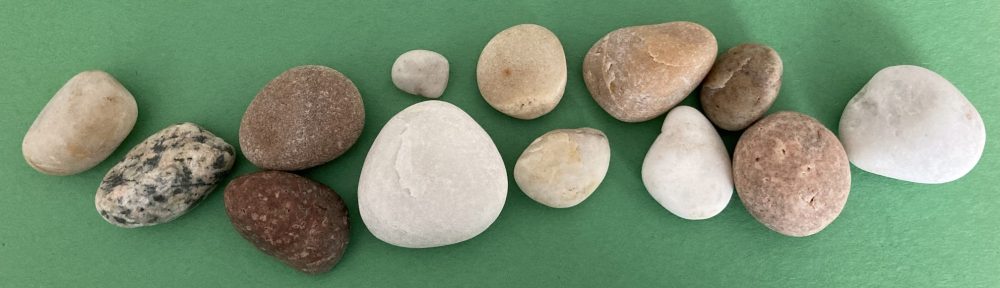
A ritual procession down 56th

A good funeral, poet/undertaker Thomas Lynch says, gets the dead where they need to go and the living where they need to be. When my husband Helmut died four years ago in the middle of the Covid pandemic, the usual mourning rituals had to be significantly modified. Not all of this was disappointing. It was a privilege for me, for example, to wash his body myself and, with the help of a son, dress him after death. The funeral service had us as a family separated into three “bubbles” but was meaningful nevertheless, as music, readings, eulogy, and homily flowed smoothly via the technological help of one of our pastors. We very much missed the physical presence and hugs of other people but, as a livestream production, it was possible for local friends and family as well as those in faraway places like Winnipeg and Paraguay to participate.

Once Helmut knew his diagnosis was probably terminal, he built his ashes box himself, of two favourite woods–maple and walnut. The plan was for cremation and then interment in a columbarium niche. The first part happened, and then four years passed with the box and ashes in the apartment with me. I didn’t mind at all, to be honest. But the time had come, and the opportunity, for the second part. This month, the whole family was together in B.C. for the wedding celebration of our daughter and her wife who were married five years ago, also during Covid, but sans the party. The couple graciously yielded a day of their celebration week for the interment of Helmut’s ashes.

I decided I wanted to walk to the cemetery and all the children and available grandchildren (some were in university classes and couldn’t come) gladly joined me. It’s about two kilometres from my apartment to the cemetery, but everyone’s fit to walk. The nearly-nine-year-old granddaughter wanted to know why we were doing this and I told her about the practice of pallbearers, about the symbolism of carrying our dead where they need to go. It took us about half an hour, down 56th Street, the main street of Tsawwassen, and whoever wished to, had their “turn with the urn.” (It was heavy!). I enjoyed this walk and the various conversations enroute, this carrying of our husband, father, father-in-law, grandfather at the pace of our feet.

A granddaughter takes her turn.

At the cemetery, we gathered under a canopy. I shared a few thoughts and memories, as did others, the granddaughters read some selected scripture texts, we spoke a litany of commital together, and the three children placed the box in the niche. Then the cemeterian came and closed the niche and placed the plaque over it. It felt emotional for many of us, but good.

I’ve startled a few people already with the photo of the niche plaque, because my name is also there. Please don’t be, it’s what my parents did with their cemetery stone, and it feels perfectly comfortable for ours. A niche has room for two “urns” and it’s where my cremains will go as well. Whenever; year only to be added.

After the ceremony, we gathered at the home of the oldest son and family, not far from the cemetery. Since I’d baked cinnamon buns for our lunch together and since I needed to be alone for a bit after the interment, I walked back down 56th Street, just me this time, and that felt necessary and symbolic too, and I picked up the pans of buns and brought them to the house in the car. We had a lovely day together, all of us gradually turning our thoughts to the upcoming marriage celebration. (Which turned out to be a wonderful day too.)

Where I Am Now

Since the basement suite at my Toronto son’s home is currently between renters, he and my daughter-in-law and I decided this would be a perfect time for me to come and stay longer than my usual visits. I left Vancouver yesterday morning and arrived in the evening to a warm welcome. I’ll be here a month.

IMG_5078

On the flight I watched a movie: Young Woman and the Sea, based on the true story of Trudy Ederle, the first woman to swim the English Channel. I found myself choking up at numerous points, which surprised me, because although it’s well done and inspiring, it’s also a fairly predictable triumph-over-adversity narrative. Why was my emotional skin so thin that every little thing in the movie threatened to puncture it?

I discerned that perhaps even more than I’d been aware of, I was discouraged by the recent U.S. election, especially in matters concerning women. It felt as if the formidable challenges Trudy Ederle faced as a female in sports in the 1920s were standing in for the resurgence of an ugly cultural misogyny.

Perhaps the anticipation of inhabiting the exact space Helmut and I did more than eight years ago was part of it too. After we packed our Winnipeg belongings into a storage pod, spring 2016, we came to Toronto for two-plus months, living in the basement. Helmut helped son Peter wall off the area for the current two-room apartment. My sister, whose husband died several years before mine, once observed, “You get used to it.” And it’s true, eventually you do. It would actually be awful if one didn’t get used to things. Nevertheless, anticipation of a return to the space we (and then I) had not been in again since 2016 (because it was renter-occupied) seemed to be triggering sad nostalgia.

IMG_5077

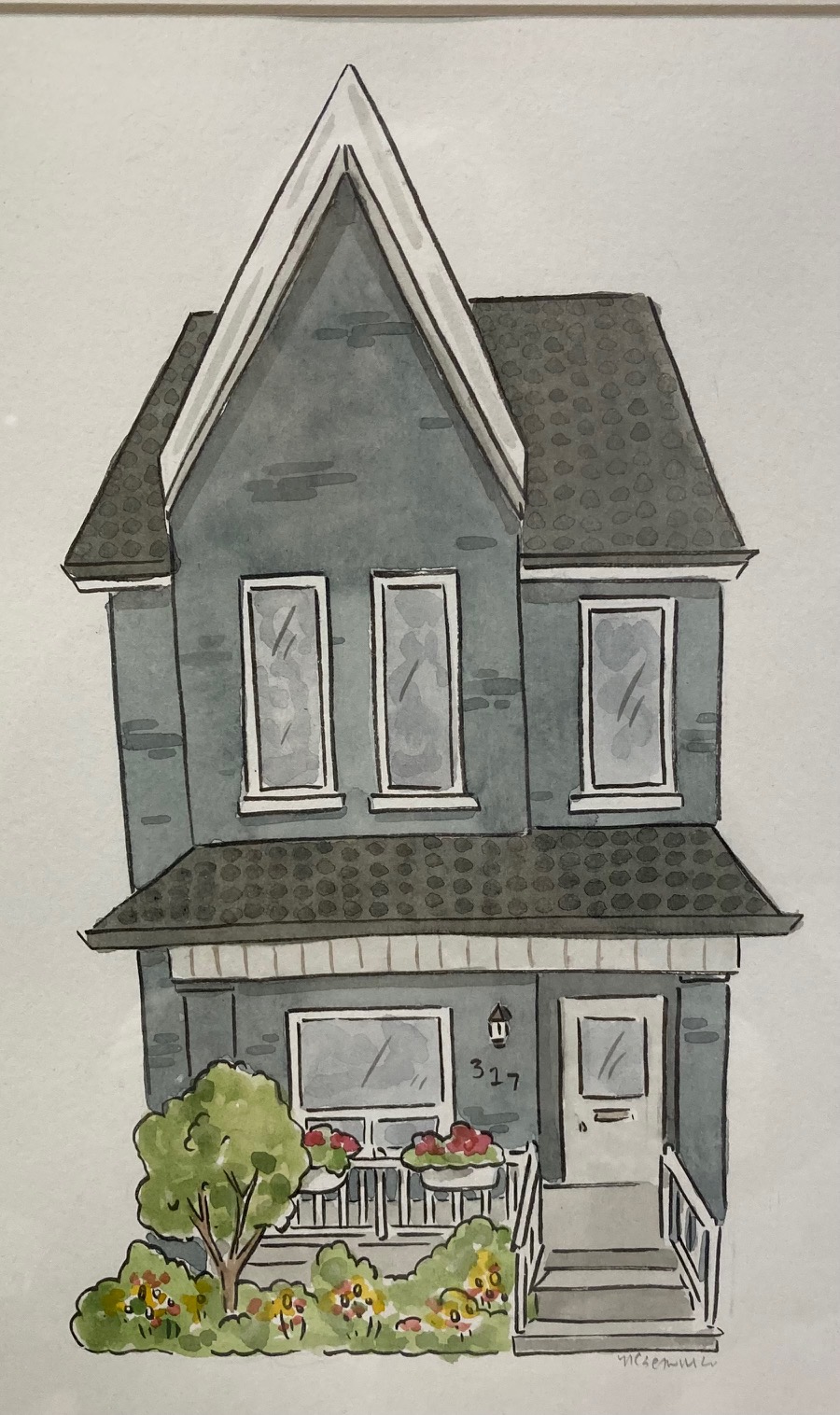
The Toronto house I’m in. (By Natalie Czerwinski.)

Once inside it, however, I was slightly disoriented and realized that the space had subtly altered in my memory. I have a strong sense of places I’ve lived, but obviously it’s far from infallible. As I settled into the specifics of the present — one twin bed in the room, not two squished together, and the addition of a desk and chair and some other furniture — the memories became clearer and re-arranged themselves, and I was happy about them and also ready to enjoy being here with the children and three granddaughters — semi-independent but connected — and to work on a couple of small writing projects as well as help along in whatever ways I can. My emotional skin feels thicker; there’s fresh courage in this space.

Stories and songs

I forgot my phone at Bonnie’s house yesterday so have no photos to prove I attended the second day of the Russlaender conference! But I was definitely there, at my alma mater, the University of Winnipeg, for a day as rich as the first. It felt less compressed, because there were only three presentations per slot instead of four as had been the case during parts of in the day before. Once again, there was much of interest.

It struck me that though an academic conference, many participants and certainly many in the audience had their own stories and lineage to set into what they were hearing about the period under consideration: the emigration of some 20,000 Mennonites from Russia in the 1920s. For one example, Josephine Braun, a great-grand-daughter of Isaac J Braun of the somewhat notorious Friesen-Braun trial in Saskatchewan, presented her attempts to dig deeper into the life of a man whose story had been suppressed within her own family, as Braun was jailed for some five years and then deported back to Russia, with his wife and sons left behind to somehow manage in Canada. A fascinating story with much remaining mystery.

The question at the time of that decade in Russia was: leave or stay? In another paper I particularly enjoyed, on Friday, Colin Neufeldt presented a long list of reasons people had NOT to emigrate. Some 20,000 did, yes, and it was that decision and the reasons for it as well as subsequent immigrant adjustments to a new environment that these days are commemorating, but the large majority did not leave. Some wanted to but couldn’t for various reasons and others could have but didn’t, also for various reasons. Many, perhaps more than we realize, he suggested, wanted to participate in the creation of the world’s first socialist state. For those less privileged within the Mennonite community, there was the possibility of upward mobility in the new circumstances. Also, the New Economic Policy seemed for many an optimistic reconstructive step after the chaos of the civil war. And of course there were always family reasons: one member of a couple might wish to go but not the other, or there were elderly parents to consider and so on.

Last week, before coming, I happened to be looking at some pages of my grandmother Helene Derksen Harder’s diary, where she recounts in broad strokes the last years and months before their decision to leave and then the auction and flurry with papers/permissions and other preparations for the journey. She tells of instances of great fear as “guests”–her euphemism for bandits and soldiers–invaded the household, wanting food, horses, money, and so on. She tells of hunger, loss, tension, deprivation. She mentions the bravery of her old mother who helped them pack, realizing she might never see her daughter again. Now I want to search those pages more thoroughly for my grandparents’ particular motivation to leave–along with their three small children—their beloved homeland and parents for new and unknown future.

As mentioned already, it was the decision to leave, whatever the motivation, that the conference (as well as a train tour from Quebec City to Abbotsford these weeks) was commemorating and for me the most wonderful way to do it was yesterday evening’s Saengerfest. Choirs–adult, youth, children–singing songs old and new, and we in the “sold out” Centennial Concert Hall sometimes got to sing along too. It’s songs of lament and faith and hope that reach back to connect both the stayers and the leavers, that sustained those who suffered through the challenges of their decisions; it’s the songs that now mostly strongly connect me into that story and my heritage and into my own childhood and youth, that brought me to tears last evening.

IMG_2432

I’ll end with mentioning just one small part of the festival of song. In Bach’s “Befiehl du deine Wege” (Entrust Thy Ways), conductor Henry Engbrecht had the choir begin each line together and then sing it individually, however slowly or quickly, and then at his signal end in harmony on the final note. It was the strangest and most astonishing cacophony of sound and then resolution, a perfect demonstration of the hundreds of individual stories we each set against the backdrop of historical events but drawing together as community then, as we hear one another, in harmony.