Fate unknown

This week I attended, with my sister and brother-in-law, an exhibit at the Mennonite Heritage Museum, Abbotsford, B.C., called “Unearthing the Vanished: Mennonite Experiences in Stalin’s Great Terror.”

It tells the stories of some of an estimated 9000 Mennonites — generally men — arrested during the Terror of 1937-38 in the Soviet Union. These stories are but a sampling of the 9000, and the 9000 itself but a portion of the number in the larger population who were affected in that period. (See, for example, books like Solzenitsyn’s The Gulag Archipelago.)

Janet Boldt, one of the writers/researchers of the exhibit, whose own relatives were taken in the Terror, gave us an excellent introduction to the exhibit.

In panels of text, photos, art, and poetry, and materials like a boy’s begging cloth and copies of trial documents, the exhibit presents the background to the Terror, details of arrests and interrogation and sometimes (if known) outcome, as well as faces in a 3-panel Wall of Sorrow. Even starker than photos are simply names with “profile cutouts.” In many cases, all that can be said is “Fate unknown.”

“Take a moment to gaze at their faces,” the exhibit guide advises. “[A]ll were part of the fabric of society, all were part of what it means to be family.”

A wail of lament

The exhibit also addresses the affect of these arrests and disappearances on women and on children. Collectively, it’s emotional; it’s moving. It’s a wail of lament.

I can’t help thinking of a 1912 funeral photo (below) of my grandfather’s family (he’s the second from right in the back), at the time of his father’s death. Of these siblings, only he and one brother, far left, would later manage to immigrate to Canada. What was the fate of the rest of them? A few letters in the early 1930s speak of Verbannung (exile) and great hunger.Of her family, my grandmother wrote, “If only I knew where all our family members are…. What happened to them all?”

It’s also impossible to look at this exhibit and not think of images and videos we see in the news every day, not arrests into a “Black Raven” vehicle at midnight but masked and often unidentified ICE agents seizing people in broad daylight. Reports of terrible treatment in places like Alligator Alcatraz are emerging. There seems no recourse in these grabs to lawful procedures or justice. It’s neither alarmist nor conspiracy theory to draw parallels between the “disappeared” of my heritage and today’s new masses of the “disappeared.”

Ten Sentences about Mennonite/s Writing Ten

  1. On the flight home from Winnipeg to Vancouver, I scan my notes and discover they’re so pathetically cryptic, they’ll be useless for saying anything meaningful about the conference sessions.
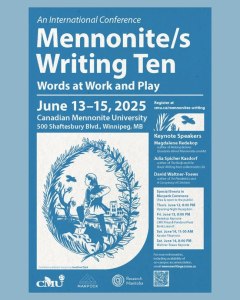
  2. Nevertheless, I can state the facts: this was # 10 in a series of conferences called Mennonite/s Writing, held every 3 years or so, and this time at Canadian Mennonite University in Winnipeg, Manitoba, June 13-15, under the theme “Words at Work and Play.”
  3. The conference happened against the news of nearly 300 dead in an Air India crash, Israel attacking Iran, ongoing National Guard/ICE craziness in Los Angeles, yet here we were, maybe 110 (?) of us, thinking and talking about writing, for in her keynote, Julia Spicher Kasdorf said her response to global concerns is to become more local, and these days, this was our local.
  4. I really enjoyed the conference — the sessions and keynotes of course, but also the collegiality, the many conversations with old and new friends, a happy sense of belonging because even though I don’t label myself a “Mennonite writer” (what does that actually mean, never mind these regular gatherings trying to figure it out) I still know that in some real way this is my tribe and besides, they’ll have me, which is always a happy and satisfying thing.
  5. The keynotes were highlights: Magdalene Redekop in an almost poetical trail of insights and juxtapositions on “translation” — a task we all take up in our lives — and David Waltner-Toews tackling “the meaning of everything” via science, that is, each of us “an unstable patchwork at our very core” yet interconnected, and Julia Spicher Kasdorf ruminating on Mennonite identity, noting “identity politics reduces complexity” and “identity work can wear a body out” yet calling us — stirringly — to commit to writing as practice and conversation.
  6. I very rarely — honestly — notice what people are wearing, though there were several memorable, if minor, exceptions this time, for I glimpsed a well-known writer in his pyjamas in the residence hallway and I think they were blue and white, and Di Brandt wore a garland of (cloth?) red flowers and leaves on her head during her presentation, and my longtime friend Sarah Klassen looked classy in a neat, belted teal dress, but I do notice space and felt the conference metaphorically balanced by having parts in the aged, wood-toned ambience of the Great Hall and its connecting corridors and other parts in the newish light-filled Marpeck Commons.
  7. Most of the sessions ran concurrently with others, which meant that every choice meant missing something else, but the personal program I selected began wonderfully with David Elias on his grandfather’s brother and Elsie K. Neufeld on her work as a personal historian and Linda Umble on reading Mennonite texts, and ended as wonderfully Sunday morning with three poets — Jeff Gundy, Julia Spicher Kasdorf, Ann Hostetler — reading their work, and in between I presented too (“Thinking about Oneself: Desire and Discovery in the Personal Essay and Memoir”) alongside Mary Ann Loewen who gave a memoir talk about herself and her granddaughter, both of which went well, we thought, and provoked some good discussion..
  8. A good number of younger people attended, and some presented, as in a session I attended featuring readings by Joelle Kidd, James Bergman, and Geoff Martin (whom I had “met” before, in a manner of speaking, when essays we’d written sat side-by-side in The New Quarterly — his was the winning one!) and it was great to hear new and younger voices in the mix.
  9. On the Thursday evening before the conference began, In Search of a Mennonite Imagination, edited by Robert Zacharias, containing key texts in Mennonite literary criticism, was launched at McNally Robinson Booksellers and I bought it, all 700+ significant pages of it, and later some other books besides, not as many as I may have wished but more than I could carry in my full backpack, but then a friend who lives in the next town over kindly offered to transport some of them, including the massive tome, in his luggage.
  10. The conference included an optional “literary tour” of Steinbach, which I selected to do, and it was interesting to see places associated with writers such as Miriam Toews and Patrick Friesen and ended with a delicious faspa at the Mennonite museum, where my final “Mennonite” sight of the weekend was a sculpture of the famous Dirk Willems story, which makes me wonder — in terms of two words Julia Spicher Kasdorf set against each other —  whether it represented, and could be told, as “continuity” rather than “rupture.” 

Konstantin Paustovsky & Hildi Froese Tiessen: there, then

I’ve been working my way through Konstantin Paustovsky’s 6-book Story of a Life this month. I heard about Paustovsky on The Mookse and the Gripes podcast and was drawn to his work when I discovered he was an almost-exact contemporary of my grandfather, about whom I’ve been thinking on account of last fall’s trip to the Caucasus. My grandfather was born in Molotschna Colony, Ukraine (then Russia) in 1890 and Paustovsky was born in Kiev, Ukraine in 1892.

I was also pleased to discover that the entire series is held at the Vancouver Public Library. I took them all out.

Since I may — someday — do a personal essay about my grandfather in the Caucasus during WWI, reading Paustovsky is a kind of research, though of the most pleasurable variety, for he writes vividly, not at a distance but from within each experience as it occurred. During the war he worked on a medical train, as did my grandfather. He was in Moscow during the early revolutionary period, when the city was “one solid, seething, endless public meeting.” He was in Kiev during part of the 3-year period when Ukraine underwent civil war and 17 political upheavals.

The first three books were especially compelling, but I will persist to the end because after a year in Odessa during the blockade (Vol. 4), Paustovsky spends time in the Caucasus in Vol. 5, which I’ve reached too. I look forward to his descriptions of that region.

Mennonite/s writing

I’ve also worked my way this month through On Mennonite/s Writing, selected essays by Hildi Froese Tiessen — “a scholar widely recognized as the primary critical figure in contemporary Mennonite literary studies” — recently published by CMU Press. The selecting of 18 essays, from her more than 80 contributions in the form of essays, book chapters, special journal issues, and so on–was done by Robert Zacharias. He also provides a fine introduction to Froese Tiessen’s overall work and this collection.

This is an important book, both in terms of honouring Froese Tiessen and of encapsulating a history of critical engagement with Mennonite literature. It was also fun to read.

I think I may have read some of the essays before, and certainly had some sense of the emergence of a so-called Mennonite literature, but I enjoyed starting at the beginning with her first essay in 1973 about Rudy Wiebe’s work, and seeing, in real time as it were, her continuing and developing insights into what was going on, especially in the relationship of Mennonite writers and their Mennonite community.

I read this book as a reader of Mennonite literature — and do recommend it to other readers and to students of literature — but I also enjoyed it as one of those “writers who happens to be Mennonite,” whose work came along rather later, in the wake of the period she especially observes. Reader or writer, we will all likely share the question of what comes next, and may have our opinions about what should or could, for as Froese Tiessen makes clear, the field has changed and continues to change. Her last essay describes the shift as one of “Mennonites as a community written about” to “Mennonites as a community writing.”

Two asides, or additional points of interest for me. The essay on the “forever summer, forever Sunday” trope of the Mennonite past in Russia, which entered the work of Rudy Wiebe, Sarah Klassen, David Waltner-Toews, and Sandra Birdsell (“Between Memory and Longing”) struck me as almost ironical as Froese Tiessen discerns/articulates an effect she herself could be said to have created. (She and her husband published a book of Peter Gerhard Rempel’s photographs of Mennonites in Russia with that title.) Perhaps an element of such circularity also characterizes her wider contribution to the field.

And then, in the middle of the book, in the essay “The Case of Dallas Wiebe,” three poems! His voice “distinctive enough to unsettle or inspire,” she says quite rightly. From the poem “God Speaks to the Geriatric Convention,” lines that sprung out to me:

You should imagine
that when you walk
through the valley of the shadow of death
that I am the one
who casts the shadow.

Reflecting on her life’s work, Froese Tiessen says, “[D]uring that irruption of Mennonite writing concentrated in the last two decades of the last century I had found myself, so often, right there, right then.” We can be grateful she was there, then, for her thinking is astute, her writing is clear and accessible, and her impact was enormous.