Eating at IKEA and Eating Like a Mennonite

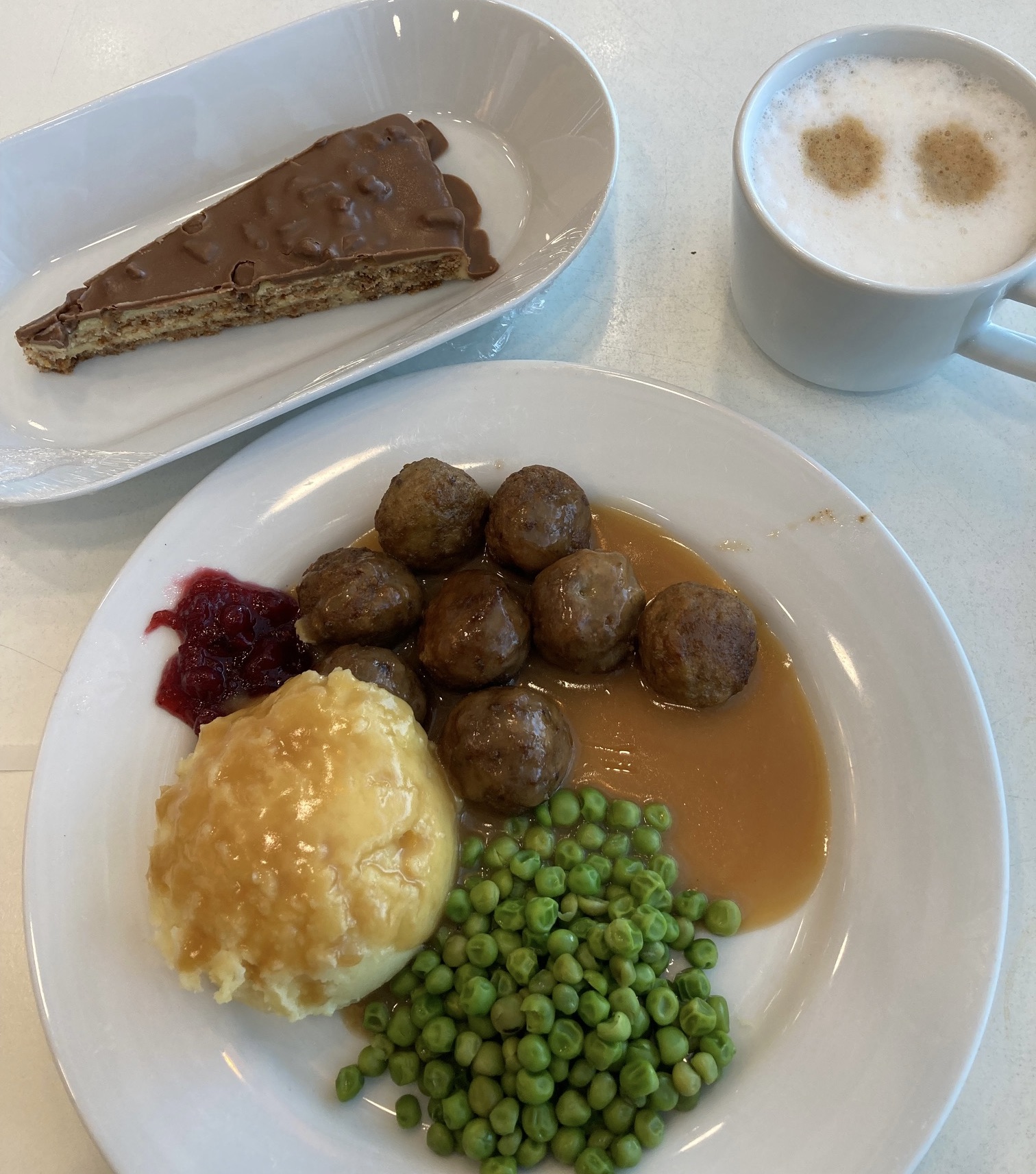
I stopped at IKEA for a few things recently and since it was close to noon, had lunch in their dining room. As usual, I had the Swedish-meatballs-mashed-potatoes-vegetables-and-dab-of- lingonberries plate and a triangle of DAIM cake for dessert.

IMG_3702

As usual, I say, because this is the very thing Helmut and I ate on our numerous trips to IKEA after re-locating to B.C., when we needed bookshelves, and then more bookshelves, and end tables, and so on and on. Although we brought some furniture along, we had left a good deal behind as well, and now we re-furnished as if we were students starting out — as cheaply and easily as possible! 

So I have good memories of those meals and if I happen to eat at IKEA now, I find myself making the same selection as before. It’s tasty enough, though IKEA-mass-produced, and I’m not sure what makes the meatballs Swedish, but it’s a meal of comfort for me on account of remembering those earlier times.

61SLqzKq6yL._SY522_

A few days later, I attended the launch in Abbotsford of Marlene Epp’s new book, Eating Like a Mennonite: Food and Community across Borders. Marlene Epp is professor emeritus of history at Conrad Grebel University in Waterloo, Ont. and well-known for her book, Women without Men: Mennonite Refugees of the Second World War (2000). She brings the same careful analysis, research, and skill with anecdotes to the topic of food: its role in identity, how what it “is” shifts through migration and encounters with other foodways (“hybridity”), how recipes are passed on, “the complex terrain of food and gender,” food trauma, and the place of food in religious practice. 

These topics play out in other groups as well, of course, but Epp’s focus is Mennonites (world-wide) and because I happen to be Mennonite, her book has been of great interest to me. As I read I couldn’t help inserting my experiences with food into her analysis. When she speaks of “the symbolic capacity of food to contain the past,” true for persons as well as communities, there was the recent repeat selection of a memory-laden meal at IKEA as an example. In fact, it is often food — his favourites or my making of Paraguayan chipa, which was his “specialty” and job — that evokes bittersweet recollections of him.

IMG_5562

Epp writes a fascinating chapter on cookbooks. She also addresses presumptions about Mennonite women as good cooks, as seen in the Mennonite Girls Can Cook blog phenomenon, for example. It was the MGCC phenomenon that prompted some writer friends of mine to propose, some years ago, an anthology around the idea that Mennonite Girls Can Write (about Food). Although the project didn’t happen, it inspired me to look at my life through the lens of food, written into something I called “Notes toward an autobiography,” though told in the third person, which landed in Return Stroke: essays & memoir. In that piece I had to start with the truth that though I admired and wished to emulate my mother, she was not a particularly good cook. (It occurs to me that because of that, I tried harder, even though I too am more dutiful than fond when it comes to meal preparation.) 

When I read a section about my experience with cookbooks at a launch of my book, I was surprised how much laughter it elicited. But it’s true, there’s often great seriousness about food, and there’s trauma in histories or presence of hunger, but looking back, laughter as well.

…She began with the cookbooks of her own tradition: The Mennonite Treasury of Recipes and The Mennonite Community Cookbook. She put eager comments in the margins when something turned out well: Aug.24/75 With our own apples! Yummy, and my first platz! Later she added, Also nice with rhubarb.

In time it annoyed her that most of the women who’d submitted the recipes identified themselves through their husbands — they were Mrs Jake Krahns, for instance, or Mrs Sam Detweilers — but well before that she was frustrated by their all-knowing vagueness. They left out baking times and other vital information. They said things like “enough flour for a firm dough.” What was a firm dough compared to a soft one?

Betty Crocker saved her. In Betty Crocker’s cookbook, no one cared about Mr Crocker’s name, or whether Betty was even married, or if she went to church. The language was English, the ingredients available in any regular store. The amounts were precise. Every single step was explained. The recipes succeeded. With Betty as her guide, she learned to make cream puffs, tall elegant cakes, pudding from scratch, strogonoff, and turkey pie. She hung on to that cookbook long after its cover had torn off and its pages were ruined with grease and gobs of batter. Long after her dependency on Betty Crocker had ended, she loved Betty’s book best.

Marlene Epp’s book would make a great selection for a book club, though the discussion of all the angles she pursues and their significant considerations around food might well devolve into an evening of personal stories (as has happened here in this post) and likely a fair bit of laughter. At any rate, I enjoyed Marlene’s book and recommend it.

sc009b2db3

But last of all this, who knew that watermelons were such a “marker” of food identity for Mennonites? And that there are various ways to cut them — neatly or for slurp effect? When we lived in Paraguay, where watermelons were plentiful in season, our young sons tackled theirs outside and with spoons! 

Because of the postcards

Friends, tomorrow I set out on another adventure: a tour in the Caucasus. Namely, Azerbaijan, Georgia, and Armenia.

I was away for three weeks in July, road-tripping and retreating, and it felt big, and this seems almost too soon in its wake, but I’d booked this trip quite some time ago, and now it’s here. Tomorrow, Vancouver to Frankfurt to Baku (the capital of Azerbaijan). Two weeks with a small group of ten with Adventures Abroad, and then, since one of my sons and his family is spending the school term in Nice, France, I’ll stop to visit them for a week on my way home.  IMG_0168

When I tell people I’m going to the Caucasus, the first question is often “Where’s that?” Between the Black and Caspian Seas, I say. The second question is often “Why?” It’s because of the postcards, I say.

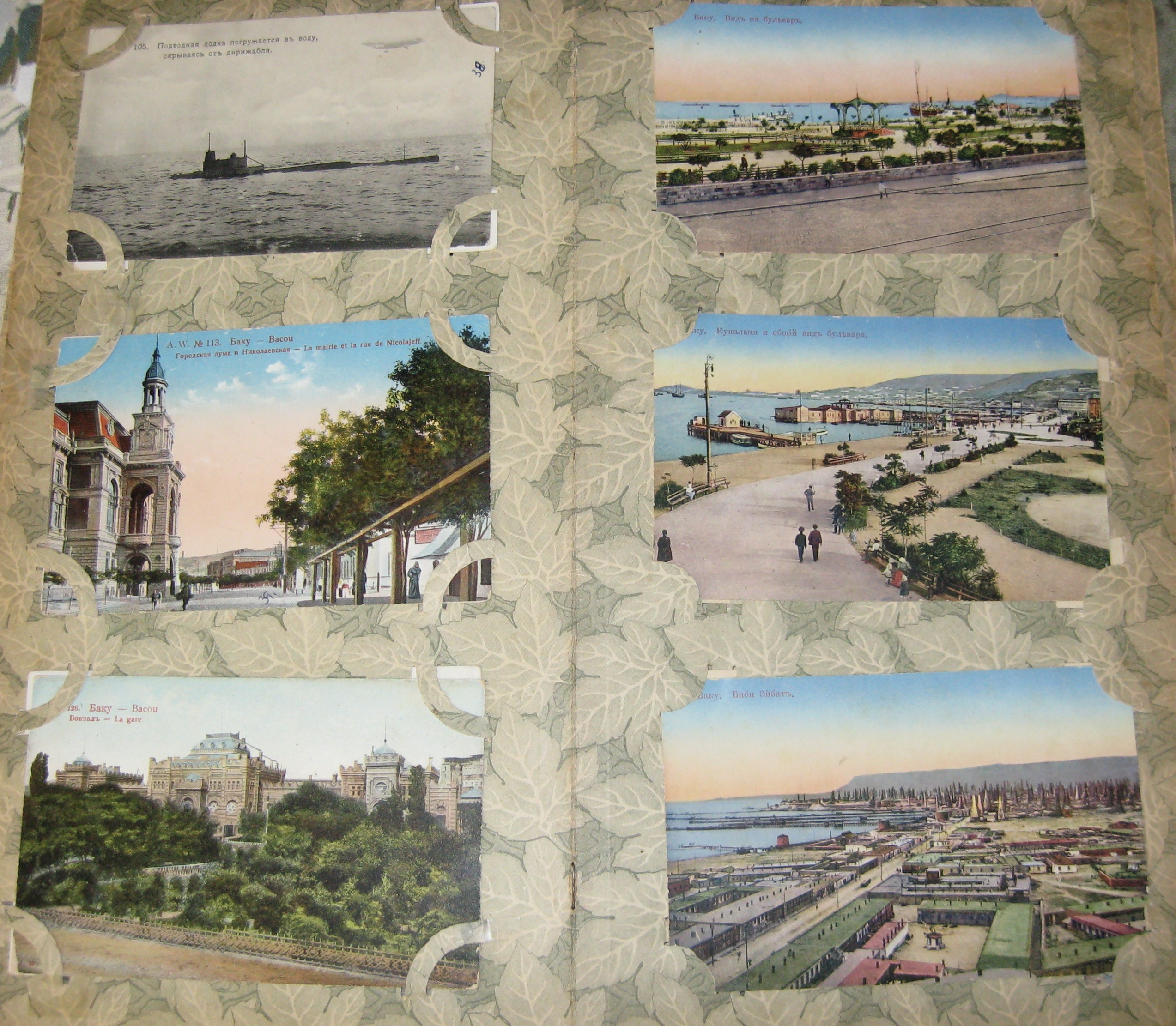
My grandfather, Heinrich Harder, did his World War I service for the Russian Empire in the Caucasus. (The area was part of Russia then.) He was a medic tending the wounded on the trains that brought them from the front, where Russia was fighting the Ottoman Empire (now Turkey), to hospitals in Baku and Tbilisi and so on. When he and my grandmother later immigrated to Canada, they brought along an album of some 80 postcards, most of them collected during his time in the Caucasus. This album ended up in my possession and one Christmas I spent my holiday time exploring the places on these cards via the internet. (The coloured ones are not colour photography but tinted from black and white photos.)

As I read his letters to my grandmother during the war, as I researched and contemplated the cards, the desire built to see — more than a hundred years later — some of the places where he spent several formative years of his life. It’s not really a follow-in-his-footsteps, because of course I’m on the schedule of an organized tour. But I will be there, in the cities of Baku, Tbilisi, Gyumri, Yerevan, all places he was too. And apart from that, I’ll be in a fascinating and complex part of the world.

So, tomorrow. Nothing further to do but go, and receive what there is, what will be. Nothing to do but be curious and open.

Accepting the chalice of our existence

Some time ago, a friend passed on a quote from the German Catholic priest Johann Baptist Metz (1928-2019), who stated that “Our self-acceptance is the basis of the Christian creed.” He described it as “accepting the chalice of our existence” and for some reason, this image struck me and has stuck with me.

I grew up in a low church environment, so chalice was not a familiar term or object, but there was the cup of the Eucharist and the cup Jesus spoke about when in Gethsemane he prayed, “if it is possible, let this cup pass from me; yet, not as I will, but as you will,” by which he meant his approaching death. The word chalice, with its roots in both drinking cup and cup of a flower, has a more evocative sound and larger scope for me than cup. When I think of the chalice of my existence it means the whole business of being me, not only whatever pain there’s been, but everything of past, present, and future. The tasks at hand, the particular aloneness of new widowhood, the particular losses and joys in aging, my relationships, my work.

Metz went on to say:

You shall lovingly accept the humanity entrusted to you! You shall be obedient to your destiny! You shall not continually try to escape it! You shall be true to yourself! You shall embrace yourself!

IMG_2595One afternoon during my writing retreat at St. Peter’s Abbey this summer, our small band of writers needed a break so we drove into nearby Humboldt to check out the thrift store. There was nothing I needed and the book section, except for dozens of Danielle Steele novels, was sparse. As I wandered around, waiting for the others, a chalice in white and blue (perhaps my favourite colour) caught my eye. It’s clearly mass-manufactured, certainly nothing uniquely handcrafted, but just the day before I had mentioned the “chalice of our existence” quote to one of my new friends, and here was a chalice, humble and ordinary, for the grand and entirely affordable price of $2. I knew it was for me!

Now it stands in my kitchen, reminding me in those moments when I’m tempted to dissatisfaction, of accepting all that belongs. And now and then, I drink something out of it too, either bracing or sweet.