Grief and gratitude

On Monday this week, my father died.

That’s the easy sentence to write. Now what do I say?

I can say that in some deaths, grief so out-powers gratitude of any kind, the latter cannot be found until much later. In this one, there’s also grief, but gratitude rises more quickly to the surface — because my dad was a good man, because he lived a long life (88 years and 8 months), and because his last years were ravaged by Alzheimer’s disease (and I use the word “ravage” intentionally with all the meaning it holds: “to work havoc upon, to do ruinous damage”) and so we’d already been grieving slowly and subtly and I trust it won’t be surprising to hear that we’re relieved the suffering of that illness is over.

I’m also grateful I could be at his side when he died. Although Dad had been declining physically as well as mentally, that decline had accelerated in the past weeks. When we left for our Christmas holiday travel, I said good-bye as if I’d not see him alive again. By Christmas Day, he was expected to die before the day was out, but when we returned on the 26th, he was still breathing. He lived a further two days. The staff at the care facility marvelled: such a palpable shutting down, no responsiveness, and yet his heart kept beating. We who knew him were less surprised. Not only had he always been strong and athletic, but this persistence was symptomatic of his temperament. He had a stubborn determination about him; he was not a quitter. Whatever he’d committed to, whether it was his commitment to Jesus Christ at age 14 or his commitment to our mother more than 62 years ago, it lasted by virtue of diligent going-on with it, one hour after the other.
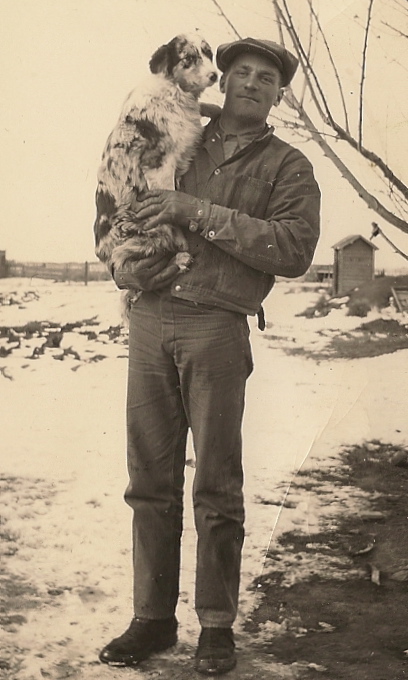
My dad as a young man, with Curly


Our last vigil at my father’s side was as much listening as watching. When life is so reduced, one only notices what’s left. In this case, it was his breathing. The day before his death, Dad would stop breathing for up to 30 or 40 seconds at a time, then resume a further round of it. The day of his death, another pattern ensued, with very few pauses but the breathing faster and shallower and noisier. While we waited and listened, my mother and whoever else was there passed the time talking, singing, reading. We often stroked Dad’s forehead or held a hand. Sometimes I found myself glancing from the black and white photograph on the wall, of my father as a lean young man, holding his dog Curly, to the shrunken body, mouth slack, eyes half open but seeing nothing. In his last hour, his extremities already cool and purplish, the eyes now open completely though still not seeing us (though “seeing” the unseen eternal, as per 2 Corinthians 4:18, perhaps), his breaths became very quiet and scarcely deeper than his throat. Then, each one quieter and shallower, they stopped.

William Kurelek’s joy

This week, in the local used books establishment, I found a real treasure: Kurelek’s Canada (Pagurian Press, 1978), which is no longer in print. It contains more than 30 reproductions in colour, as well as some in black and white, of the paintings of William Kurelek (1927-1977), and also his writing about them. And all this for only a dollar!

I’ve liked Kurelek’s work ever since I first encountered it, through A Prairie Boy’s Winter (1973) and A Prairie Boy’s Summer (1975), and then his wonderful A Northern Nativity, which pictures the holy family in a variety of ethnic and geographic settings — from a fisherman’s hut to an Amish Mennonite buggy to a boxcar to a soup kitchen. For many years, until they became just too faded, we had four framed calendar prints of some of the prairie scenes hanging on one of our walls. 

Kurelek had an unhappy childhood in many ways and a complex relationship with his father — both hating and worshipping him, he said later. He was the oldest of seven children of a hardworking prairie couple (Alberta and Manitoba), his parents of Ukrainian immigrant origin. He was painfully shy, sensitive, artistic, but inept at those mechanical and physical things that might have earned his parents’ praise. So powerful was his desire to do art, however, that he risked their disapproval to study it. 

In 1957, Kurelek risked his parents’ disfavour once again by converting to the Roman Catholic church (his family had been nominally Orthodox). His mother, he writes, was “particularly vocal in expressing her view that religion killed joy.” Yet the theme of Kurelek’s Canada is joy, he says in his foreword, “my view of joy, both remembered and observed, in this my native land.”

Kurelek was also a “message painter,” doing a series of 160 paintings on the Passion of Christ, for example, housed at the Niagara Falls Art Gallery, but there’s no didacticism in these paintings of ordinary people in the various parts of this country doing such ordinary things. They stir joy in me too, over the colours, over his sense of the land, its diversity and yet the way its parts cross-reference each other: the land in Manitoba “so flat it is like being on an ocean” and then the ocean off Nova Scotia giving him “the same feeling as the prairie in winter when the landscape is an endless series of wind-sculpted snowdrifts…”

Kurelek’s sensitivity to this country’s landscapes and history, and his sensitivity to the pleasures and dreaminess of being young, have always resonated with me. It’s as if his memories are my memories too, no matter how different the details.

"Skating on Spring Run-Off," pages 98-99


But in studying and enjoying my “new” book this week, I find this artist is giving me something else. He’s giving me memories of my father. What do I mean? Well, it occurred to me that the specific references in so many of these works belong to Kurelek’s generation, which of course, is my father’s generation as well. That’s obvious enough, but I never thought of this before, because I didn’t need to, I suppose, just delighting in them for my own reasons. Now, however, my dad (88) has Alzheimer’s disease and is so very gone from us already, and in the last weeks declining even further. 

I took the Kurelek book along when I went over to see him yesterday afternoon. He was in bed, mostly sleeping. When he opened his eyes, I showed him “Skating on Spring Run-Off.” He looked at it but he didn’t seem to see it.

I see it though. I see his being, his memory, there. He was a boy of the farm, a boy of hard work, close to his horses and dogs, a boy sensitive to the land and the seasons, an athletic boy too, amazingly athletic actually, and here he is again, skating where the ice is found, “skim[ming] over the prairie surface with breath-taking ease,” feeling as the artist also remembered it when he painted the scene, “as though you have wings on your heels.” 

Has this ever happened to you, a familiar story or beloved artist’s work suddenly meaning something else for you altogether? 


The paradoxical gift of rest

The third gift I experienced at the “Winter Stillness” retreat this past weekend (see previous post) was rest. Opening the gift of rest wasn’t/isn’t quite as unambiguous as opening hospitality and silence, however. 

In his article, “Sabbath Resting in God,” Ron Farr writes:

There is a terrific amount of momentum in our lives like that of a freight train…. Indeed, most of us seem to have an ambivalent relationship with the idea of rest. We feel guilty about doing ‘nothing’ and resting before we’ve cleared up things in the world…. In an odd sort of way it is painful for us to rest because resting means just sitting with things as they are for awhile, just sitting with our own unresolved struggles and anxieties, just sitting with our neighbor’s untended wounds and tears. In the silence of rest, we are forced to recognize our own limits and see all our underlying conflicts and bruised places to which we’ve blinded ourselves through the diversion of our busyness. There are so many forces and fears within us, pulling us like that freight train away from a simple Sabbath resting in prayer! Yet our deep need for such rest cannot be denied and cries out to be honored.

Through the spiritual direction given us at this weekend’s retreat, we were invited to observe the “movements” we experienced as we prayed Scriptures that were given us by the director or that we had chosen ourselves. These movements might be of peace, joy, sorrow, anxiety, despondency, resistance, etc. We were invited to then journal about this, or perhaps go to the art room and express it visually.

Detail from "The Last Visit of Saints Scholastica and Benedict," clay sculpture, Helen E. Norman


So, it takes movement to get to stillness. Jesus said, “Come to me…and I will give you rest,” (Matthew 11:28) but that coming might be an eager run or it could be a lurching and stumbling procedure, or even a long and reluctant shuffle.

But it’s amazing how much movement there can actually be when there’s nothing else to do for a weekend but confront one’s restlessness. And for most of us in the group, it seemed, the weekend’s path ended in the longed-for rest and peace.

Or, in joy. Which again, paradoxically, isn’t exactly motionless either. I’m still chuckling happily over the phrase that jumped out at me from the last text my director gave me in Luke 1 — unborn John leaping for joy in his mother’s womb! Such a wild, excited creature he was, that John the Baptist, from the very beginning! Safe, secure, tucked away, receiving everything he needed from his mother, about as still as it probably gets — but when he heard the voice of Mary, the mother of his Lord, he simply had to leap for joy. That’s the paradoxical gift of rest.