Monuments often bear witness to those who are missing, but the design of the granite monument unveiled to “Soviet Mennonite Victims of Tribulation, Stalinist Terror and Religious Oppression” in Zaporizhia, Ukraine on October 10, 2009 is particularly poignant about absence. Designed by Paul Epp, it consists of three life-size silhouettes: a woman, a man, and two children. The base is meant to represent a mantel upon which we keep pictures of those who we want to remember, says Epp, except that here “we are left with a void, with all of what that can represent.”
The International Mennonite Memorial Committee for the Former Soviet Union, has erected a number of memorials in the former Soviet Union, but according to a report of the event by Anne Konrad, this is the first one within the former USSR to memorialize all Soviet Mennonites.

Mennonite memorial (photo credit: T. Dyck)
Committee co-chair Peter Klassen (left) said, “This monument bears enduring witness to the suffering of many thousands who cannot speak for themselves,” and co-chair Harvey Dyck (at mic) said, “The story of 30,000 Soviet Mennonites… chronicles a tragic past and opens us more fully to the suffering and heroism of Ukrainians, Russians, Jews, peoples of Siberia and Central Asia and people around the world.”
My grandparents were among those fortunate to escape what World War I and then the Russian Revolution unleashed, not to mention World War II and the long terrors of the Stalinist regime in the Soviet Union. But as was the case in so many families, others in their family were not. The difference in the fates of those who left and those who stayed were often literally the difference between life and death.
I can’t get my head around how arbitrary it all sometimes seems, except to engage in the linked theological practices of thanksgiving and lament, but let me raise to the void of the new memorial just a few faces and names that belong there.
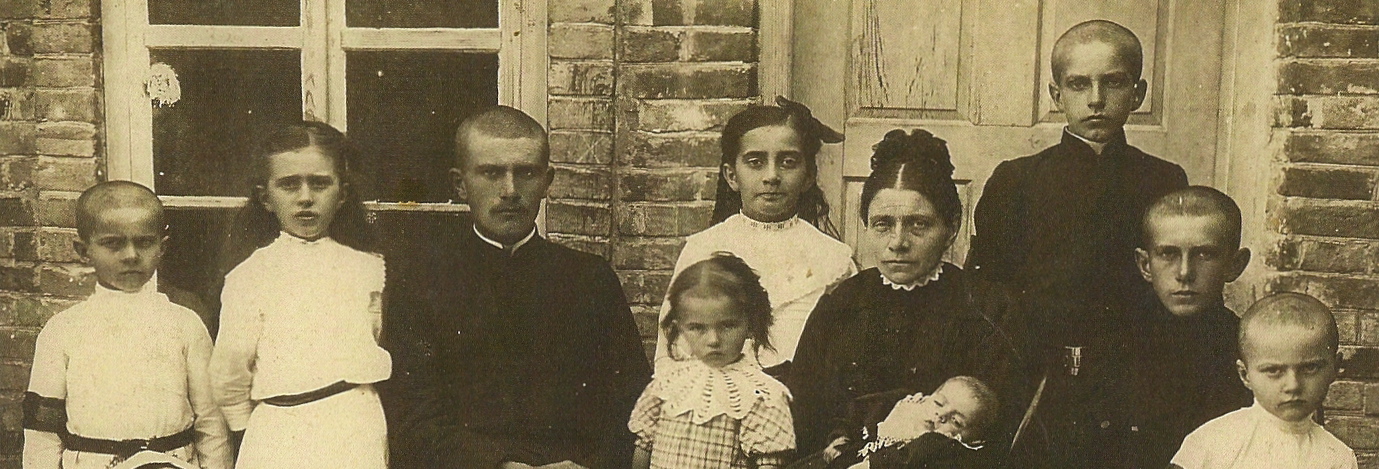
Tina Woelk and children, 1917
My grandmother Helena (Harder) and her family came to Canada. Her older sister Tina (Woelk) did not. Here is Tina with her 9 children, photographed at the burial of her husband in 1917. The oldest son, David, third from the left, was murdered in the political turmoil of 1919. As for the three boys on the right: Jakob reached Germany during the Second World War and did not return to Russia; Gerhard disappeared in that same war; Kornelius simply disappeared. Helena, second from the left, died of cancer in Siberia in 1956, Siberia being shorthand for the family’s exile to the work settlements of the north. Peter, on the left, died in Karaganda, that name shorthand for exile to the coal-mining southeastern region.
This is about all I know about these relatives of mine, told by the daughter of Katharina (standing at her mother’s shoulder), who grew up in the Soviet system and eventually, after the Cold War ended, moved to Germany with her husband.
So many empty spaces, children and youth without descendants. Just faces on a photo and names on a scrap of paper.
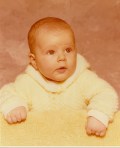 But “mother” is a role/name/fact that’s a huge part of my life, and today I’m celebrating the day it began. It all started 33 years ago today when the little fellow, pictured left at 3 months, was born. (He gave permission to post the photo.) I don’t think you can ever imagine at the time what it will be like to be bound up with another person for the long haul the way a mother is, but you discover it — through joy and difficulties — as you go, and I can say this for sure, the child who started it and his two siblings who followed (whose baby photos I will post on their own birthdays, if they let me) have definitely, definitely been worth it all. (Especially now that I’m off-duty.)
