Because of the postcards

Friends, tomorrow I set out on another adventure: a tour in the Caucasus. Namely, Azerbaijan, Georgia, and Armenia.

I was away for three weeks in July, road-tripping and retreating, and it felt big, and this seems almost too soon in its wake, but I’d booked this trip quite some time ago, and now it’s here. Tomorrow, Vancouver to Frankfurt to Baku (the capital of Azerbaijan). Two weeks with a small group of ten with Adventures Abroad, and then, since one of my sons and his family is spending the school term in Nice, France, I’ll stop to visit them for a week on my way home.  IMG_0168

When I tell people I’m going to the Caucasus, the first question is often “Where’s that?” Between the Black and Caspian Seas, I say. The second question is often “Why?” It’s because of the postcards, I say.

My grandfather, Heinrich Harder, did his World War I service for the Russian Empire in the Caucasus. (The area was part of Russia then.) He was a medic tending the wounded on the trains that brought them from the front, where Russia was fighting the Ottoman Empire (now Turkey), to hospitals in Baku and Tbilisi and so on. When he and my grandmother later immigrated to Canada, they brought along an album of some 80 postcards, most of them collected during his time in the Caucasus. This album ended up in my possession and one Christmas I spent my holiday time exploring the places on these cards via the internet. (The coloured ones are not colour photography but tinted from black and white photos.)

As I read his letters to my grandmother during the war, as I researched and contemplated the cards, the desire built to see — more than a hundred years later — some of the places where he spent several formative years of his life. It’s not really a follow-in-his-footsteps, because of course I’m on the schedule of an organized tour. But I will be there, in the cities of Baku, Tbilisi, Gyumri, Yerevan, all places he was too. And apart from that, I’ll be in a fascinating and complex part of the world.

So, tomorrow. Nothing further to do but go, and receive what there is, what will be. Nothing to do but be curious and open.

Stories monuments tell

I’m home again after a two-week “highlights” tour of Britain with friend Eunice Sloan, and reflecting now on personal highlights – Evensong at Westminster Abbey, for one, Stonehenge, for two, and so on and on. I won’t bore you with a list but want to share a few thoughts instead about public monuments, erected for commemoration, which become for tourists a kind of stand-in for whole swaths of history and meaning.

Ever since taking a course about memory and commemoration for my history degree, I’ve been intrigued by the art of monuments. They both reflect and shape public memory; they’re never entirely neutral. (Think, for example, of the religious imagery wrapped into many memorials of the First World War.)

Some statues of persons we saw on the trip did the work of reminder, of a “big” person but also everything associated with that life, as with the figure of Churchill across from the Parliament, which was being polished and waxed the day we viewed him, or a possible likeness of William Shakespeare in Stratford on Avon, where I just barely managed to squeeze in a photo before yet another tourist rushed forward to pose beside him as if to imbibe his genius or signal they’d had to study one of his plays in high school.

In the case of the Beatles, I couldn’t resist rushing in either, to claim a connection I suppose, however tenuous. The monument to Prince Albert in Kensington Gardens seemed complicated, inaccessible, layered – to my mind – with the sentimentality and obsessive ornamentation we associate with Victorian attitudes to grief.

Two monuments, each involving two men, told me stories that have been playing in my mind, as stories do.

One was at Trafalgar Square in London, where the fourth plinth brings contemporary art to the public square. A new piece called “Antelope” had been unveiled just days earlier. It shows two men, backs to one another, one considerably larger than the other.

Here’s the description from a London press release:

BF680F86-DB4F-44E0-95AB-91E25DA5DD3E

Samson Kambalu’s bronze resin sculpture restages a photograph of Baptist preacher and pan-Africanist John Chilembwe and European missionary John Chorley, taken in 1914 in Nyasayland (now Malawi) at the opening of Chilembwe’s new Baptist church.

Chilembwe is wearing a hat, defying the colonial rule that forbade Africans from wearing hats in front of white people, and is almost twice the size of Chorley. By increasing his scale, the artist is elevating Chilembwe and his story, revealing the hidden narratives of underrepresented peoples in the history of the British Empire in Africa, and beyond.

John Chilembwe was a Baptist pastor and educator who led an uprising in 1915 against British colonial rule in Nyasaland triggered by the mistreatment of refugees from Mozambique and the conscription to fight German troops during WWI. He was killed and his church destroyed by the colonial police. 

It’s a powerful piece, not particularly subtle about its anti-colonialist message, but inspiring and necessary in our time. I’m glad I got to see it.

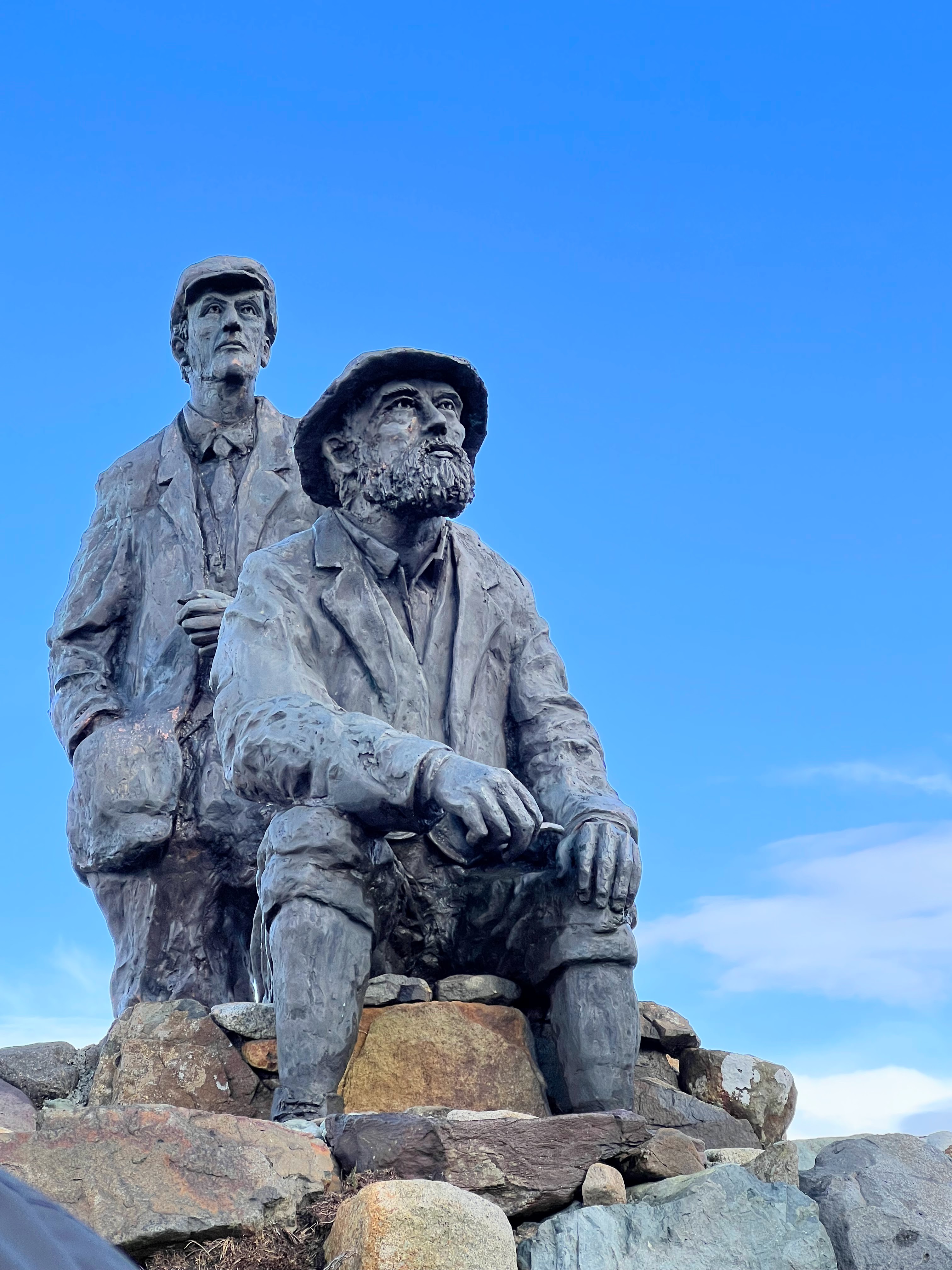
I’m also glad I got to see a relatively recent sculpture on the Isle of Man which celebrates the achievements of two British mountaineering “legends,” John Mackenzie and Norman Collie, who climbed together in the Cuillin mountains of Scotland for many years, making various discoveries in the terrain and developing climbing techniques. Their story as told us on the tour related the large difference in class between scientist/professor Mackenzie and crofter/guide Collie, and perhaps it could be said that the way the men are posed (Mackenzie standing) pronounces on that, but we were also told about a friendship so deep they were buried beside each other. What speaks to me here is not their relative positions as much as the way each gazes upward in the same direction, to the mountains, as if to say it was the intensity of that shared love that united them.

C39FF8E4-D279-4169-B87D-2C174C9EE9D8

photo: Eunice Sloan

Getaway

H. and I enjoyed a short getaway last week: two nights and three days in the Chilliwack area, at the Fraser River’s Edge B & B, about an hour-and-a-half away. We filled up on a gorgeous view of the river, the warm hospitality (with full pandemic protocols), delicious breakfasts, and restful ambience of the lodge. If the continuing Covid season made a change of scene seem urgent, it also made this particular spot possible, for, as co-owner Adriana told us, they’re normally fully booked by out-of-country guests who come for fishing adventures.

We let the other two couples at the lodge wrestle with fish (a nine foot sturgeon, we heard, which beat the humans after more than an hour’s effort) while we explored the river’s edge, Chilliwack Mountain, and the Vedder River trail; bought and ate the best corn of the summer from a local stand; and found my grandparents graves in the Chilliwack cemetery. We’d roamed about in that cemetery some years ago, looking without finding, but this time I’d phoned ahead to get the exact location, and thus we successfully completed the earlier quest. Continue reading