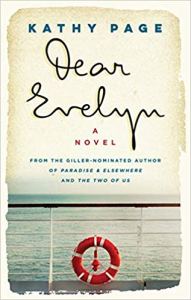
 Dear Evelyn opens with a birth — of Harry Miles, who is half the couple featured in the book. I’d just read some wonderfully feisty comments by the late Margaret Laurence about birth scenes in novels, so was immediately positively predisposed to this novel by Kathy Page, which dared such a scene right out of the gate. (A male reviewer of Laurence’s first novel, This Side Jordan, had wondered about “the obligatory birth scene in novels written by women,” which infuriated Laurence, though the good thing was, “that dolt” launched “a kind of self-liberation” for her in writing. Fine for men to write endlessly of violence or masturbation or sexual conquest, she said, but “not at all right, apparently, for a women to speak of the miraculous beginnings of human life.” After that, she never hesitated to write about birth, “from the viewpoint of the mother.”*)
And then, I happened to read Tess Hadley in a Guardian interview saying she wanted to write about long marriages (as apparently she does in her latest book, Late in the Day), because “they seem immensely interesting and they are kind of new in a way … people just live so much longer,” and I thought, well I certainly like to read about long marriages, being — at 44 years and counting — well on the way into a long marriage myself, and there I was, happily into Dear Evelyn too, which is exactly on the topic.
It’s not that Page’s novel needs these asides from Laurence or Hadley to bulk its worth, but I mention them by way of noting how often it’s the entire atmosphere of reading — current circumstances, personal life stage, other voices bumping alongside — that makes a particular book memorable. At any rate, with or without all that, Dear Evelyn is a fine and memorable book. Page skilfully unfolds the characters and experiences of Harry Miles and Evelyn Hill — from his birth to her death — in linked short stories. Each chapter/story treats of a specific episode or slice of their separate or joint lives, but the sum of them feels seamless, as if everything in between has been revealed to us as well.
Harry and Evelyn meet outside a library, and he is taken not only with her beauty but her strong sense of striving. “A girl like her would need him to be ambitious, more so than he had been so far. Even as he realized this, he committed to it.” We already know that poetry grabbed hold of Harry’s head and heart under the tutelage of his teacher Mr. Whitehorse, and at this early point it’s easy enough to assume that his “ear for verse” and nascent interest will grow and be fulfilled. But that’s the thing about life and marriage — they limit, even thwart. Which is why Harry and Evelyn as couple is a story of love but far from a happily-ever-after one. Their ambitions, so compatible at one level, compete drastically at another, not to mention the changing and powerful shaping circumstances of war (and the separation and temptations it imposed), children, and old age.
A week after finishing the book I’m still thinking about this fictional relationship. Does one admire, or pity? Can fault, realistically speaking, be laid? The 2018 Rogers Writers’ Trust Fiction Prize jury, which awarded Dear Evelyn the win, called the novel “tender and unsettling.” Yes. Both those words.
*Margaret Laurence, Dance on the Earth




 Mid-afternoon I learned that All That Belongs is featured on the cover of the current issue of Prairie Books Now and that a review of the book had appeared in the Winnipeg Free Press today. Both were lovely surprises. I haven’t seen the PBN article yet or read the review but my sources told me it was good, which was enough to get me through the evening without worrying about it. Some writers don’t read reviews, either good or critical ones. I’ll read this one eventually, but today was not the day. I needed to focus on the evening event.
 Borrowing Bones
