Rich vocabulary for the beautiful game

Normally I’m not much of a sports fan, but for the big events like the World Cup, I also get involved, enjoying the televised dramas of athletes and nations, and the remarkable skillfulness and intricacies of what’s been called “the beautiful game.”

A bonus in this particular series is listening to the play by play commentary of the announcers (British they seem to be). I’m not the first person to mention this. Early in the series I recall a newspaper writer saying he’d taped an otherwise unremarkable game just to listen to the way it was called. The announcers have at their disposal a rich and fascinating vocabulary, drawn sometimes from the world of epic battle, sometimes from the earthy informality of schoolboys playing on a neighbourhood vacant lot, and it streams from them quite unstudied, it seems, as if they always talk in such vivid and varied ways.

I jotted down a few examples from today’s Ghana-Uruguay game. It was a “potentially crackling game,” though as the game progressed to its end with a tie, no prediction could be “forthcoming.” When one team did something well after a sluggish stretch, they were “rejuvenated.” A good opportunity stopped by the defense? They’d made “a total hash of that.” The Ghanians, it was declared, have “an insatiable appetite for work.” Something happened “in the winking of an eye” and a saved ball landed in the keeper’s “welcoming arms.”

It’s the game’s pace, perhaps, that leaves a little more room for adjectives than (our game) hockey’s “he gets the pass, he shoots, he scores.” One play was “a valiant job,” another “a heart-stopping moment.” On one play, the defenders not only defended but “bravely” defended.

Verbs of all sorts too, of course — strong and varied ones. Players “instigated” plays, the crowd was “roaring in anticipation” (and later, “had another blow on the vuvuzuela.”)

When Gyan missed the penalty kick in the last moments of overtime, he had his “glory snatched away, but he served his country well enough.” And when he stepped up for his turn at the deciding penalty kicks, “the whole of Africa [was] praying lightning doesn’t strike twice.”

Once, after a number of attempts on goal during regular play, the announcer said that no shots had been “particularly cogent.”

Did he just say cogent?

Beautiful game indeed.
Catch-up

The industrial bleakness of Baku’s Black City (above) depresses me slightly every time I come to this blog, because it reminds me of the still gushing oil spill… But Life Must On, as they say colloquially, and here it’s time to catch up.

When I first started “Borrowing Bones” last November, I commented that I don’t “use” my children in my writing much, because they have their own lives to interpret and describe, but — it being First Son’s birthday that day — I did post a baby photo of him and remarked how glad I am to be a mother. I also said that I would follow suit with the next two when their birthdays rolled around.

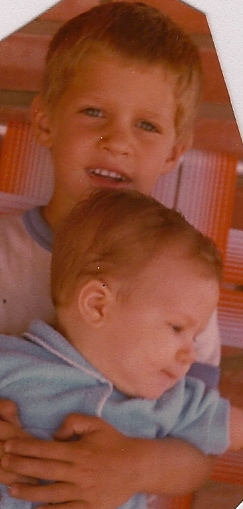
Daughter’s birthday falls at the end of May, and Second Son’s in the middle of June — so it’s more than high time to keep my promise. (Any parent knows you have to be fair to each child in turn, and you have to keep your promises.) So the little snapshot above is Daughter as a baby, held by her brother. Wow, they’re so cute — wish I could go back in time for a little cuddle with each of them.

And now? — Okay, just this once. Our oldest son is an engineer. He and his wife, who works as a doula and photographer (you can see her work on her blog under my “Family and Friends” list) have four children and live in Tsawwassen, B.C. Our second son just graduated (with honours, Mother inserts) from the University of Toronto’s law school. His wife is a teacher and they live in Toronto. And, they’re expecting a baby in November! Our daughter has been working here in Winnipeg for some years as an architectural technologist and living on her own, but just moved to Vancouver. She’s going to bike the summer away, as well as hike the West Coast Trail with the brother pictured above and other assorted relatives, and then see what the fall unfolds in terms of further adventures and work.

H. and I are no longer in the middle of their hearts, and that’s how it should be, but we’re still in the middle of the country, reasonably healthy and usually happy. Yesterday I enjoyed driving to Winkler, then reading from This Hidden Thing at the Winkler Public Library. H.’s huge number of tomato plants and carrots are growing well. (Tomatoes and carrots are two of  his favourite foods). We’re thrilled with Paraguay’s advance to the next round of the World Cup.

And in between our thoughts flit east and west.

The company of other writers

William Zinsser, whose classic On Writing Well is one of the few how-to books on writing I own, states in his last post at his weekly blog column that he doesn’t hang around with writers.

He’s not “a citizen of writing.” He doesn’t join writers’ organizations, or show up at writers’ talks and panels.

Writers tend to be not as interesting as they think. What they mainly want to talk about is their own writing, and they also have a ton of grievances, their conversation quick to alight on the perfidy of publishers, the lassitude of editors and agents, and the myopia of critics who reviewed–or didn’t review–their last book.

In my humble opinion, thinking oneself more interesting than one is, wanting mainly to talk about one’s work or interests, or complaining about those who make that work a trial can be fairly consistently observed across the board of humanity. Still, for all that it smarts, his assessment of writers is probably right, even when he goes on to describe them as “one of nature’s most insecure species.” Continue reading