
Bolivian Mennonite rape victims: update

A recent comment from “Margaret” to an earlier post about reports of sexual assaults of Bolivian Mennonite women reminded me that I promised to provide updates to this story if I received them. What one hears is often anecdotal, and perhaps it will continue to be largely told, or puzzled over, that way — by putting what “Margaret” was told, for example, beside what a source involved with the Casa del Mariposa, a woman’s shelter being built for Bolivian Mennonite women, was told.

The latter account, forwarded me via a letter, said they hear many conflicting stories and “were not sure anymore what is true and what is not.” But, they continued, they do often hear that it [assaults] is still happening. They then recounted that the daughter of one of the imprisoned men, allegedly the ringleader of the group, sought them out to speak with them about their sister who had been gang raped and drugged. The “boys” confessed, but she is now “not herself” and in need of professional help, which the Casa del Mariposa workers are seeking to arrange for her at a mental health facility in Paraguay.

But, I was also forwarded a report written by Jack Heppner of Steinbach, who recently spent 8 weeks in Bolivia. He worked in Bolivia with the EMMC (Evangelical Mennonite Missions Conference) for three years in the mid-1970s and one year in 1991-92. Heppner was a public school teacher, also taught at Steinbach Bible College for some 15 years, then was conference pastor for the EMMC and editor of their monthly magazine, The Recorder. Upon his return from the visit to Bolivia, he wrote the following report of his observations and conversations relevant to this subject. It includes an analysis within the historical context of Mennonite life, answers to questions many of us at a distance have, and some helpful suggestions for steps forward.

Heppner said he considers it “an open document which I have offered back to the Mennonite church and its various agencies as one voice among many related to the tragedies unfolding in South America.” He has given me permission to post it here. Your comments are welcome. If you wish to dialogue with him individually, you can contact me (see info at About) and I will forward the request.

It’s a fairly lengthy document, but credible and helpful, and I highly recommend it to anyone who is interested in knowing more about this issue.
Continue reading →
The impulse to revise

Things were a little intense at our house the last week or so, since I was reading proofs, and not just any old proofs, but those of my own upcoming novel (This Hidden Thing). Proofs mean the work that’s been sitting in computer files and doublespaced on 81/2 X 11 sheets of paper, has landed on designed pages for a book. Proofs mean it’s close to ready for press. Just this last chance to check things over. A wee bit of room for changes, but not much. Not much at all. The cover design is close to finished too. It’s all rather exciting and scary.

On the page in its as-good-as-permanent form, the work can look strange and unfamiliar. In spite of all the times one’s gone through the manuscript, one suddenly sees what there’s probably too much of and maybe too little of as well. I’m comforted, however, in reading the letters of Flannery O’Connor, to find that a writer as good as she was had experiences along the same line. In a letter Oct. 6, 1959 she wrote a friend:

The proofs [of The Violent Bear It Away] came… and seeing the thing in print very nearly made me sick. It all seemed awful to me. There seemed too much to correct to make correcting anything feasible. I did what I could or could stand to and sent them back…

Well, I’m not trying to scare anyone off my book by confessing and quoting that — I wouldn’t be a writer if I didn’t want readers, and I hope it’s not a surprise to hear that even at this stage of a book anxieties and vulnerabilities of all kinds manifest themselves. This is probably true for anyone who has to let go of what they’ve done, into the public. But O’Connor also said she thought the first and last sentence of the book were “mighty fine sentences” and that she had cheered herself “meditating on them.” After awhile I relaxed with the proofing process too and decided I would be okay with what was there — except for those changes I’ve pleaded the forbearance of my editor and the publishing team to make, of course! 

But there’s just something unfailing about the impulse to revise, and to revise again. I had to chuckle over the note Flannery O’Connor sent editor Catharine Carver:

I’ve rewritten the last pages so I’ll enclose them as I think they’re an improvement. When the grim reaper comes to get me, he’ll have to give me a few extra hours to revise my last words. No end to this.

I wouldn’t mind some warning from the Reaper too, for the same reason!

Oh, and this revision after the post went up (it’s the great thing about blogging): please forgive the shameless self-promotion!

—–

NOTE: The launch date of This Hidden Thing (CMU Press) has been set for May 19 at McNally’s in Winnipeg.

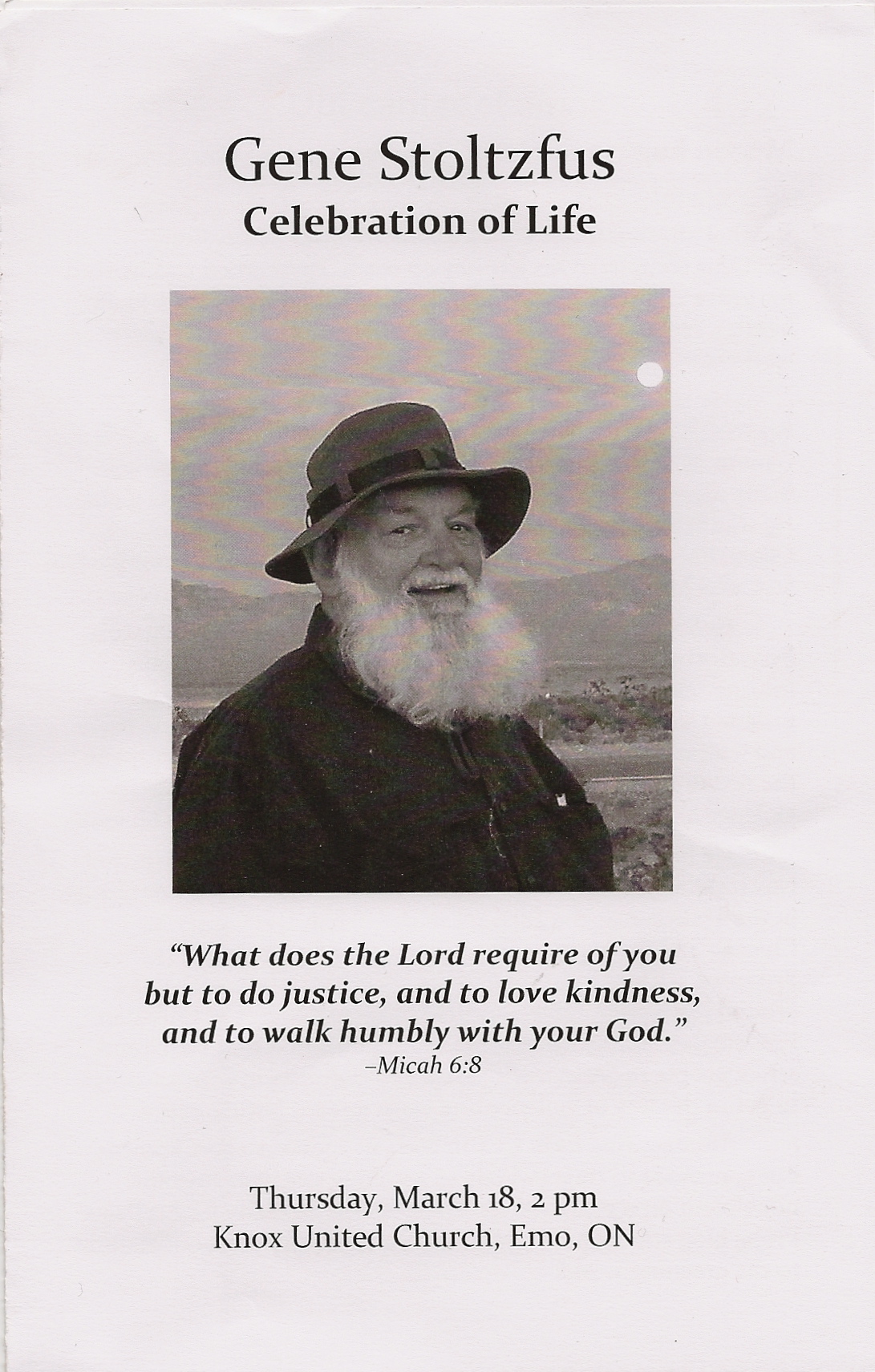
Gene Stoltzfus: celebration of life service

Last Thursday, I attended the celebration of life service for long-time peace activist and founding director of Christian Peacemaking Teams for 16 years, Gene Stoltzfus (1940-2010), which was held in Emo, Ontario.

The service was relatively small, as Stoltzfus and his wife Dorothy Friesen now lived in Fort Frances, Ontario, some distance from family roots and former places of work such as Chicago, where they resided for many years. (Memorials will also be held in Goshen, Indiana, and other places.) So it felt intimate and informal, with some of his favourite songs (including multiple singings of “Ubi caritas et amor” – “where charity and love are found, God is there”), Scriptures upon which his work was based, words from his writings, and many personal remembrances.

We sat in a kind of oval shape around a table with flowers, candles, a twig basket he had fashioned, and the copy of the Martyrs Mirror passed on to him by his father, which was so significant in shaping who be became. He spoke of this in his last article at his blog, Peace Probe, but also a May 4, 2006 column called “Beyond Imagination.” Continue reading →