It’s a slow news day, as they say, here at Borrowing Bones (though in truth the ongoing distress of Haiti remains very relevant news for us all). So I thought this might be a good time for something lighter. A good time to make something clear.
I am Al Doerksen’s sister.
Although we lived in the same city for many years, I still meet people now and then, as does he, who know us separately but don’t realize we’re siblings. If I had kept my maiden name along with my married one back in 1974 when a certain Mr. Dueck and I tied the knot, our common paternity would have been much more easily discerned by all practitioners of the deliciously satisfying Mennonite game, whereby people ferret out one’s biological connections in order to form their opinion of you quickly, thereby saving considerable time and energy in getting to know you. But I suppose “Dora Doerksen Dueck” felt like just too many D’s in a row at the time, and so it is that I’m now routinely queried about any number of Duecks to whom I could be related (but am not) and never asked if I’m Al Doerksen’s sister (not to mention John’s, Norm’s, or Vic’s).
Well, I’m proud of the fact, and though we had our squirmishes as first and second born, and though my attempts to oust him as ruler of what would eventually be a sizable kingdom of siblings were completely unsuccessful, even when I enlisted the help of the brothers who came after me, I appreciate and enjoy him immensely. I’m proud too of the work he’s done over the years, especially in development, and currently as CEO of International Development Enterprises. (Their development entry point is water.) Since he’s spent time with Bill Gates, whose foundation gave IDE a hefty grant, I can also bask in a two-degrees-away brush with celebrity.
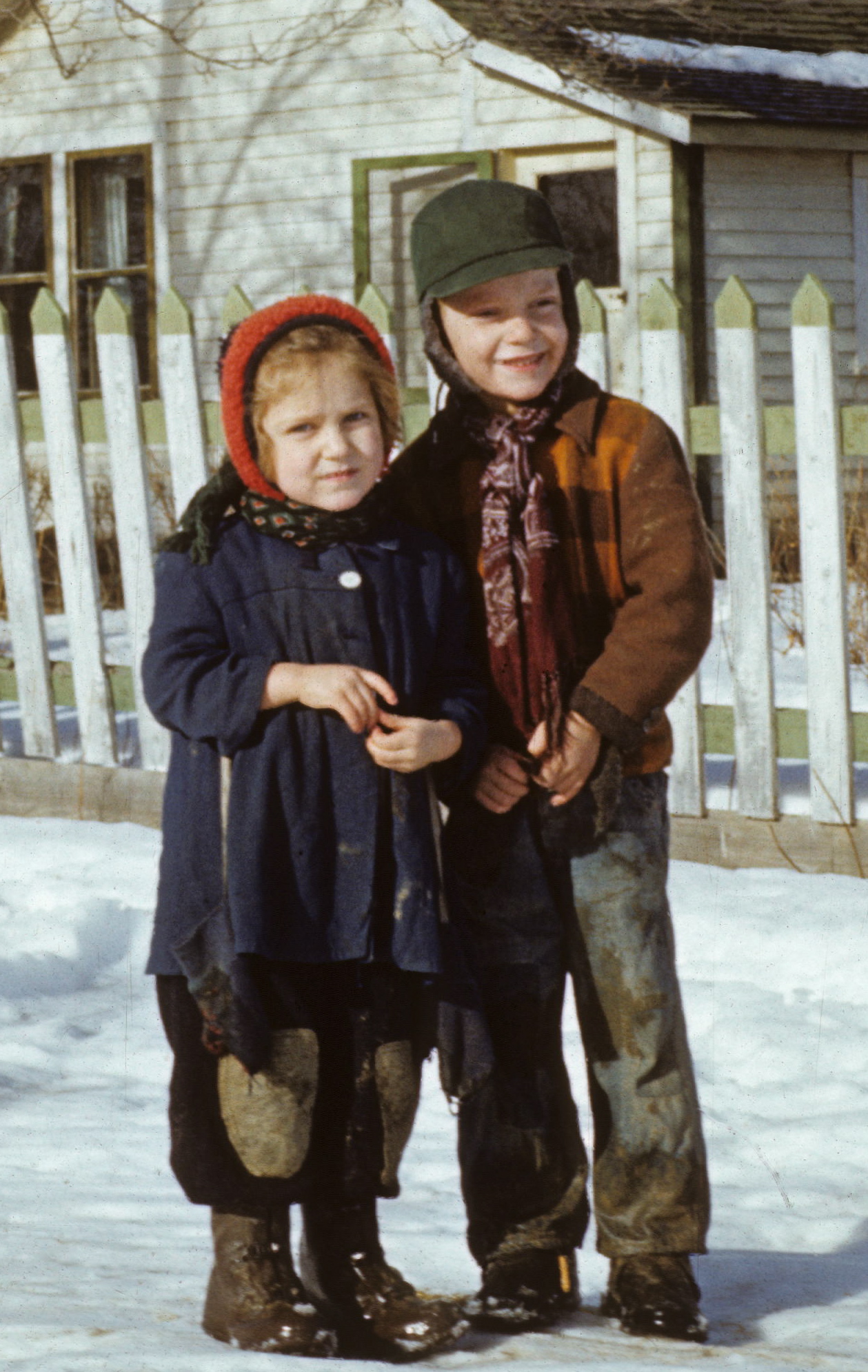 As proof of our long sibling bond, I offer the following photo from our childhood. Cast into the hard world we were, poor little things, so tattered and wretched, knowing we had to be there for the other or all might be lost. Should I ever run for president I will also use this photo as proof of hardscrabble beginnings, of how I pulled myself up by dint of no lies and lots of work — you know the drill — and of course with the precious encouragements of all my Beloveds, who would say inspiring things like, it doesn’t matter the rags, my dear, you shall have something that resembles a sailor suit someday. Yes, there are also photos of us lovely in such outfits, prairie children far from the sea, but clearly arrived in one good port or another, taking turns at the oars no doubt, still as sweet and solicitous as we could be.
But the sailor suits shall be saved for another slow day. 🙂