A friend recently asked me if I missed my dad. After stopping to think, I said no, not really, it’s already nearly ten years since his death and, because he had Alzheimers, it seems he’s been gone even longer. So, no.
Then I happened to be in my 1993 journal, looking for something else, and I came across a really lovely letter he wrote me that year, this after I’d pushed somewhat impetuously — in the midst of a mid-life exercise of figuring myself out as it were and re-visiting my upbringing — to discuss my perceptions of our relationship when I was a kid. He’d been exemplary in so many ways, a good provider, but always busy it seemed and also being relatively quiet, left the verbal articulation of affection up to Mom, who was much more outgoing. The letter acknowledged all this, used the word “shy” about himself, and then set down exactly what I suppose I was after: words of pride and love. Much felt resolved on account of it and it must have been how I realized that we were both introverts and that I actually took after him and not my mother in personality, much as I’d aspired to be like her. Re-reading the letter, I missed him.
 I was also reading Finding Father: Stories from Mennonite Daughters, an anthology of 13 personal essays, edited by Mary Ann Loewen (University of Regina Press, 2019). It made me miss him too, because good personal writing not only enlarges our awareness of others but turns us back into ourselves. I think this is especially true if one shares some things in common with the authors, which in this case includes being a daughter, but also being Mennonite and in the same demographic as many of them.
At any rate, I enjoyed this collection very much. There’s variety of voice and approach. Elsie K. Neufeld movingly excavates her father’s history as a soldier in the German army and then postwar immigrant; Magdalene Redekop structures her “findings” around seven incidents with her father, the incidents rather small but together conveying an entire relationship; Jean Janzen begins with a poem and moves into poetic prose befitting the bond between this father and daughter; Raylene Hinz-Penner wonders if her father’s Lutheran roots accounted for his confidence, exuberance, and subversion of the dour pieties of their Mennonite environment; Cari Penner writes of a man who remains a stranger to her. And so on and so on.
I noticed something interesting happening by the time I finished the book, comprised as it is of numerous voices and relationships. The fathers seemed to have merged in my mind into one father, one good man, tall and dark-haired and somber in his Sunday suit, carrying sorrows from his immigrant or near-immigrant past, trying his best, silent or inarticulate about many things. Part of the patriarchy to be sure — the one sitting in the driver’s seat– but certainly not its most negative representative. None of the fathers in the anthology is the father I’ve just described, but somehow they’d fallen into line behind this composite figure. What remained more distinctively individual, however, were the daughters — the writers — and what they were doing in their pieces in terms of understanding, reaching back and towards, praising, longing for, or defending. Each had been shaped by her father, but each seemed to have become fully herself, whether with the help of or in spite of this first and vital man in her life. And now she was able to write perceptively about him, and with the perspective of her own life experience.
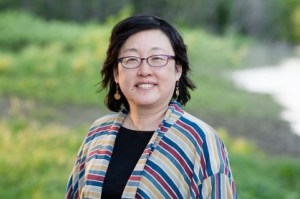
 Born to a Japanese couple in Alberta and growing up mainly in Sherwood Park, Alberta, Ito’s life and genealogy tugged between Canada and Japan. Some members of her fore-family immigrated to Canada and then returned to Japan, others remained there, yet others moved from their first Canadian home in southern B.C. to an internment camp and then to the flats of southern Alberta. Her story includes the challenges of immigration, race, assimilation, but also the reality of Canada’s insensitivity and injustice to her citizens of Japanese descent at the time of the Second World War.
