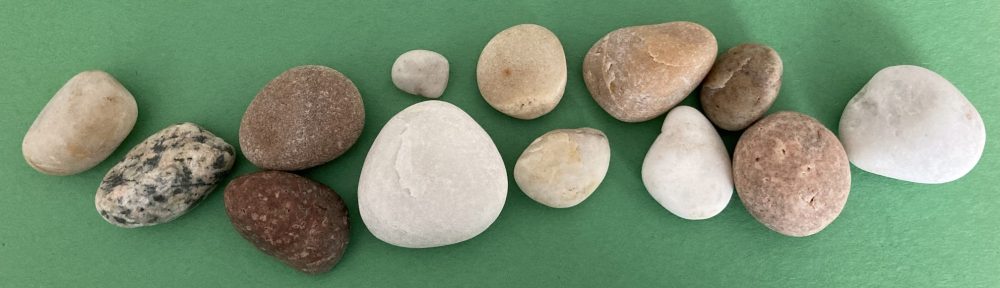
On Porches and Balconies

“I cannot separate it [watching the world go by] from the porch where it occurs. The action and the space are indivisible. The action is supported by this kind of space. The space supports this kind of action. The two form a unit, a pattern of events in space.”
Christopher Alexander, The Timeless Way of Building

Visiting my children in Toronto the past week I once again spent happy hours sitting on their porch. It’s a lovely place to have my morning coffee, a lovely place to converse, a lovely place to wait for the grands bursting up the walk after school. It has a roof, room for several chairs and a low table, and is tucked behind a railing with flower boxes and further sheltered behind a front yard tree. Nevertheless, I can see, at angles, the sidewalk and street and feel a part of the world while set away from it too.

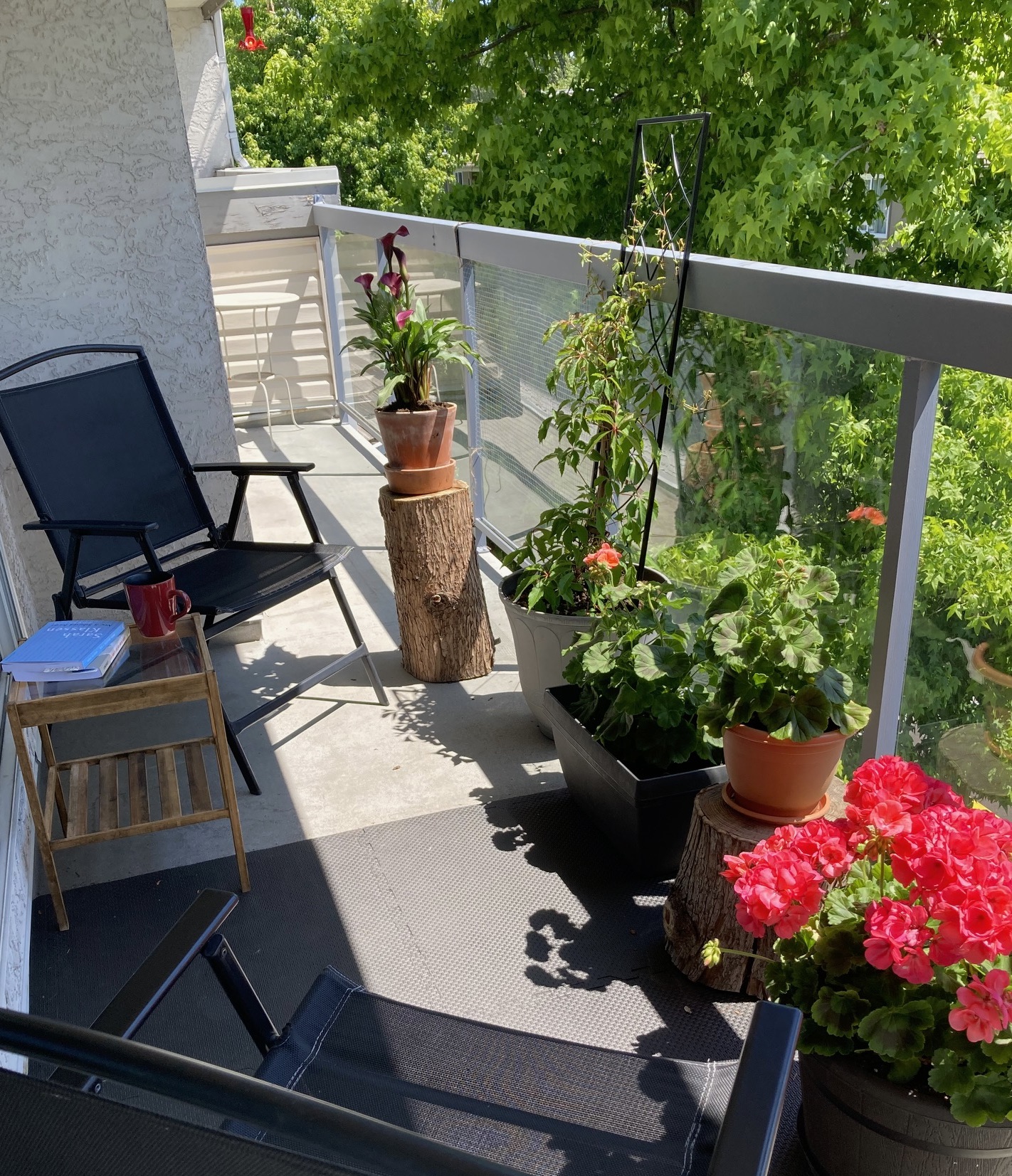
The balcony in my Tsawwassen apartment poses more of a challenge for this effect than the Toronto porch. I live in a congenial complex of apartment buildings in which, as such buildings usually do, each apartment has a balcony. Mine faces south and is a great place for winter light and for greenery in summer. Many of the balconies in the complex are attractive with flowers and patio chairs and so on. Something I’ve noticed, though, is that I very rarely see people in those chairs on their balconies. I don’t actually spend much summer time on mine either until I create a bit of a cozy shaded corner where I can feel part of the outside world but still be somewhat secluded and private. 

Back in the early 1990s, a friend introduced me to A Pattern Language by architect Christopher Alexander, quoted above. This book was a bible to me in understanding how space works — what, that is, makes us enjoy one space and not another. Pattern # 167 discusses balconies. “Balconies and porches which are less than six feet deep are hardly ever used,” he wrote. Less than six feet, there’s not adequate room to group chairs; they have to be in a row. People on balconies also need a sense of being recessed; a cantilevered balcony feels unsafe, if only psychologically.

My balcony is five feet wide. The railing panels, furthermore, are a glass-like material, good for light and viewing from within the apartment but offering too much exposure for any length outside. There’s nothing I can do about the width, but I’m lucky in that the balcony is covered and part of it is recessed a little, and using that, I can fashion a nook where I can come out with my morning coffee, hear the sounds, see the sights, feel the air of the emerging day, and do this almost hidden from street view. This year I have an Engelmann ivy which I will train to cover part of the adjoining balcony panel, and other plants for beauty and partial barrier. When I have a guest, as I did yesterday, we can turn our chairs to face one another alongside the flowers. I’m pleased with how this year’s cozy corner is shaping up. If you visit, we’ll sit there together! IMG_4379
Do you have a porch or balcony? Do you use it?
The mysterious Irene P., etc.

Earlier this month, I was a panelist at a Delta Literary Arts Society (DLAS) event here in Tsawwassen, with writers Raoul Fernandez, Debra Purdy Kong, and S.J. Kootz. Along with an honorarium, each of us was gifted a book from “the abandoned library” of a woman known as Irene P.; mine was Bird by Bird by Anne Lamott. “Do books long for a new owner?” asks a note pasted into the flyleaf. Assuming they do, “Just such a case has brought this book to you… once one of thousands in a collection owned by one Irene P.”

I asked the event organizer about her. She didn’t know much beyond the fact that when the woman’s house sold, there were thousands (6000, did she say?) books left behind, and hundreds about writing which somehow came to the DLAS and are used as unique thank yous. With all that advice on her shelves, did Irene P. write? I don’t know that either; hers is a story still to be told perhaps, but at any rate, I now have her 1995 edition of the Lamott classic, and it gives me pleasure. Since I already own the book, I’ll pass my copy on to someone else. And I think I’ll see if I can’t get more information about our mysterious donor.

*

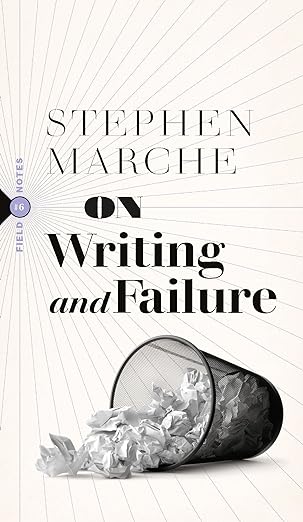
Speaking of writing advice, I recently read a small (80 pages) book by Stephen Marche called On Writing and Failure. Marche is no slouch, he’s written books and essays for all kinds of prestigious magazines, but he’s honest about the reality of the life: rejection. He kept track of them, he says, until they reached 2000, and hardly notices any more. He offers examples from other writers, and the point of it is not the promise of some inevitable arc to success, but his subtitle: On the Peculiar Perseverance Required to Endure the Life of a Writer. The book is full of quotable quotes:

English has provided a precise term of art to describe the writerly condition: Submission. Writers live in a state of submission. Submission means rejection. Rejection is the condition of the practice of submission, which is the practice of writing.

In an environment where some 300,000 books are printed yearly in the U.S. alone, and only a few hundred of those are what could be called creative or financial successes, there’s certainly no urgency for anyone to join the ranks. But if one’s there already, nothing for it, he says,81l-0zGg3GL._SY522_ but to keep at it, to keep submitting the work. “No whining,” he insists repeatedly. “The desire to make meaning…is a valid desire despite the inevitability of defeat.”

*

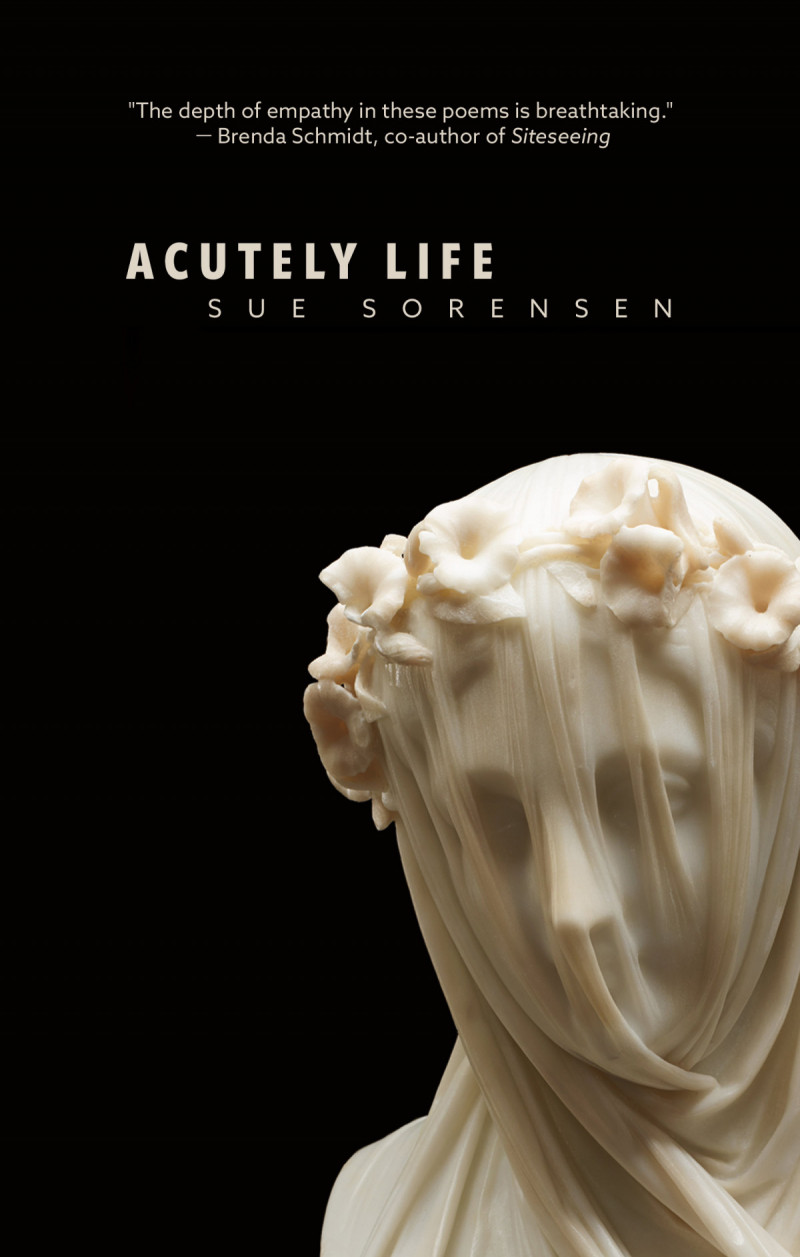
And, speaking of small but profound books, Sue Sorensen’s new poetry book, Acutely Life (At Bay Press), is an absolute delight. Whether she’s considering Freud or a musician or art or gardening/marriage or Mary the mother of Jesus, Sorensen registers on the page with both brilliant wit and deep emotional insight. Somewhere I read (though I can’t find the exact quote), one doesn’t interpret poetry as much as experience it. That’s how it’s been reading this book. I intend to read/experience it again.AcutleyLifeCover_(1)_800_1257_90

Did you turn into someone else?

When my eldest granddaughter was 3-something, I showed her our wedding photo, which  happened to stand on the family mantel in her home. I said it was Grandpa and me. Obviously she’d never made the connection, for she looked back and forth from the photo to me, comparing the young woman with long dark hair inside the frame to the woman with short grey hair and glasses who was holding her.

“Grandma,” she finally said, earnestly, “did you turn into someone else?”

I can’t remember what I said in reply, though I chuckled. I still chuckle, thinking of it more than a a decade and a half later. What a great question.

I could have said Absolutely, yes, I’ve turned into someone else, in fact I’ve been a number of “elses” over my lifetime, at the cellular level for sure, but in other ways too, in awareness, knowledge, thinking, views on matters theological, political, and otherwise. Change is the stuff of life and I’ve tried to be open to changes and conversions of all kinds Here’s hoping it shows. 

But no surprise my granddaughter was confused. I get confused about myself too. I shopped for pants this week. Strolling the mall, seeing the window displays, I realized that when I look at the mannequins, in some weird way I still inhabit the sense of being a teen, assume myself slender and taut. Once inside the change room then, with my items to try on and it’s Mirror, mirror on the wall, who’s that you’re looking at? and it’s someone with soft belly, soft thighs. With a sigh, recognition realigns with reality.

On the other hand, I could have said, No, no, no, same me, or better said, same old me. Surface is surface, and underneath is the me I’ve always been. It seems to me that there’s something basic in personality and sense of self that threads back as far as memory can take one and furthermore, that this thread, at least for a child with a reasonably happy childhood, doesn’t want to break. Shouldn’t.

I was struck by something I heard at an online funeral recently: the deceased person, on getting their terminal diagnosis, had said, “I’ve enjoyed being alive.”

Me too, I thought, I enjoy being alive.

Joy and wonder. That’s the part that feels unchanged, or when lost, can be recovered. It’s the entering the kingdom like a child. Being four or maybe five or six, the wonder of hearing exquisite music come out of a huge tape player above my head on the table. The wonder of fields and hills we played in, the wonder of “swimming” in a foot of creek water, the wonder of those letters on a page that make up words and can be read, the wonder of God is love.

Oh you sweet, bright grandchild of mine, did I turn into someone else? Yes and no. No and yes.

And you, what about you? Did you turn into someone else?

IMG_3822

A February day.