In his fine analysis of material things and human agency in Shop Class as Soulcraft: An Inquiry into the Value of Work (which I talked about here), Matthew B. Crawford says:
It is characteristic of the spirited man [sic] that he takes an expansive view of the boundary of his own stuff–he tends to act as though any material things he uses are in some sense properly his, while he is using them–and when he finds himself in public spaces that seem contrived to break the connection between his will and his environment, as though he had no hands, this brings out a certain hostility in him.
Crawford continues about the “angry feeling” that bubbles up in such a person as he finds himself “waving his hands under the faucet, trying to elicit a few seconds of water from it in a futile rain dance of guessed-at mudras.” This is “a kind of infantilization at work, and offends the spirited personality,” he says, and an example of consumerist material culture “disburdening” us of direct responsibility.
I remember thinking (briefly) as I read this that the man in the public washroom was perhaps a little too spirited, too easily offended, but I did appreciate Crawford’s point, and his book (and tried not to be too spirited myself about his general use of non-inclusive language throughout).
Then, last week, using a public washroom in the Toronto airport I had my own Crawfordian moments re. the connection between will and environment, except that in my case, instead of futility, the technology worked far too well. One of my earrings fell into the toilet.
Had it not been properly fastened? (I’d dressed before four that morning, to catch a very early flight out of Winnipeg — “Who booked this flight?” H. was heard to mutter as we headed for the airport.) Or, had it come loose in that “please use caution…contents may shift” business of flying?
At any rate, there was the earring, in the toilet rather than on my earlobe, and in the instant I comprehended it, I also knew I would reach into the toilet to retrieve it (I liked the sterling silver loop with its sheaves-of-wheat pattern!). As I moved to do so, there was an immediate, swift gush of water, a flush that seemed to chortle as it swept the earring irretrievably and forever away. Ahh…the automatic sensor! Grrr… (As though I had no hands! — I now regretted my hasty judgment of Crawford’s illustration as churlish and trifling.)
Well, nothing to do but move to the sink for the next stage of my ablutions. I put my purse down. Still stunned by surprise and loss, I suppose, I did so carelessly. The next thing I realized (I was removing the other earring) was that my purse had slipped into the sink, and adding insult to injury, was now getting a brisk morning shower under the tap!
None of this was terribly serious, even the earring. It wasn’t a Crown jewel after all. Back home, I told my husband the story, and that was the end of it. Until several days later, that is, when H. asked, “Did you keep the other earring?” This led me to speculate that the episode had given him an idea for my Christmas gift, to which I added agency of my own by reminding him that a local department store is closing and selling everything, including jewelry, at significant discounts.
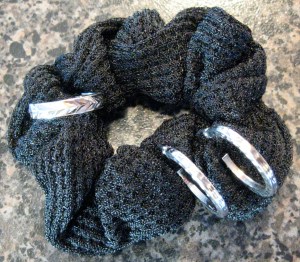 And the moral of the story? Human agency is alive and well in our household, and all’s well that ends well. I now possess an early Christmas present of 10K white gold earrings (pictured accross from the widowed one, right) — alive and well, I say, even if it means shopping, which of course was exactly the point Crawford was not making! (Now if only someone would start selling earrings in threes.)


 Borrowing Bones