- On the flight home from Winnipeg to Vancouver, I scan my notes and discover they’re so pathetically cryptic, they’ll be useless for saying anything meaningful about the conference sessions.
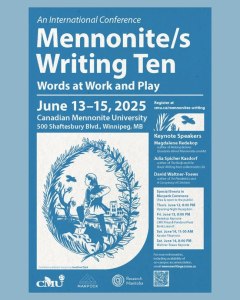
- Nevertheless, I can state the facts: this was # 10 in a series of conferences called Mennonite/s Writing, held every 3 years or so, and this time at Canadian Mennonite University in Winnipeg, Manitoba, June 13-15, under the theme “Words at Work and Play.”
- The conference happened against the news of nearly 300 dead in an Air India crash, Israel attacking Iran, ongoing National Guard/ICE craziness in Los Angeles, yet here we were, maybe 110 (?) of us, thinking and talking about writing, for in her keynote, Julia Spicher Kasdorf said her response to global concerns is to become more local, and these days, this was our local.
- I really enjoyed the conference — the sessions and keynotes of course, but also the collegiality, the many conversations with old and new friends, a happy sense of belonging because even though I don’t label myself a “Mennonite writer” (what does that actually mean, never mind these regular gatherings trying to figure it out) I still know that in some real way this is my tribe and besides, they’ll have me, which is always a happy and satisfying thing.
- The keynotes were highlights: Magdalene Redekop in an almost poetical trail of insights and juxtapositions on “translation” — a task we all take up in our lives — and David Waltner-Toews tackling “the meaning of everything” via science, that is, each of us “an unstable patchwork at our very core” yet interconnected, and Julia Spicher Kasdorf ruminating on Mennonite identity, noting “identity politics reduces complexity” and “identity work can wear a body out” yet calling us — stirringly — to commit to writing as practice and conversation.
- I very rarely — honestly — notice what people are wearing, though there were several memorable, if minor, exceptions this time, for I glimpsed a well-known writer in his pyjamas in the residence hallway and I think they were blue and white, and Di Brandt wore a garland of (cloth?) red flowers and leaves on her head during her presentation, and my longtime friend Sarah Klassen looked classy in a neat, belted teal dress, but I do notice space and felt the conference metaphorically balanced by having parts in the aged, wood-toned ambience of the Great Hall and its connecting corridors and other parts in the newish light-filled Marpeck Commons.
- Most of the sessions ran concurrently with others, which meant that every choice meant missing something else, but the personal program I selected began wonderfully with David Elias on his grandfather’s brother and Elsie K. Neufeld on her work as a personal historian and Linda Umble on reading Mennonite texts, and ended as wonderfully Sunday morning with three poets — Jeff Gundy, Julia Spicher Kasdorf, Ann Hostetler — reading their work, and in between I presented too (“Thinking about Oneself: Desire and Discovery in the Personal Essay and Memoir”) alongside Mary Ann Loewen who gave a memoir talk about herself and her granddaughter, both of which went well, we thought, and provoked some good discussion..
- A good number of younger people attended, and some presented, as in a session I attended featuring readings by Joelle Kidd, James Bergman, and Geoff Martin (whom I had “met” before, in a manner of speaking, when essays we’d written sat side-by-side in The New Quarterly — his was the winning one!) and it was great to hear new and younger voices in the mix.
- On the Thursday evening before the conference began, In Search of a Mennonite Imagination, edited by Robert Zacharias, containing key texts in Mennonite literary criticism, was launched at McNally Robinson Booksellers and I bought it, all 700+ significant pages of it, and later some other books besides, not as many as I may have wished but more than I could carry in my full backpack, but then a friend who lives in the next town over kindly offered to transport some of them, including the massive tome, in his luggage.
- The conference included an optional “literary tour” of Steinbach, which I selected to do, and it was interesting to see places associated with writers such as Miriam Toews and Patrick Friesen and ended with a delicious faspa at the Mennonite museum, where my final “Mennonite” sight of the weekend was a sculpture of the famous Dirk Willems story, which makes me wonder — in terms of two words Julia Spicher Kasdorf set against each other — whether it represented, and could be told, as “continuity” rather than “rupture.”
Tag Archives: Canadian Mennonite University
Leaning Yes to an Anabaptist alliance
Myron Augsburger, president emeritus of Eastern Mennonite University in Harrisonburg, Virginia, and well-known Mennonite statesman, has a new vision for Mennonites in North America.
He’s proposing an Alliance of Anabaptists.
In an article in the current issue of Mennonite Weekly Review, Augsburger says that some 60 years of ministry among diverse groups of believers have shown him that Anabaptist denominations are “too small, too exclusive and too institutional.”
“I’d like to see something far larger, more diverse, more open to others who differ – and also a fellowship of shalom rather than a structural organization,” he says.
Augsburger is not talking merger, but alliance – for “fellowship and witness.”
He suggests benefits such as a greater impact on our society, unity in diversity, support for “our common quest to walk with Jesus,” and a sense of belonging.
Two other bloggers have already responded to this proposal at “The World Together,” one leaning yes and the other no.
As for me, I’m leaning Yes. Oh, there’s a flurry of questions that immediately arises in me and pessimism that such a thing could ever be launched, let alone flourish. And yet I find something intriguing in this vision, something compelling, something that needs to be given space for solid consideration before I let myself bog down in questions and fears. (It’s a personal tendency, I’ll admit). A kind of dreaming space where visions can root, a space to absorb all the reasons this idea is both wonderful and timely.
I’ll start by affirming the reasons Augsburger has already articulated and in addition, offering the following reasons I like his proposal.
1.The fresh theological articulation of a broad, yet core, understanding of what it means to be Anabaptist today is well underway. And, what’s significant about this articulation is that it’s coming from places outside, and/or larger than, individual denominational statements. I’m thinking of the work done by the Mennonite World Conference in their What We Believe Together by Alfred Neufeld and The Naked Anabaptist by Stuart Murray, for example, as well as non-Mennonite articulations of Anabaptism in other parts of the church such as Emergent.
2.The “third way” of Christianity that Anabaptism represents is, by many reports, increasingly relevant and attractive today. But it will need a new wineskin for the twenty-first century, one shaped not only by the traditions and histories of those already in the Mennonite family but by a new generation within Mennonitism and by those coming to it new and unencumbered from the outside. Today’s global culture, technological realities, and ecclesiastical challenges not only require new ways of thinking and being but could make it possible for such an alliance to succeed.
3.Working together across denominational lines works. I have no 60 years of experience on the Mennonite scene as Myron Augsburger does, but I know this from my own small experience of inter-Mennonite cooperation. I’m part of Jubilee Mennonite Church, a congregation that belongs to two long-contentious denominations (the Mennonite Brethren and Mennonite Church Canada, formerly known as General Conference), still alive and well after 15 years, and have watched what’s happened over 10 years at Canadian Mennonite University in Winnipeg, which merged schools from the same two often-contentious and sometimes dissimilar denominations. Such ventures do not allow for “same old” and both involved many questions, fears, resistance from the powers-that-be and/or the constituency, and many challenges. I still remember my own fears, inner resistances, and doubts. The new that results is — yes — different, but it’s “good new.”
(I know Augsburger dares wish for no structural amalgamation but if “more with less” is a Mennonite credo, just think, for a moment of a publishing house that operated out of Anabaptist Alliance ownership instead of denominational ownership. The creative potential – the reach, the resources! — for all groups and the wider church would be enormous.)
4.For Mennonite Brethren, I think, there would be two additional advantages in such an alliance. First, it would solve the problem of the MB name. Both “Mennonite” and the non-inclusive “Brethren” are currently significant barriers in Canada (compounded, in our Quebec churches, by Catholic scandal that attaches itself to the word “brothers” in the name.) Many congregations avoid the label, or reference it in such small print that it’s scarcely to be found. Imagine being able to say, below one’s church name, “an Alliance of Anabaptists in North America congregation” instead. Second, since the MBs have had, and continue to acknowledge, an identity problem, it would force (or allow) clear occupation in their acknowledged large main house. And if they wish to set down in the house’s “evangelical” wing, so be it, but at least it could be said, this is where MBs live. Mennonite Brethren could begin to define themselves from within that alliance name/ID, instead of working backwards towards and through MB-ness in a continuous quest to sort out and measure the denomination’s constituent components.
What do you think of Mr. Augsburger’s idea? Why not register a response to his article at MWR, “The World Together,” or here?
News and notes
1. The launch of my book, This Hidden Thing, is about a week and a half away now. I expect that for a short time, at least, the book will have something of a life of its own, so I’ve given it a separate page, above. I’ll probably say something about the launch event here after it happens on May 19, but I’ll park reviews and other stuff related to it there. Already up, the news release Jonathan Dyck of CMU Press put together, the book flyer, and order information.
2. I’ve agreed to serve on the advisory council for the Chair in Mennonite Studies at the University of Winnipeg for the next three years. This is a relatively easy and also pleasurable task, involving free lunch twice a year at the university and listening/responding to a report of what Royden Loewen, as well as students and other professors involved with the Chair are up to. They’re up to a lot, actually, including the planning of two conferences this year, one on Mennonites in Siberia which is taking place in Omsk, Siberia in June, and one in Winnipeg, Oct. 14-16, called “Mennonites, Melancholy and Mental Health: Historical Reflections.” I’m under no obligation to “do press” for the Chair, but some of the papers proposed for the latter (examples: “Madness in my Family’s Journey,” “Duke Ferdinand vs Pilgram Marpeck: Lunatics or Preachers of Care,” “Trauma, War and Soviet Mennonite Women Refugees”) sound so interesting I’m keen to offer advance notice. Further information here.
3. Another event that greatly intrigues me, which unfortunately I not be able to attend as we’ll be away on holidays then, is “Celebrating 150 Years!” This has been organized by Canadian Mennonite University (CMU) for June 5-6 in Winnipeg. I’ve mentioned the 150 year celebrations of the Mennonite Brethren in this blog. This conference recognizes that anniversary, but also the 150-year anniversary of the formation of the General Conference Mennonite Church formed in Iowa in 1860. (This body is now Mennonite Church Canada and Mennonite Church USA.) These two 150-year-old bodies are the supporting denominational bodies of CMU — “two compelling stories…brought together in a special way.”
“[I]t is appropriate to reflect on what we have experienced and learned with and from ‘the other’,” states the conference invitation. Presenters of workshops and discussions have been drawn from both bodies and topics include “Exploring Stereotypes,” “Marriage across the MB-GC Divide,” and “Periodicals as Windows.”