“What if it’s Grandpa?”

On Sunday, a bird crashed into a window at my son’s house. I was in the room, relaxing, as was my daughter-in-law and a granddaughter. We heard the impact, saw feather stain on the glass, jumped up to see what had happened.

“What if it’s Grandpa?” the granddaughter burst out.

This startled me, though our more immediate concern was the fate of the bird, which now lay some distance from the window. (As it turned out, sadly it was dead.)

I’ve been thinking about the girl’s remark, made in that moment when we could still simply imagine  the bird wanted, as it were, to join us. She knows how much her grandpa — my late husband Helmut — loved birds.

In Winnipeg, his favourites were robins. To him, a robin building a nest in one’s yard was a bestowed blessing. I remember how thrilled we were by the delicate blue-green eggs in their nest, and how devastated when we found the nest emptied not long after, by some predator we assumed, and the parents gone too.

Here in Tsawwassen, B.C. it was eagles he loved, for they are numerous during winter months, and also hummingbirds, which he could watch year round at a feeder on our bedroom balcony. One day, about six weeks before he died, at a point when pain had once again intensified to a new level and the pain medication dosage once again inadequate, he was weepy. He went through four or five Kleenex tissues and I was crying too. We were both weary. He told me an eagle had swooped low by the window and there had been a hummingbird at the feeder. He would like, he said, to be “between”. I didn’t ask what he meant by this because I think I knew.

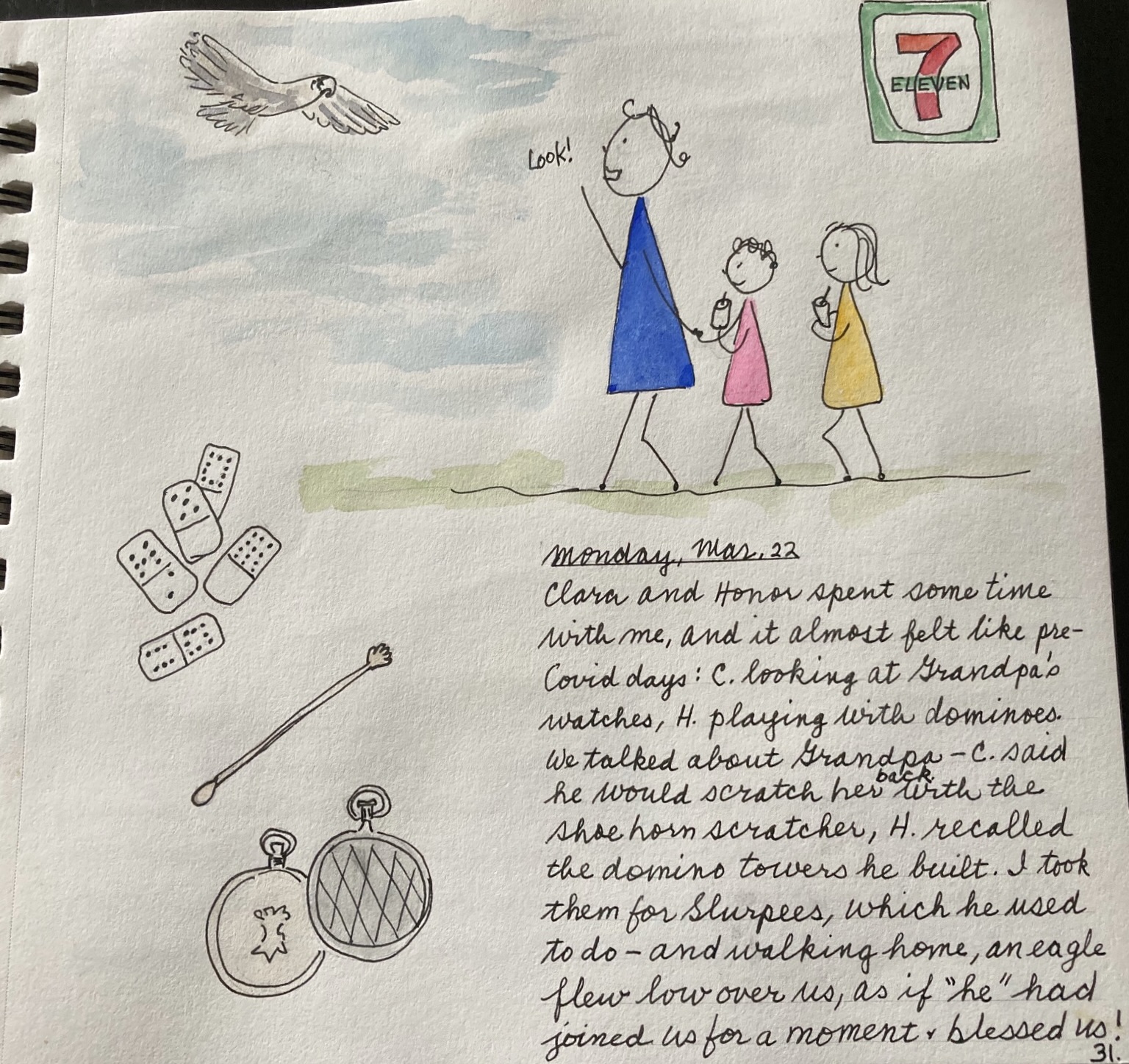
In many cultures and spiritual traditions, birds have long been considered links, even messengers,  between Earth and Beyond. (Perhaps because they have wings?) At the very least, they’re symbols — the eagle of strength, for example, the hummingbird of joy. There’s a saying, “When robins appear, loved ones are near.” I’m not dogmatic about such meanings, coincidence is perfectly fine for me, and I’m content in the mystery as well as my granddaughter’s response. But, while not a birdwatcher per se, I’ve had encounters with birds that not only reminded me of Helmut but brought profound consolation which seemed intended for me. I usually keep these moments for myself, for there’s vulnerability in them, but here is one instance I documented in a grief journal of words and little stick-people drawings I kept the first months after his death, which I hope makes you happy too!
The progression of grief

Walking this morning, I was thinking about grief, how it progresses through time and changes.

When my husband Helmut died in February 2021, I kept a kind of visual journal of grief, for even though I generally traffic in words, that activity helped me represent what I was feeling. For example, on a day in which I’d been busy with a variety of activities and then, afterwards, found myself overwhelmed with aloneness, though not crying, I expressed it as my upper body full of tears. IMG_1087

Eventually, however, the 98-page sketchbook was full, and by then it was November and less was “new” in the experience of grief. The first Christmas passed, and more crucially for me, New Year’s, which I approached with dread because the year in which he had still been alive would then be finished. The first anniversary of his death came and passed as well, which also signalled changes.

For an entire year I had found myself unable to move his keys from the ledge where they had always waited when not in use, but now, finally, I hung them on a hook under my jacket, as a spare set in case of need. Also — and I’m not sure why — I began after a year to sleep on “his” side of the bed. (Of course, alone in a queen bed one can push into the middle or all over as much as one wants, with no one pushing back, but I’m talking about the side of getting in and out.)

People with experience of grief told me the second year could be harder than the first. I don’t know if harder is the word for me, but certainly there are new challenges and questions. There’s a brutal finality that still confronts me, which no “magical thinking” of keys or leaving his side of the bed open could dissuade, nor moving keys or switching sides accomplish either, a finality that seems the more brutal because of how persistent is the disbelief around the truth that this is how it is. The challenges are the questions involved in shaping a new existence in the face of it: Is there anyone who truly needs me now? Who is witness to my life? Since I’m still here, what should I be doing with this time? 

If I were to sum up the first year visually, it might be thick vertical lines — lines of grief, say in purple, alternating with thick lines, say in green, of going on, as in coping and adapting. This, then this, then this. To sum the place that time has taken me now, I would use horizontal lines. Layers. Simultaneous. The most obvious layer perhaps what my sister, also a widow, meant when she said “you get used to it.” Doing the things of each day. There’s a solid layer of joy as well. As in my walk today, following a trail in a ditch and comprehending the subtle but rich colours of autumn grasses — cream, yellow, white, brown. As in fears overcome, and some upcoming travel to anticipate. As in my children, grandchildren, friends. As in the youngest grandchild, who, as babies do, delights me with his visible curiosity and cheerfulness. Another layer I call quest, short for the questions mentioned above. And always a layer of memories and missing, solidly in the mix though not dominating or excluding the rest of life as much as earlier.

Charlie Pride at midnight

I keep telling myself I don’t want to write about grief, but then I show up to my semi-regular blog writing and it wants out again. Grief expert Alan Wolfert says grief is the interior experience and mourning expresses it outside yourself. And mourning is essential, he says, because one heals through mourning. (My friend Ruth Bergen Braun alerted me to Wolfert’s work; see “The six needs of mourning”.) So here I am, expressing.  

I’ve been reading Emily Carr’s journal, Hundreds and Thousands. I had not known that, besides her wonderful painting, she was such a good writer. Describing her dead sister Lizzie “radiant” in her coffin, all her “frets and worries” gone, she writes “I always want to remember Lizzie’s coffin face. It was so completely satisfied.” Seeing the dead person may be traumatic in many circumstances of death but my experience of Helmut’s body was similar to Carr’s of Lizzie’s, for in spite of the awful sad silence of him no longer breathing I was struck by the beautiful ease of his face. He looked good. I’d always thought him handsome, but what I mean is, his face was settled — utterly settled. There was nothing intentional or effortful there, just rest. This wasn’t entirely new for his face, for he’d won resolve and patience in his suffering, but now it was a step beyond; perfected.

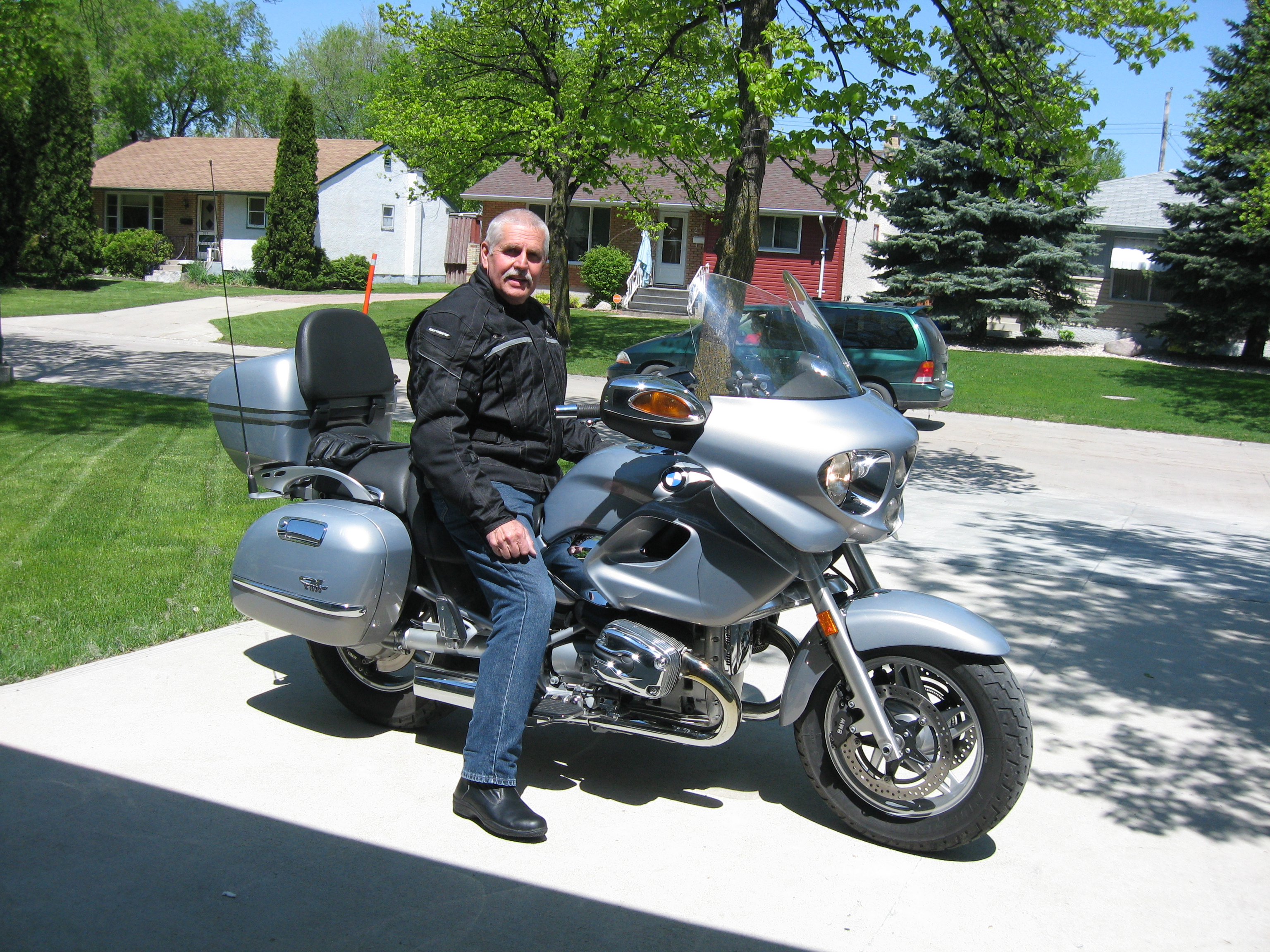
So I was thinking about that, remembering, and later, when I went to bed I couldn’t sleep because I was imagining him slipping away from himself with his last exhale, but I couldn’t see him running or leaping or dancing, the way people often imagine their ill loved one’s release. He was never runner, leaper, dancer. What it would have to be was the sensation of wind, freedom on the open road. What he felt on his motorcycle. A motorcycle ride was like prayer for him: restoration in almost every kind of way. And if his drive took him northwards or through Birds Hill Park and he happened to see a deer, that was a God-sighting as bonus. D4EBDA4D-42F0-4903-A444-A202CBD15A03

Yes, that I could imagine. Or flight. He’d taken a test flight once and would have liked to learn to fly. Air and speed or lift. Not the mechanics of these objects in their metal and leather for his soul, but the particular ecstasy of movement they imply.

Or like hitting the road in his El Camino. Which made me think of our honeymoon, a road trip from Manitoba to Ontario and back again, all those hours in that two-seater brown El Camino when we listened, many times, to his tapes, chiefly Kenny Rogers and Charlie Pride. Music in my family of origin consisted of two kinds of music — classical and church music like hymns, fireside choruses, cantatas, oratorios, and the like — to which I added radio pop, but he liked country, and that’s what we listened to that week, and the sway and croon of it seemed just right for miles and miles to go and for a honeymoon.

So I was thinking all this and wasn’t falling asleep. Suddenly I wanted to hear Charley Pride once again. I knew there was a CD of his hits in the other room, which hadn’t been listened to for ages, and I figured maybe I would listen the next day, for nostalgia’s sake. But no, I needed it now and I argued with myself because I glanced at the bedside clock and saw it was midnight. But who would it bother, I was the only one in the apartment, and besides, I would keep it midnight low, so my wanting won out and I got up and put the CD in my little boom box, next to my pillow, and I listened through all 20 songs. They sounded a bit thin in that little thing, and began, the sleepier I got, to sound more or less the same, but for that hour or whatever it was, I lived in the longing and heartbreak of that music, and in the memory of being on the road a long while ago, together.